Diamond Molecular Model
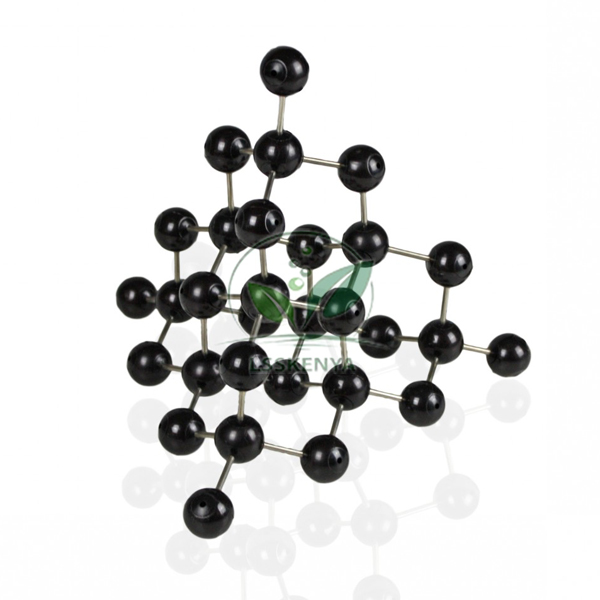
Product Code : LSK-CL-10078
Diamond Molecular Model (SKU LSK-CL-10078) represents the arrangement of carbon atoms in diamond, so students can see why the hardest known natural substance is so strong: every atom is held by four bonds in a continuous framework. It suits chemistry and physics lessons that introduce allotropes and covalent solids. Science Lab Supplies prepares quotations for it in Ambala, India, and can deliver to schools, colleges, tender contractors and distributors.
Specifications
Size, weight and subject of the diamond structure model are given row by row in the table. In short, the model measures 26 x 24 x 23 cm, weighs 1.5 kg and focuses on one substance, diamond, showing the three-dimensional framework in which its carbon atoms are arranged.
| Specification | Value |
|---|---|
| SKU | LSK-CL-10078 |
| Structure shown | Arrangement of carbon atoms in diamond |
| Substance | Diamond, the hardest known natural substance |
| Dimensions | 26 x 24 x 23 cm |
| Weight | 1.5 kg |
| Supplied by | Science Lab Supplies, Ambala, India |
Applications and Experiments for the Diamond Molecular Model
The model answers a common student question: why is diamond so hard when graphite, made of the same carbon, is soft? Viewing the atom arrangement makes the tetrahedral bonding clear. It fits NCERT Class 10 allotropes of carbon, Class 11–12 bonding and solid state, and B.Sc. inorganic and materials chemistry.
- Class 10 carbon and its compounds: diamond as an allotrope of carbon.
- Class 11 chemical bonding: four covalent bonds per carbon in a tetrahedral arrangement, explained in orbital terms by the Orbital Model of Sp3 Hybridization.
- Class 12 solid state: covalent network solids and their high melting points, compared with the unit cells built from the Crystal Lattice Model Set.
- Physics and materials lessons on hardness and electrical insulation.
Standard Scope of Supply
The Diamond Molecular Model is supplied as a single unit as described above, measuring 26 x 24 x 23 cm and weighing 1.5 kg. Any optional accessories or companion models appear as separate lines on the quotation, so you can see exactly what each line covers.
Packing, MOQ and Lead Time
One model for a single classroom or a batch for every section of a school can be quoted. Science Lab Supplies gives the packing, delivery time and price for that quantity on each quotation, and structure models for graphite or sodium chloride may be listed alongside.
Registered as an exporter with an Importer-Exporter Code, Science Lab Supplies can ship to buyers in Ghana, Ethiopia, Tanzania, Uganda, the UAE and Saudi Arabia. A message on the contact page with the number of models, or an enquiry cart request, brings back a priced offer; tender-based purchases follow the steps on the lab tender page.
Frequently Asked Questions
What does the Diamond Molecular Model show?
It shows how carbon atoms are arranged in diamond, each bonded to four neighbours in a rigid three-dimensional framework that explains the hardness of diamond.
How big is the model?
It measures 26 x 24 x 23 cm and weighs 1.5 kg, and it is supplied as one unit rather than as a kit of separate parts.
How is it different from the Diamond Crystal Model?
The Diamond Crystal Model is an assembly kit of 57 jacks and 84 connectors with an instruction manual. This molecular model is a single 26 x 24 x 23 cm unit; both can go on one quotation for comparison.
Who supplies the Diamond Molecular Model?
Buyers receive their quotation from Science Lab Supplies in Ambala, India, which offers the model to schools, colleges and distributors in single pieces or in tender quantities.
Related Carbon and Structure Models
Diamond sits naturally beside graphite, an ionic lattice and the hybridisation that explains them, so these items round out a carbon allotropes lesson. They let students assemble lattices themselves, compare the layered form, and link the atom arrangement back to orbitals and bond types.
- Diamond Crystal Model — the same lattice as a kit, built from 84 connectors with an instruction manual.
- Graphite Crystal Model — 69 standard and 8 long black connectors for the layered allotrope.
- Sodium Chloride Crystal Model — 27 jacks in black and red, joined by 54 connectors.
- Carbon-Carbon Molecular Model — four orbital models in a 510 x 345 x 140 mm set.
- Orbital Model of Sp2 Hybridization — gives a three-dimensional idea of the structural formulae of organic compounds.
- Schrodinger Atomic Model — a three-dimensional view of an atom with cross sections of its orbitals.
- Molecular Model Kits for Teachers — inorganic/organic teacher set of about 108 atoms, including 20 carbon atoms.
Browse the full Chemistry Lab range, the structure kits in the Physics Lab range, or all school lab equipment.
Last updated: 9 October 2026
.jpg)
.jpg)