Salt Bridge
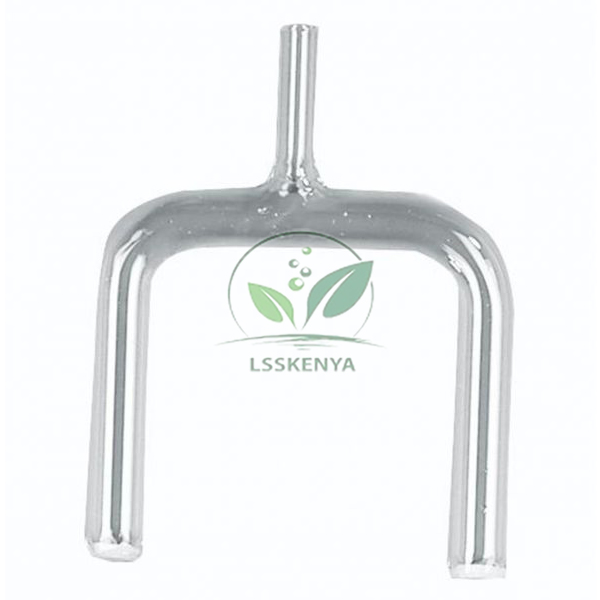
Product Code : LSK-CL-10086
Salt Bridge (SKU LSK-CL-10086) is the U-shaped connecting tube that links the two half-cells of an electrochemical cell, letting ions flow between them while keeping the solutions apart. This model has arms of 13 mm diameter and is intended for experiments that measure cell EMF under forward, zero and reverse current flow. Electrochemistry benches in schools and colleges, as well as tender contractors and distributors, can source it from Science Lab Supplies in Ambala, India.
Specifications
The 13 mm arm size and the current conditions this salt bridge is meant for are tabulated below. In short, it is a tube with two arms that dip into the electrolyte of the two half-cells; once filled with a suitable electrolyte, it completes the internal circuit so the EMF can be read with forward, zero or reverse current flowing.
| Specification | Value |
|---|---|
| SKU | LSK-CL-10086 |
| Form | Connecting tube with two arms |
| Arm diameter | 13 mm |
| Intended use | Measurement of cell EMF |
| Forward current flow | Supported |
| Zero current flow | Supported |
| Reverse current flow | Supported |
| Electrolyte filling | Not included |
| Supplied by | Science Lab Supplies, Ambala, India |
Applications and Experiments for the Salt Bridge
A salt bridge is needed in any galvanic cell experiment where the two electrodes stand in different solutions, such as the Daniell cell. It supports the electrochemistry chapter of NCERT Class 12 chemistry, B.Sc. physical chemistry practicals on EMF and electrode potentials, and potentiometer work in physics.
- Class 12 chemistry: setting up a Daniell cell and measuring its EMF.
- Class 12 practical: studying how EMF changes with the concentration of copper or zinc ions, using 100 x 10 mm copper and zinc from the Electrode Rod range.
- B.Sc. physical chemistry: electrode potentials and the Nernst equation, read against the Reduction Potential wall chart.
- Physics potentiometer experiments comparing cell EMF under different current conditions.
Before use, the tube is filled with an inert electrolyte, commonly potassium chloride or potassium nitrate set in agar, prepared by the laboratory. Wash and dry it after each practical so the solutions of the two half-cells are not contaminated.
Standard Scope of Supply
The Salt Bridge is supplied as a single unit as described above, with 13 mm arms. The electrolyte filling, beakers, electrodes and voltmeter are not part of this item; they can be quoted separately so the complete cell set-up reaches you on one order.
Packing, MOQ and Lead Time
Bridges can be quoted one at a time or in class quantities for every practical station. Science Lab Supplies lists packing, delivery time and price for the number you give on each quotation, and school chemistry lab equipment in India such as Daniell cells and electrodes can be included too.
Science Lab Supplies can ship to buyers in Nepal, Bangladesh, Zambia, Rwanda, South Africa and Qatar as a registered exporter holding an Importer-Exporter Code. Count your EMF stations and send that number through the contact page or the enquiry cart; if the purchase is going to tender, start from the lab tender page.
Frequently Asked Questions
What does a salt bridge do in a cell?
It connects the two half-cells so ions can move between them, keeping each solution electrically neutral and letting current flow, while stopping the solutions from mixing directly.
What is the arm diameter?
Each arm of this salt bridge is 13 mm in diameter. Check that the half-cell vessels you plan to use will take two arms of that size before ordering.
Is the electrolyte included?
No. The bridge is supplied empty, and the laboratory fills it with a suitable electrolyte such as potassium chloride in agar before the experiment.
Who supplies the Salt Bridge?
Quotations come from Science Lab Supplies in Ambala, India, which can price one bridge for a demonstration or a quantity for every EMF station for schools, colleges and distributors.
Related Electrochemistry and EMF Equipment
A salt bridge is one component of a galvanic cell. These items from the Chemistry Lab, Physics Lab and Electrical and Electronics ranges supply the rest, from Daniell cells and electrode plates to potentiometers for EMF measurement, so an electrochemistry bench can be equipped on one quotation.
- Daniel Cell — 130 x 90 mm copper vessel, porous pot and zinc amalgam rod, EMF of about 1.1 V.
- Cell Daniel Copper With Zinc — heavy gauge copper vessel with a perforated shelf for copper sulphate crystals.
- Salt Bridge — inverted U-tube with its ends closed by sintered discs.
- Electrode Plate — 100 x 45 mm plates with socket terminal in aluminium, carbon, copper, lead or zinc.
- Apparatus for Demonstrating the Galvanic Element (With Galvanometer) — two 250 ml graduated glass cups, zinc and copper plates and a U-shaped glass funnel.
- Potentiometer Kit — 4-output potentiometer with a Daniel-type cell, rheostat and 30–0–30 galvanometer.
- Potentiometer with Jockey Pencil — wooden base with brass blocks, 4 mm sockets and a 100 cm scale.
Browse the full Chemistry Lab range, the Electrical and Electronics range, or all school lab equipment.
Last updated: 9 October 2026