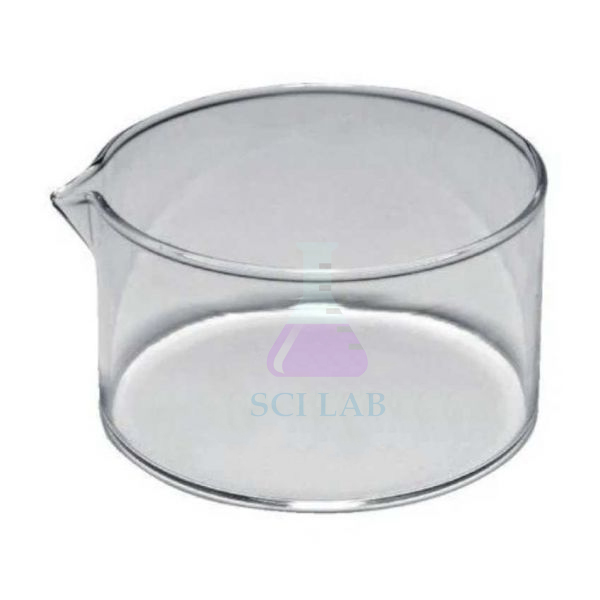
Crystallizer
Product Code : SCL-CL-11695
This Crystallizer is a clear glass crystallising dish, 90 mm across and 40 mm high. A hot, concentrated solution is poured into it and left to cool so crystals can grow on the flat base. The glass is chemical resistant and heat resistant.
Specifications of the Crystallizer
| Specification | Value |
|---|---|
| Material | Clear glass, chemical resistant and heat resistant |
| Diameter | 90 mm |
| Height | 40 mm |
| Supplied by | Science Lab Supplies, Ambala, India |
Growing Crystals in the 90 mm Crystallizer
Concentrate the solution first, filter it hot into the dish, then leave it to cool without moving it. The shallow, wide shape gives crystals room to grow and makes them easy to lift out.
- Pure copper sulphate from an impure sample (Class 11): dissolve it in warm water with a few drops of dilute acid, filter through a Glass Funnel and cool the filtrate in the dish.
- Concentrating a salt solution: heat it gently in a Porcelain Dish on a Wire Gauze until a drop crystallises on a cold rod, then pour it into the crystallizer.
- Growing a single alum crystal: hang a small seed crystal on a thread in a saturated solution and leave it for several days.
Precautions: do not boil the solution or let it dry out, and wipe off any crust that forms on the rim.
Frequently Asked Questions
How is a crystallizer different from an evaporating dish?
An evaporating dish is heated to drive off solvent. A crystallizer is a flat glass dish where a concentrated solution cools and forms crystals; it is not meant for evaporating a solution to dryness.
Why should the solution cool slowly?
Slow, undisturbed cooling gives fewer, larger and better-shaped crystals. Fast cooling or shaking produces many tiny crystals that trap the mother liquor and its impurities.
What does it mean if only tiny crystals form?
The solution was concentrated too far before cooling. Add a little water, warm it to dissolve the solid again, and let it cool more slowly.
Should the dish be covered while crystals grow?
Cover it loosely with a watch glass or a sheet of filter paper. That keeps out dust but still lets a little water escape as the crystals grow.
Can I heat the crystallizer directly on a flame?
The glass is heat resistant, but a flat dish heated on a flame can crack from uneven heating. Heat the solution in a beaker or porcelain dish, then pour it in, and keep the hot dish off cold, wet benches.
Related Dishes and Crystallisation Aids
- Glass Crystallizing Dish, 180 x 90 mm: larger glass crystallizer, 180 mm across and 90 mm high, with grip.
- Watch Glass: pack of 12 shallow dishes for covering beakers and controlled evaporation.
- Glass Petri Dish with Cover, 100 mm: glass petri dish, 100 mm diameter and 20 mm high, with a cap.
- Tripod Stand: three-legged metal platform that holds apparatus during heating.
- Glass Bottle, Wide Mouth: 60 ml colourless bottle with wide mouth and frosted stopper.
See the rest of the Chemistry Lab range and the wider School Lab Equipments catalogue.
With an Importer-Exporter Code, Science Lab Supplies can send orders to schools and labs in Rwanda, South Africa, Qatar, Sri Lanka, Vietnam and Malaysia. Quotations can be requested on the contact page or through the enquiry cart.
Last updated: 14 November 2026