
Electrode Rod Carbon Voltameter
Product Code : LSK-CL-10057
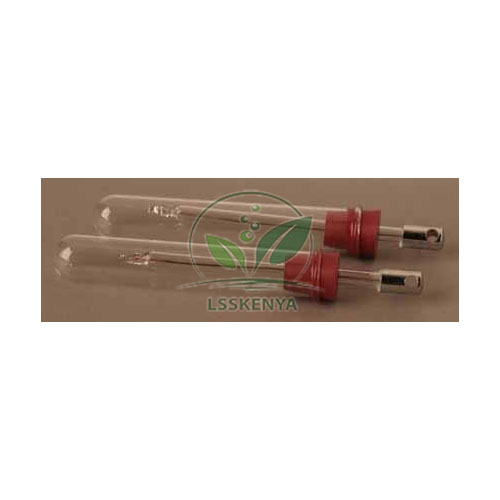
The Electrode Rod Carbon Voltameter is a 100 x 10 mm carbon rod set in a glass tube with a terminal. It serves as an electrode in voltameters and other electrolysis set-ups, where carbon gives a simple conducting surface that does not dissolve in most electrolytes.
Specifications of the Carbon Voltameter Electrode
| Specification | Value |
|---|---|
| Electrode | Carbon rod, 100 x 10 mm |
| Mounting | Glass tube |
| Connection | Terminal |
| Use | Electrochemistry experiments |
| Supplied by | Science Lab Supplies, Ambala, India |
Water Electrolysis with Carbon Voltameter Electrodes
The electrodes are fitted at the base of a voltameter filled with water made conducting by a little dilute sulphuric acid. Gas from each electrode rises into its own graduated tube.
- Composition of water (Class 10 to 12): fit the electrodes to a Hofmann Voltameter held on a Hofmann Voltameter Stand, run the current and compare the gas volumes.
- Gas tests: let off a little gas from each limb and test for hydrogen with a lit splint and for oxygen with a glowing splint.
- Faraday's laws: record current and time, then relate the volume of hydrogen to the charge passed.
Common errors: reading volumes before the gases settle, and running for too long so that the carbon anode starts to break up.
Frequently Asked Questions
Which classes use carbon voltameter electrodes?
Secondary and college chemistry classes use them for electrolysis of acidified water: students collect hydrogen and oxygen in separate limbs, test each gas and relate the volumes to the formula of water. Recording current and time links the same run to Faraday's laws.
Why should the current be kept low with carbon electrodes?
A large current heats the electrolyte and speeds up the attack of oxygen on the carbon anode. More oxygen turns into carbon dioxide, the volumes read low and the rod crumbles sooner. A few volts from a DC supply gives steady bubbles and a longer electrode life.
Are carbon electrodes kept as spares for a voltameter?
Yes, many labs keep a spare pair. Oxygen slowly attacks a carbon anode, so it softens, pits and sheds dark particles over many runs. Before ordering, check that the 100 x 10 mm rod in its glass tube fits the electrode openings at the foot of the voltameter limbs.
Why not use copper rods in a water voltameter?
A copper anode dissolves into the acid instead of giving off oxygen, so little oxygen collects and the solution turns blue. Carbon is used because it conducts and does not dissolve in the electrolyte.
Related Voltameter and Electrode Items
- Electrode Rod Platinum: 100 x 10 mm rod in a glass tube ending in a leaf of platinum.
- Hoffman Voltameter With Electrodes: two 50 ml limbs with stopcocks, supplied with carbon and platinum electrodes.
- Voltameter: base with terminals, platinum electrodes and two 10 ml graduated test tubes.
- Electrolysis Kit: insulated stainless steel electrodes with large clips and rubber gaskets for the test tubes.
- Hofmann Voltameter, 25 ml Tubes, 600 mm: three glass tubes, 600 mm high, with 25 ml graduated tubes.
Voltameters and their spare electrodes are in the Chemistry Lab range; School Lab Equipments covers the other subjects.
Spare voltameter electrodes can go from Science Lab Supplies to Ethiopia, Tanzania, Uganda, the UAE, Saudi Arabia and Oman, as the company trades with an Importer-Exporter Code. A quotation for carbon electrodes can be asked for by message on the contact page or through the enquiry cart.
Last updated: 15 November 2026
.jpg)



.jpg)

