Geometry of Molecules
Product Code : SCL-CL-11595
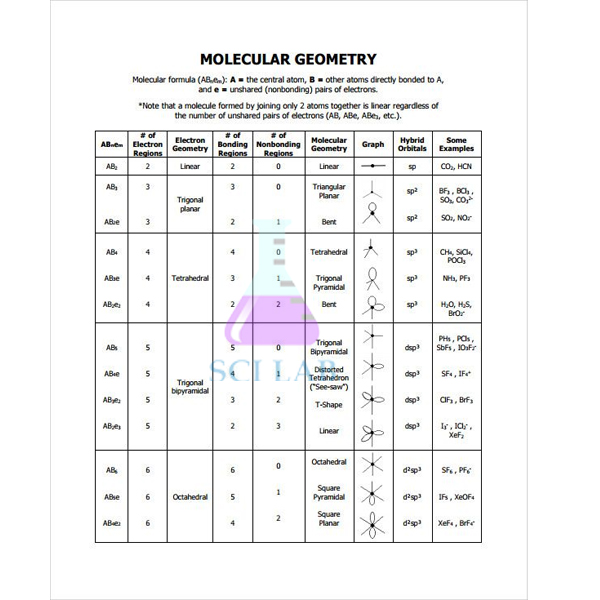
Geometry of Molecules is a laminated wall chart, 70 cm x 100 cm, on the three-dimensional shapes of molecules. It supports lessons on electron-pair repulsion, bond angles and the shapes of simple molecules such as methane, ammonia and water.
Specifications of the Molecular Geometry Chart
| Specification | Value |
|---|---|
| Format | Laminated wall chart |
| Size | 70 cm x 100 cm |
| Mounting | Wall mounted |
| Use | Classrooms and laboratory |
| Supplied by | Science Lab Supplies, Ambala, India |
Building Molecular Shapes Alongside the Chart
Students draw the dot-and-cross structure, count electron pairs on the central atom, and then build the shape to compare with the chart.
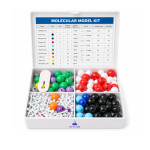
- Shape building: make methane, ammonia and water with Molecular Micro-Models and measure how the shape changes as lone pairs replace bonds.
- Hybrid orbitals: compare the tetrahedral layout with the Orbital Model of Sp3 Hybridization and the flat layout with the Orbital Model of Sp2 Hybridization.
Common errors: forgetting lone pairs on the central atom, and naming the electron-pair arrangement instead of the molecular shape.
Frequently Asked Questions
Why is water bent and not linear?
Oxygen in water has two bonding pairs and two lone pairs. All four pairs repel and point roughly to the corners of a tetrahedron. Only the atoms are counted in the shape, so water is bent.
Why is the bond angle in ammonia smaller than in methane?
A lone pair repels more strongly than a bonding pair. Ammonia has one lone pair, which pushes the three N-H bonds closer, so the angle is about 107 degrees instead of 109.5 degrees.
What is the first step in predicting the shape of a molecule?
Draw the Lewis or dot-and-cross structure. Then find the central atom, count its bonding pairs and lone pairs, and match the total to an electron-pair arrangement.
What is the difference between electron-pair geometry and molecular shape?
Electron-pair geometry includes lone pairs; molecular shape describes only where the atoms are. Ammonia has a tetrahedral electron-pair geometry but a trigonal pyramidal shape.
Related Molecular Structure Charts and Models
- Isomer: laminated wall chart, 70 cm x 100 cm.
- Alkanes: 70 cm x 100 cm chart for classroom and laboratory.
- Molecular Models Demonstration Kit: box with 38 carbon, 40 hydrogen and 12 oxygen atoms plus single, double and triple bonds.
- Atomic In/Organic Junior Model: molecular model set in a 24 x 20 x 5 cm storage box.
- Electronegativity: wall-mounted laminated chart, 70 cm x 100 cm.
All our structure charts are listed under Chemistry Lab, inside School Lab Equipments.
Holding an Importer-Exporter Code, we can deliver to Kenya, Ghana, Ethiopia, Tanzania, Uganda and the UAE. Ask for a quotation using the contact form or the enquiry cart.
Last updated: 14 November 2026