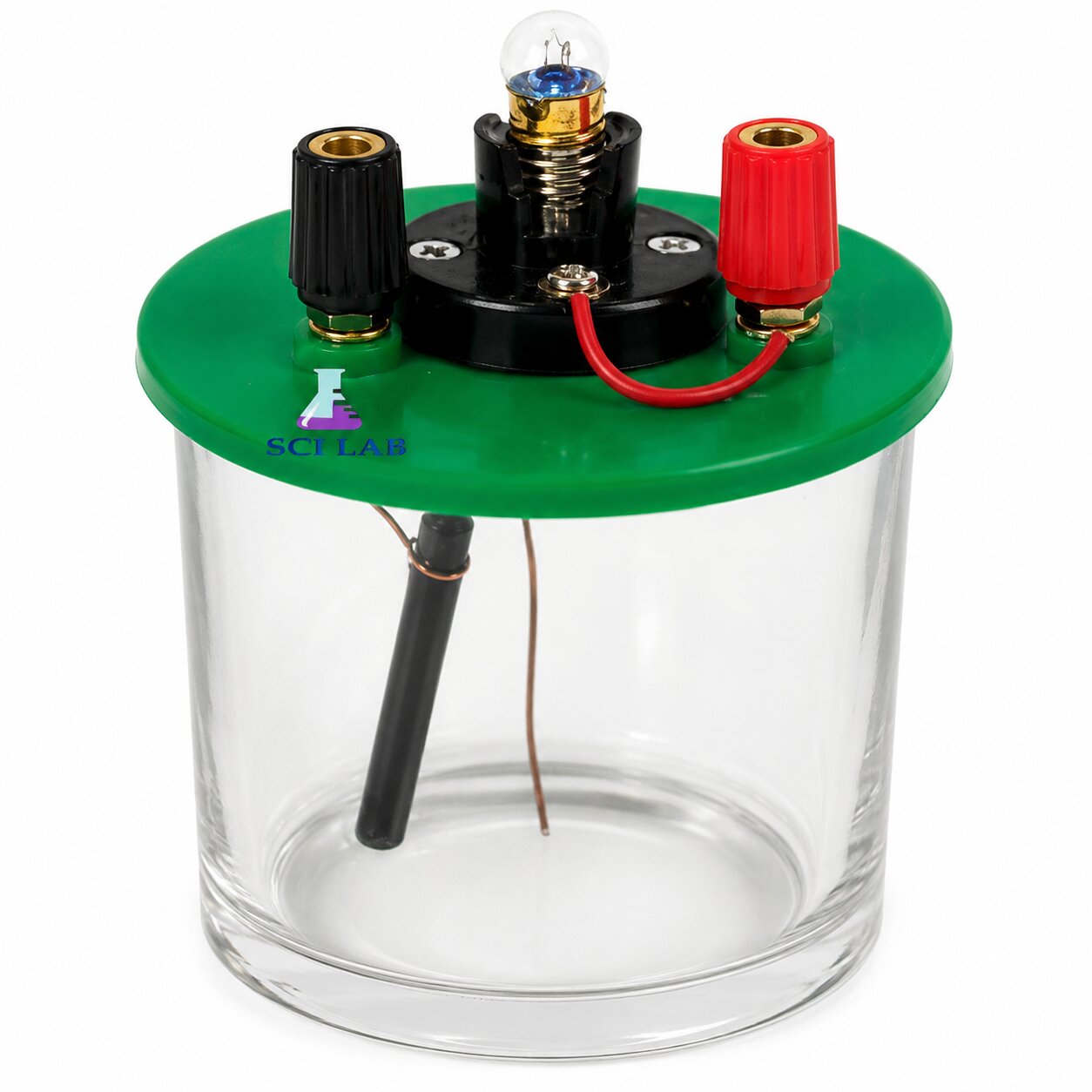
Apparatus for Electrical Conductivity of Electrolytes
Product Code : SCL-CL-11447
The Apparatus for Electrical Conductivity of Electrolytes compares how well different liquids conduct electricity. It has a base, four 250 ml cups in which the electrodes dip, and four bulbs connected in parallel, so four solutions can be tested side by side and compared by bulb brightness.
Specifications of the Conductivity Apparatus
| Specification | Value |
|---|---|
| Base | One base carrying the cups and bulbs |
| Cups | 4 x 250 ml, electrodes immersed in each |
| Bulbs | 4, connected in parallel |
| Supplied by | Science Lab Supplies, Ambala, India |
Comparing Electrolytes with the Four-Cup Apparatus
Fill each cup with a different liquid to the same level, switch on and compare the four bulbs. A bright bulb means a good conductor, a dim bulb a weak electrolyte, and no light a non-electrolyte.
- Electrolytes and non-electrolytes: test salt solution, sugar solution, dilute acid and pure water from the Laboratory Deioniser side by side.
- Strong and weak acids: compare hydrochloric acid and ethanoic acid of the same concentration.
- Effect of concentration: make three dilutions of one salt in 250 ml Glass Beaker and compare the bulbs.
Rinse the electrodes between tests and use the same liquid level in every cup, or the comparison is not fair.
Frequently Asked Questions
Why are the four bulbs wired in parallel?
Each cup and bulb gets the same voltage and works on its own. One poor conductor does not dim the others, so the four results can be compared directly.
Why does sugar solution not light the bulb?
Sugar dissolves as whole molecules, not ions. With no charged particles free to move, the solution cannot carry a current.
Why does a weak acid give a dim bulb?
A weak acid ionises only partly, so fewer ions carry the current. A strong acid of the same concentration ionises fully and the bulb glows brighter.
Does pure water conduct electricity?
Hardly at all. Pure water has very few ions, so the bulb stays dark. Tap water conducts a little because of dissolved salts.
Why might a bulb stay dark even with salt solution in the cup?
Check that the supply is on, the bulb is sound and tight, and the liquid covers the electrodes. Coated or corroded electrodes and a low liquid level reduce the current, so clean the electrodes and fill the cup to the same level as the others.
Can the liquid be touched while the apparatus is on?
No. Switch off before touching the cups, the electrodes or the liquid, and before changing solutions. Wear eye protection, since many of the test solutions are acids or alkalis.
Related Electrolysis and Conductivity Apparatus
- Apparatus for Demonstration of Electrolytic Processes: base with bulb, two electrode supports and five electrode types.
- Apparatus for the Electrolysis of Salts: 15 mm U-tube with 60 mm graphite electrodes.
- Electrolysis Kit: two insulated stainless steel electrodes for splitting water.
- Light Bulb: 9 V, 0.2 A bulb on a stand with two spares.
- Connecting Cables with Clips, 50 cm: 50 cm leads for school circuit work.
Browse the Chemistry Lab range or all School Lab Equipments.
Science Lab Supplies holds an Importer-Exporter Code and can ship to buyers in Saudi Arabia, Oman, the Philippines, Nepal, Bangladesh and Zambia. To ask for a quotation, use the contact page or the enquiry cart.
Last updated: 15 November 2026
.jpg)