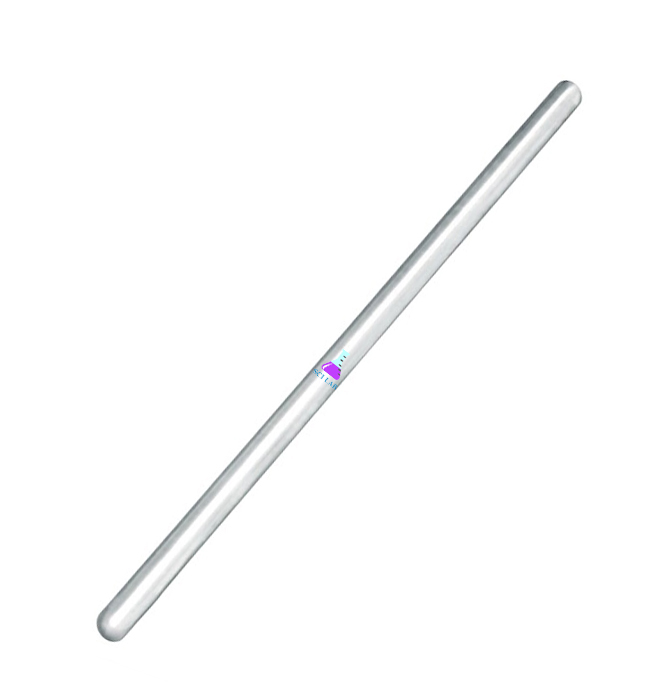
Glass Stirring Rod, 200 x 4 mm
Product Code : SCL-CL-11920
The Glass Stirring Rod, 200 x 4 mm is a solid, clear glass rod, 200 mm (20 cm) long and 4 mm in diameter. It is used to stir and mix chemicals, help solids dissolve, guide liquid into a funnel or vessel when pouring, and spread substances. The glass is heat and chemical resistant, and the rod needs no power.
Specifications of the Glass Stirring Rod
| Specification | Value |
|---|---|
| Length | 200 mm (20 cm) |
| Diameter | 4 mm |
| Material and form | Clear glass, solid cylindrical rod |
| Resistance | Heat and chemical resistant |
| Contents | One rod |
| Supplied by | Science Lab Supplies, Ambala, India |
Stirring, Pouring and Decanting with the Glass Rod
The rod is moved in slow circles without striking the bottom or wall of the vessel. To pour, hold it against the lip of the beaker: the liquid clings to the glass and runs down the rod into the funnel or receiving vessel instead of splashing.
- Filtration (Class 9 and 10): pour a suspension down the rod into a Glass Funnel with Angled Stem, 90 / 150 mm lined with Filter Paper, aiming the stream at the side of the paper cone.
- Dissolving solids: stir copper sulfate or common salt into warm water in a Borosilicate Beaker until no crystals remain.
- Decanting: let a solid such as chalk settle in water, then tip the clear liquid off along the rod and leave the solid behind.
- Litmus check: touch a drop of solution from the rod onto Blue Litmus Paper instead of dipping the paper in the stock.
Precautions: do not use a chipped rod, never lever or force lumps apart with it, avoid knocking the base or walls of the beaker, and lay it on a tray to cool after stirring hot liquids.
Frequently Asked Questions
Why do fire-polished ends matter on a glass stirring rod?
Cut glass ends are sharp: they scratch beakers, can cut fingers and chip easily. Fire-polished ends are rounded smooth in a flame, so the rod is safer to handle and gentler on glassware. Check the ends when a consignment is unpacked.
Which rod length suits the beakers and flasks used in a school lab?
A rod should reach the bottom of the vessel and still stand well clear of the rim. At 200 mm, this rod suits beakers up to 500 ml and conical flasks up to about 250 ml; tall cylinders and large flasks need a longer rod.
Why stir with glass and not a metal rod?
Glass does not react with most acids, alkalis and salt solutions. A metal rod could react, add metal ions or corrode. Glass is also smooth, so it is easy to see when it is clean.
When is decanting along a glass rod used instead of filtering?
Decanting suits a heavy solid that settles quickly, such as sand in water. The clear liquid is poured off along the rod while the solid stays in the beaker, which is quicker than filtering the whole mixture.
What are the limits of separating a mixture by decanting?
Fine or light particles settle slowly and are carried over with the liquid, and some liquid always stays with the solid. For a clean separation the decanted liquid is filtered, or the solid is washed and decanted again.
Related Rods, Funnels and Bench Glass
- Glass Stirring Rod, 350 x 8 mm: glass rod 350 mm long and 8 mm in diameter, chemical and heat resistant.
- Glass Rod: colourless glass, about 6 mm across and 200 mm long.
- Glass Funnel, 75 mm, Short Stem: clear glass funnel, 75 mm across, with a short stem.
- Beakers: borosilicate glass beakers with clear graduations and a pouring spout.
- Glass Beaker, Low Form, 100 ml: transparent, graduated beaker with a low, flared shape.
- Wash Bottle, LDPE, 500 ml, Pack of 6: LDPE squeeze bottles with an integrated delivery tube.
Look through the Chemistry Lab range for funnels and beakers, or the parent School Lab Equipments section.
Science Lab Supplies can ship glassware to Malaysia, Peru, Egypt, Iraq, Nigeria and Kenya under its Importer-Exporter Code. For a quotation, go to the contact page or the enquiry cart.
Last updated: 19 November 2026