Apparatus for Distilling Liquids, Set with Tripods and Thermometer
Product Code : SCL-CL-11448
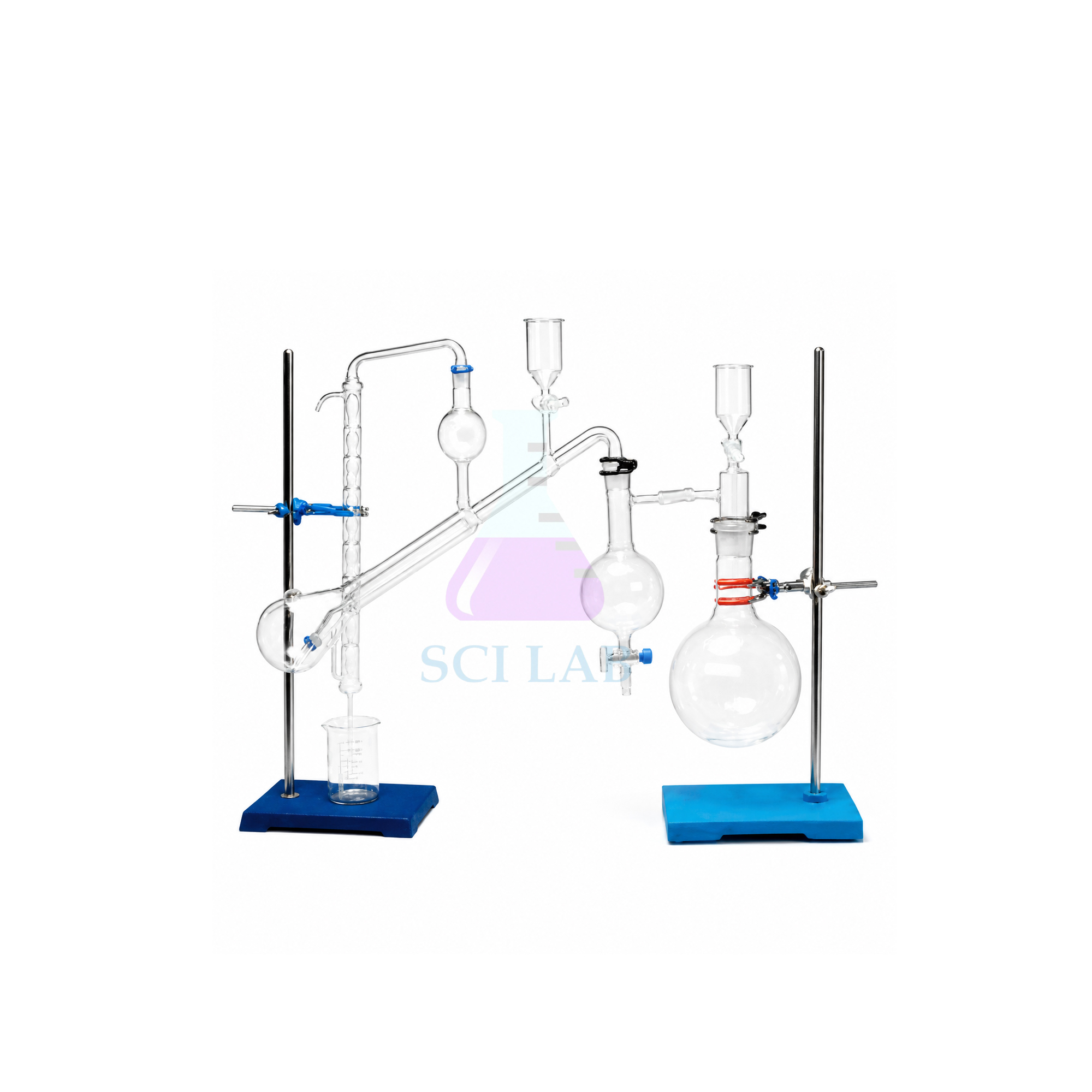
The Apparatus for Distilling Liquids is a simple distillation set. A liquid is boiled in a 250 ml side-tube distillation flask, the vapour is cooled in a 300 mm straight Liebig condenser and the distillate is caught in a 250 ml glass beaker. Supports, a 0-100 °C thermometer and tubing are included.
Specifications of the Distilling Apparatus
| Specification | Value |
|---|---|
| Supports | 2 tripods with metal base and support rods, 2 metal weights for holding the cylinder and the condenser |
| Flask | 250 ml distillation flask with side tube, rubber stopper with hole |
| Condenser | Straight Liebig condenser, 300 mm long |
| Receiver | 250 ml chemical glass (beaker) |
| Gauze | 150 x 150 mm |
| Thermometer | 0 to 100 °C |
| Tubing | Rubber tube, 6 mm diameter |
| Supplied by | Science Lab Supplies, Ambala, India |
Simple Distillation Practicals
Clamp the flask over the gauze with the thermometer bulb level with the side tube. Connect the condenser so cooling water enters at the lower end and leaves at the top, and place the beaker under the outlet. Heat gently and collect the distillate.
- Pure water from salty or inky water: heat with a Laboratory Spirit Burner and show the distillate leaves no residue when evaporated in a Porcelain Dish.
- Boiling point: read the steady thermometer value while water distils and compare it with 100 °C.
- Ethanol and water: watch the temperature rise in steps as the more volatile liquid distils first.
Common errors: thermometer bulb too high or too low, water flowing the wrong way through the condenser, no anti-bumping granules, and heating the flask until it is dry.
Frequently Asked Questions
Why does cooling water enter at the bottom of the condenser?
Water entering at the lower end fills the jacket completely and flows against the vapour. This cools the vapour more and leaves no air pocket at the top.
Where should the thermometer bulb sit?
Level with the opening of the side tube. There it reads the temperature of the vapour that is leaving to the condenser, which is the boiling point of the liquid distilling over.
Why add anti-bumping granules?
They give small, even bubbles. Without them the liquid can superheat and boil up suddenly, which may throw liquid into the condenser.
Why should the flask never boil dry?
A dry, hot flask can crack, and any solid residue may char or decompose. Stop heating while some liquid is still left.
Is the distillate always pure?
From salt water or inky water, the dissolved solid stays in the flask, so the distillate is pure water. With two liquids of close boiling points, simple distillation only gives a mixture richer in the more volatile liquid.
Why is only a little distillate collecting?
Check that cooling water is flowing and is still cold, since warm water lets vapour pass through the condenser. Also check that the stopper and tubing joints are tight, so vapour does not escape before it reaches the condenser.
Related Distillation Glassware and Sets
- Distillation Apparatus, Ground-Joint Set: borosilicate set with flask, still head, adapter, condenser and fractionating column.
- Distillation Apparatus: 500 ml round-bottom flask, Liebig condenser and 19/26 joints.
- Fractional Distillation Assembly: Vigreux column, 250 ml flasks and 19/26 joint clips.
- Liebig Condenser, 450 mm, 14/29 Joint: 450 mm condenser with 14/29 joint.
- Distillation Flask with Side Arm, 250 ml: borosilicate flask with 175 mm side pipe.
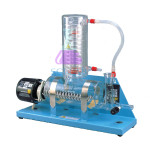
- Distiller for Distilled Water: electric unit giving 1 to 2 litres per hour.
Browse the Chemistry Lab range or the Lab Glassware range.
Science Lab Supplies holds an Importer-Exporter Code and can ship to buyers in Oman, the Philippines, Nepal, Bangladesh, Zambia and Rwanda. To ask for a quotation, use the contact page or the enquiry cart.
Last updated: 15 November 2026