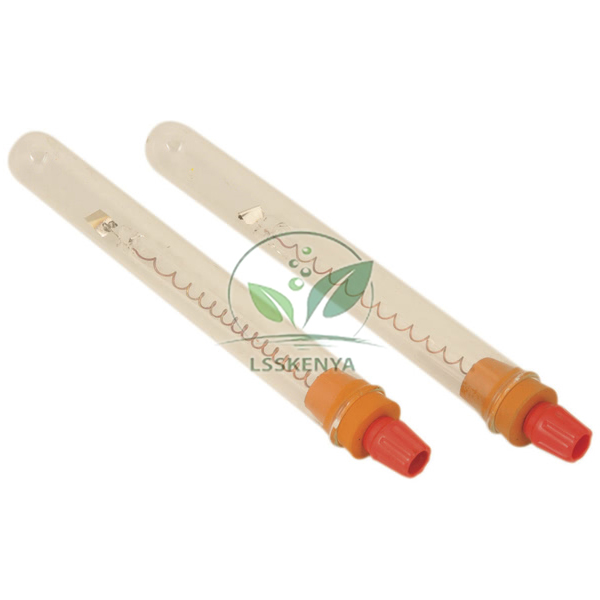
Platinum Foil Electrodes (Pair)
Product Code : LSK-CL-10246
Platinum Foil Electrodes (Pair) is a pair of electrodes for electrolysis of water and other electrochemistry work. Each rectangular platinum foil is fused into a protective glass tube. A lead runs inside the tube and through a rubber stopper to screw terminals.
Specifications of the Platinum Electrodes
| Specification | Value |
|---|---|
| Supplied as | A pair of electrodes |
| Electrode | Rectangular platinum foil |
| Inner glass tube | 110 mm long, 8 mm diameter |
| Outer glass tube | 115 mm long, 18 mm diameter |
| Connection | Internal lead through the tube and rubber stopper to screw terminals |
| Supplied by | Science Lab Supplies, Ambala, India |
Using Platinum Electrodes in Electrolysis
The foil shape exposes as much metal as possible to the water, so gas forms over a large area. The rubber stopper seats the electrode in a voltameter or cell, and leads connect to the screw terminals.
- Water electrolysis: fit the pair to a Hoffman Voltameter With Electrodes and collect hydrogen and oxygen in the graduated limbs.
- Electrolyte: dissolve Sodium Sulphate in the water so that it conducts.
- Faraday's laws: measure the gas volume for a known current and time, then compare it with the charge passed.
Care: do not touch or bend the foil; rinse the electrodes in distilled water after use and store them dry.
Frequently Asked Questions
Why use platinum electrodes for electrolysis of water?
Platinum is inert. It does not react with the oxygen formed at the anode or dissolve in the electrolyte, so the gases collected are pure and the volumes give a fair 2:1 ratio.
Why is the electrode a flat foil and not a wire?
A rectangular foil exposes as much metal as possible to the water. The larger surface spreads the current and lets gas form steadily over a wide area.
How should the electrodes be cleaned and stored?
Rinse them in distilled water after each use and let them dry fully. Store them in a clean, dry box so the foil is not bent or contaminated.
Can the foil be touched by hand?
Avoid it. Oils from skin can coat the platinum and slow gas formation. Hold the electrodes by the glass tube and keep the foil away from hard surfaces that could dent it.
Which solutions should not be used with platinum?
Avoid solutions containing sulphides, which can poison the surface, and strong chloride solutions, which release chlorine at the anode. Dilute sulphuric acid or sodium sulphate solution suits water electrolysis.
Related Electrodes and Electrolysis Cells
- Electrode Rod Platinum: 100 x 10 mm rod in a glass tube, ending in a leaf of platinum.
- Electrode Rod Carbon Voltameter: 100 x 10 mm carbon rod in a glass tube with terminal.
- Electrode Plate: 100 x 45 mm plates with socket terminal, in metals such as copper and zinc.
- Round Electrodes, 6-7 mm: 6–7 mm diameter electrodes that fit holders and holed stoppers.
- Electrolysis Cells: gases collected in two 75 x 10 mm test tubes over the electrodes.
- Hofmann Voltameter: glass unit with 50 ml limbs and removable carbon electrodes.
See the full Chemistry Lab range or all school lab equipment.
Science Lab Supplies holds an Importer-Exporter Code and can ship to buyers in Sri Lanka, Vietnam, Malaysia, Peru, Egypt and Iraq. To ask for a quotation, use the contact page or the enquiry cart.
Last updated: 15 November 2026


.jpg)