Properties of Antacids
Product Code : LSK-CL-10250
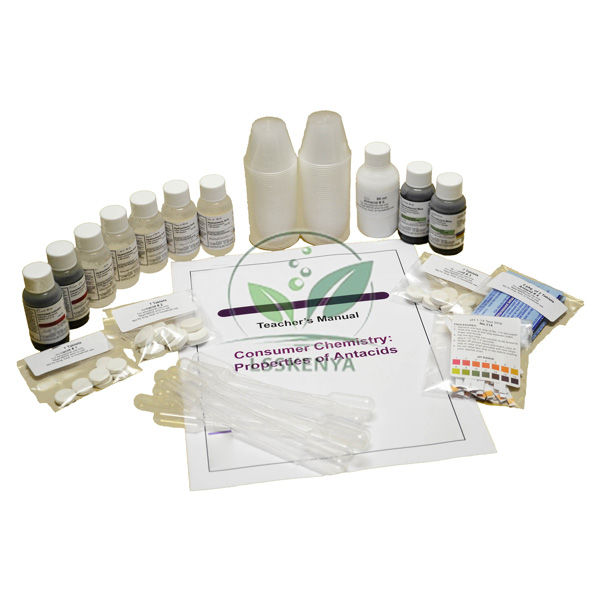
Properties of Antacids is a consumer chemistry kit for fifteen student groups. Students learn the common active ingredients in antacids, compare how fast five antacids neutralise acid, and test the buffering of three calcium carbonate antacids. All antacid samples are included.
Specifications of the Properties of Antacids Kit
| Specification | Value |
|---|---|
| Groups | Enough materials for 15 groups |
| Antacid samples | Antacids 1, 2 (extra strength) and 3: 1 pack of 7 tablets each; antacid 4: 2 packs of 2 tablets; antacid 5: 60 ml liquid |
| Acid | 5 x 30 ml hydrochloric acid, 1 M |
| Indicators | 2 x 30 ml universal indicator, 2 x 30 ml bromothymol blue 0.5% aqueous, 2 packs of 50 universal indicator strips |
| Labware | 15 graduated plastic pipettes, 90 disposable medicine cups |
| Supplied by | Science Lab Supplies, Ambala, India |
Antacid Investigations in the Chemistry Lab
Each group puts a dose of antacid into a medicine cup, adds indicator and then adds acid drop by drop. The colour change shows when the acid is neutralised. Timings and drop counts allow a fair comparison.
- Rate of neutralisation: add 1 M hydrochloric acid to each of the five antacids with indicator and time the colour change.
- Buffering: follow how the pH of three calcium carbonate antacids holds as acid is added, and check readings with a pH Pocket Tester.
- Extension (Class 11–12): run a full titration with a Burette and a Conical (Erlenmeyer) Flask to find how much acid one tablet neutralises.
Safety: 1 M hydrochloric acid irritates eyes and skin, so wear eye protection. The antacid samples are for laboratory study only and must not be eaten.
Frequently Asked Questions
What active ingredients do the antacids contain?
Most antacids are bases, such as calcium carbonate, magnesium hydroxide, aluminium hydroxide or sodium hydrogen carbonate. They react with hydrochloric acid to form a salt and water; carbonates also give carbon dioxide.
How can students make the antacid comparison a fair test?
Use the same dose per sample, the same volume and strength of acid, the same indicator and the same temperature. Crush tablets fully so that particle size does not decide the result.
Why does the colour change slow down near the end point?
Some antacids are insoluble solids that react slowly. Adding acid in small portions and swirling between additions avoids overshooting the end point.
What does buffering ability mean for an antacid?
A buffer keeps the pH nearly steady when acid is added. An antacid with good buffering holds the solution near a fixed pH for longer before it turns acidic.
What extra equipment is needed?
The kit includes the chemicals, pipettes and cups. Add eye protection, a timer and paper towels. Beakers and a pH meter are useful for extension work.
Related Acid-Base and Consumer Chemistry Kits
- Properties of Aspirin: compares regular, extra strength and buffered aspirin; materials for fifteen groups.
- Acids and Bases Kit: metals with acids, indicator dyes and titration of an unknown.
- Hydrolysis of Salts Kit: tests salt solutions for relative pH and hydrolysis.
- Universal Ph Indicator: test paper covering pH 0–14.
- Bench pH Meter: 0–14 pH range with a large 18 mm LCD; electrode sold separately.
- Le Chatelier's Principle Kit: students test how an equilibrium shifts when a stress is applied.
See the full Chemistry Lab range or all school lab equipment.
Science Lab Supplies holds an Importer-Exporter Code and can ship to buyers in Egypt, Iraq, Nigeria, Kenya, Ghana and Ethiopia. To ask for a quotation, use the contact page or the enquiry cart.
Last updated: 15 November 2026

.jpg)

.jpg)