
Crucible Tongs, 4 cm Jaw Opening
Product Code : SCL-CL-11915
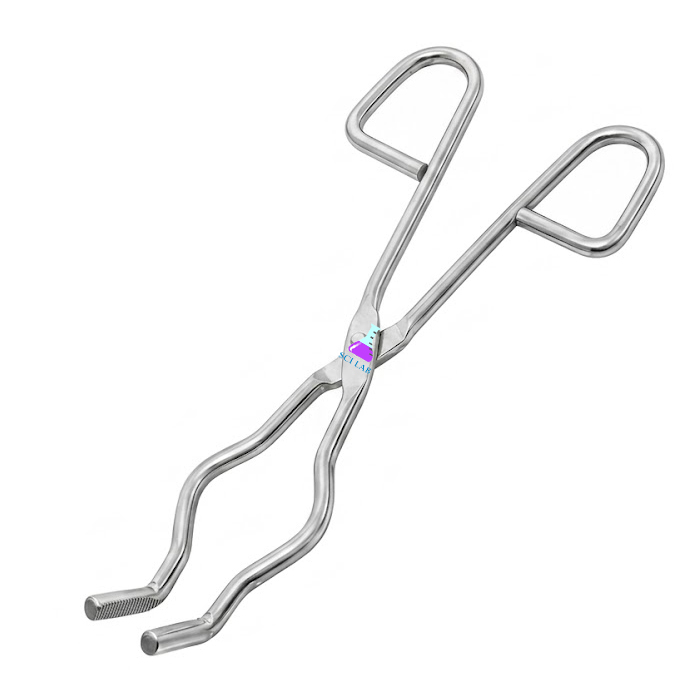
Crucible Tongs are metal scissor-action tongs for moving crucibles, evaporating dishes and other hot containers to and from a heat source. The long handles keep the hands well away from the flame, and the jaws open to 4 cm.
Specifications of the Crucible Tongs
| Specification | Value |
|---|---|
| Material | Metal |
| Jaw opening | 4 cm |
| Design | Scissor action with long handles that keep the hands away from the heat |
| Use | Moving hot containers to and from a heat source |
| Supplied by | Science Lab Supplies, Ambala, India |
Handling Hot Crucibles with the Tongs
Warm the tips in the flame for a moment before touching a hot porcelain crucible, so cold metal does not crack it by thermal shock. Grip the crucible, lift it straight up and set it on a heat-proof surface or in a desiccator.
- Heating to constant mass (Class 11–12): move a Porcelain Crucible with Lid between the flame and the balance, reheating until two weighings agree.
- Burning magnesium ribbon in a lidded crucible: lift the lid briefly with the tongs to let air in, keeping the face back.
- Evaporating to dryness: lift a hot Porcelain Dish off the gauze and set it on a mat to cool, then weigh it on the Laboratory Scales Electronic.
Frequently Asked Questions
Where should I grip the crucible?
Hold it by the edge with the jaws, using light, steady pressure. Squeezing hard can crack the porcelain or make the crucible spring out of the jaws.
Why must a hot crucible not be put down on the bench?
A cold or damp bench can crack hot porcelain by thermal shock. Set it on a clay triangle or heat-proof mat to cool briefly, then move it to a desiccator.
Why weigh the crucible only after it has cooled?
A hot crucible sets up rising air currents over the pan, so it reads lighter than it really is. Cool it to room temperature, ideally in a desiccator, before every weighing.
How do I stop the tongs contaminating the crucible?
Keep the tips clean and dry, and never lay them on the bench top. Rest them on a clean heat-proof mat or foil so dust and residue cannot pass to the crucible.
Do the tongs get hot during use?
Metal conducts heat, so the jaws warm up when they touch a hot vessel and heat slowly travels along the arms. Hold the handles at the far end and do not leave the tips in the flame.
Which chemicals can damage the tongs?
Metal tongs are attacked by strong acids, especially hydrochloric acid, and by halogens such as chlorine and bromine. Rinse and dry them after any splash, and use them only to hold hot vessels, never to stir or dip into chemicals.
Related Heating and Handling Tools
- Beaker Tong SS: stainless-steel tong with a silicone sleeve, holds beakers up to 2 litres.
- Wooden Test Tube Holder: wooden holder for gripping a test tube while it is hot.
- Bunsen Burner, 150 mm: 150 mm burner with a gas knob and a rotating air collar.
- Porcelain Evaporating Dish (Capsule), 50 ml: white porcelain dish with 50 ml capacity, chemical resistant.
- Porcelain Mortar and Pestle: 80 mm porcelain mortar supplied with a porcelain press.
Find other heat-handling tools in the Chemistry Lab catalogue or across School Lab Equipments.
Science Lab Supplies is registered with an Importer-Exporter Code and can supply buyers in Rwanda, South Africa, Qatar, Sri Lanka, Vietnam and Malaysia. A quotation can be requested from the contact page or through the enquiry cart.
Last updated: 15 November 2026

.jpg)


