Distiller for Distilled Water
Product Code : SCL-CL-11567
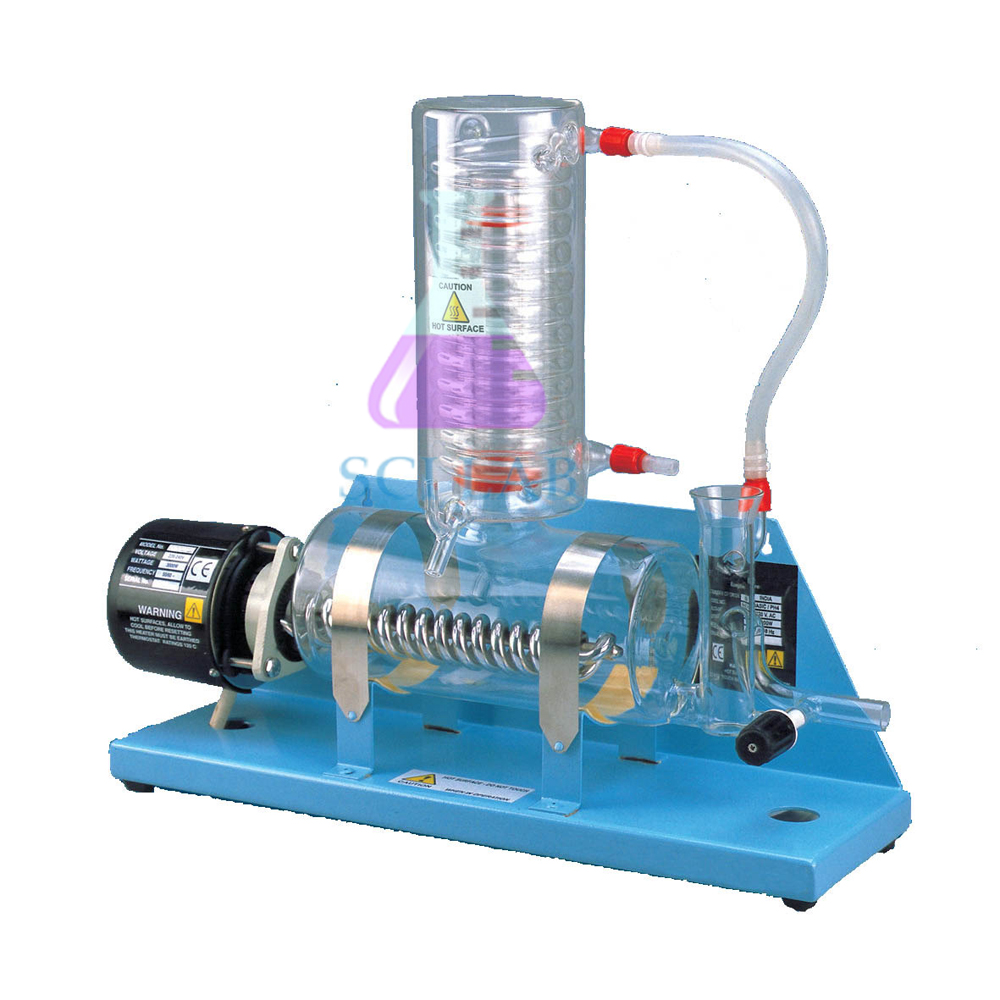
This electric water distiller boils tap water and condenses the steam to give distilled water for the laboratory. It produces 1 to 2 litres per hour and runs on a single-phase 220 V supply, drawing 700 to 900 W.
Specifications of the Water Distiller
| Specification | Value |
|---|---|
| Output | 1 to 2 litres per hour |
| Supply | Single-phase, 220 V |
| Power | 700 to 900 W |
| Supplied by | Science Lab Supplies, Ambala, India |
Distilled Water for the Chemistry Lab
Distilled water is the solvent for standard solutions, reagents and final rinses, because tap water carries dissolved salts that change results. Collect the output in a clean, closed container and keep it free of dust.
- Standard solutions: make up solutions to the mark in a Volumetric Flask with Stopper.
- Final rinses: fill a Plastic Wash Bottle for rinsing burettes, pipettes and precipitates.
- Comparison tests: show students the difference between tap and distilled water by evaporation residue or conductivity.
Precautions: use a properly earthed 220 V socket that can carry 900 W, and keep water and wet hands away from the plug.
Frequently Asked Questions
Is 1 to 2 litres per hour enough for a school lab?
For most school and college labs, yes. A few hours of running before practicals fills a storage bottle for reagents and rinses. Labs using many litres a day need longer runs.
Why does scale build up inside a distiller?
Hard tap water leaves calcium and magnesium salts behind when it boils. Scale slows heating and raises power use, so descale regularly; harder feed water needs more frequent cleaning.
Does distillation remove everything from water?
It leaves behind dissolved salts, metals and most other non-volatile matter. Some volatile substances with low boiling points can carry over with the steam, so the first portion is often discarded.
How can I check the quality of the distilled water?
Measure its conductivity. Pure water conducts very poorly, so a higher reading shows contamination. Comparing it with tap water also makes a good class demonstration.
How should distilled water be stored?
Keep it in a clean, closed glass or plastic bottle away from dust. Water left open takes up carbon dioxide from the air, which lowers its pH slightly.
Related Water Purification and Distillation Apparatus
- Laboratory Deioniser: mixed-bed resin cartridge that runs from tap water, typical output 10 litres per hour.
- Mariotte Bottle (Aspirator Bottle with Tap) for Distilled Water, 2.5 L: 2.5 l glass bottle with a tap.
- Liebig Condenser, 450 mm, 14/29 Joint: 450 mm molybdenum glass condenser with 14/29 joints.
- Apparatus for Distilling Liquids: 250 ml distillation flask with side arm and a 300 mm straight condenser.
- Wash Bottle, LDPE, 500 ml, Pack of 6: 500 ml squeeze bottle for rinsing labware.
Water purification and distillation items appear in the Chemistry Lab listing; kits for other subjects are in School Lab Equipments.
Science Lab Supplies holds an Importer-Exporter Code and can ship to buyers in Vietnam, Malaysia, Peru, Egypt, Iraq and Nigeria. To ask for a quotation, use the contact page or the enquiry cart.
Last updated: 14 November 2026