Triple Beam Balance with Tare, 2.6 kg
Product Code : LSK-CL-10039
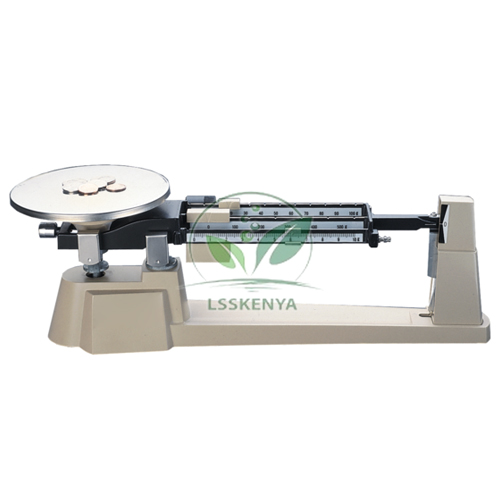
The triple beam balance with tare is a single-pan, low-form mechanical balance for school and college chemistry labs. Three notched beams carry sliding masses with centre-indicating pointers, and the reading is the sum of the three beams. With additional masses fitted, it weighs up to 2.6 kg.
Specifications of the Triple Beam Balance
| Specification | Value |
|---|---|
| Beams | Three notched weighing beams with centre-indicating sliding masses |
| Pan | Single pan, low form |
| Maximum load | Up to 2.6 kg when used with additional masses |
| Supplied by | Science Lab Supplies, Ambala, India |
Weighing on a Triple Beam Balance
With the pan empty and all sliders at zero, the pointer should line up with the zero mark. The sample is placed on the pan, then the heaviest slider is moved notch by notch until the pointer drops, and stepped back one notch. The middle slider follows, then the front slider, notch by notch, until the pointer rests at zero.
- Mass of a solid: weigh a sample in one of the Weighing Bottles so that powders do not touch the pan.
- Mass of a liquid by difference: weigh an empty Glass Beaker, add the liquid and weigh again.
- Density: combine the mass with a measured volume to find the density of a solid or liquid.
Common errors: leaving a slider between notches, and reading the pointer at an angle instead of straight on.
Frequently Asked Questions
How do I read a triple beam balance?
Add together the values shown at the three sliding masses once the pointer rests at zero. Write the total straight into your notebook rather than from memory.
Why are the beams notched?
The notches hold each sliding mass at an exact step, so it cannot sit between two values. The three slider readings are then added to give the mass.
What should a school check about the additional masses before ordering?
The beams alone cover a smaller range. The 2.6 kg maximum is reached only with the additional masses, each adding a fixed amount to the beam reading. Check that the set of additional masses is on the order, and store it with the balance so pieces are not lost.
What does the tare add compared with a plain triple beam balance?
The tare offsets the mass of an empty beaker or dish, so the beams read the sample alone. A balance without tare needs a second weighing and a subtraction. For class sets this saves time and removes a common source of arithmetic errors.
How should students carry the balance?
Lift it with both hands under the base, never by the beams, the pan or the pointer. Carrying it by a moving part can bend it, and the beam may then stick or fail to settle at zero.
Related Balances and Scales
- Triple Beam Balance 610g: 0.1 g readability with a 152 mm stainless steel pan.
- Beranger Balance, 2 Pan, 2 kg: 2 kg capacity with 20 cm stainless steel pans.
- Semi-Analytical Balance, 200 g, with Milligram Weights: 200 g capacity with 100 mg sensitivity.
- Digital Scale 1500 g x 0.1 g, Mains or Battery: backlit LCD with levelling feet and one tare key.
- Analytical Balance, 0.1 mg: analytical weighing with full range tare and zero tracking.
Browse the Chemistry Lab range or the Balances and Scales range.
This triple beam balance can be exported by Science Lab Supplies, an Importer-Exporter Code holder, to Saudi Arabia, Oman, the Philippines, Nepal, Bangladesh and Zambia. To receive a quotation for the balance, fill in the contact page or add the balance to the enquiry cart.
Last updated: 15 November 2026