Apparatus for the Electrolysis of Salts
Product Code : SCL-CL-11451
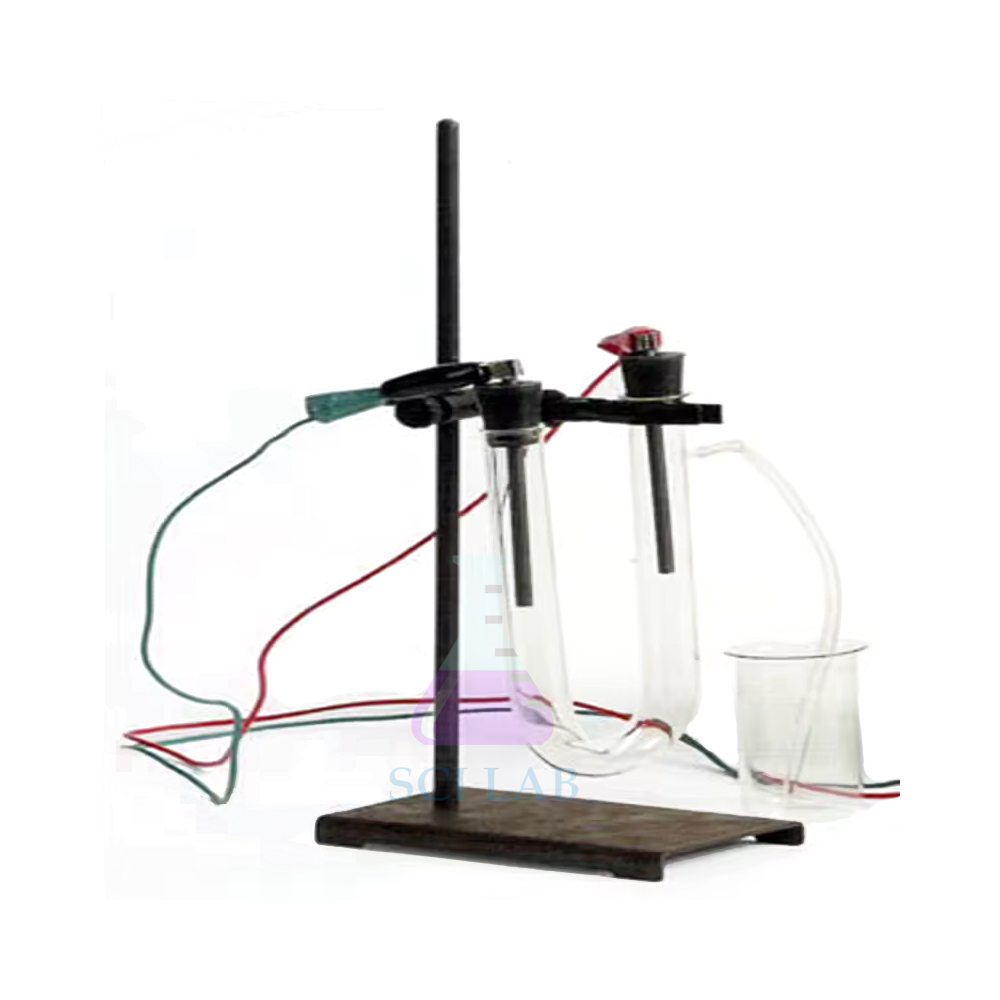
Apparatus for the Electrolysis of Salts (SKU SCL-CL-11451) is a glass U-tube cell with a graphite electrode in which a salt solution is split by direct current, so that the products formed at the anode and cathode can be seen and tested separately in each limb. It is used in school and college chemistry to teach electrolysis of aqueous solutions. Science Lab Supplies arranges dispatch from Ambala, India, and prices the cell for single schools, colleges, institutes, distributors or tender contractors.
Specifications
Every specification of the 15 mm U-tube cell appears in the table below. In short, a rubber stopper holds the 60 mm graphite electrode in the solution, electrical conductor wire connects it to the external DC supply, and the two limbs of the U-tube keep the anode and cathode products apart for testing.
| Specification | Value |
|---|---|
| SKU | SCL-CL-11451 |
| Cell | U-shaped glass tube |
| Tube diameter | 15 mm |
| Electrode material | Graphite |
| Electrode length | 60 mm |
| Closure | Rubber stopper |
| Connection | Electrical conductor wire |
| Supplied by | Science Lab Supplies, Ambala, India |
Applications and Experiments for the Electrolysis of Salts Apparatus
The U-tube cell lets students see which products form at each electrode when a salt solution is electrolysed, for example chlorine and hydrogen from brine or iodine from potassium iodide. Because the limbs keep products apart, each can be identified with a simple test or indicator.
- NCERT Class 10 science: electrolysis of brine and the chlor-alkali process.
- Class 12 chemistry: products of electrolysis of aqueous salt solutions with inert electrodes.
- B.Sc. practicals: comparing the behaviour of different salt solutions in the same cell, held upright on a Laboratory Stand.
- Indicator demonstrations: Red Litmus Paper turning blue at the cathode limb, or Universal Ph Indicator paper (pH 0–14) showing the change on both sides.
Electrolysing chloride solutions releases chlorine, a toxic gas. Keep currents and run times short, work in a ventilated room or fume cupboard, and let students handle the cell only under supervision.
Standard Scope of Supply
The apparatus comes with the 15 mm glass U-tube, the 60 mm graphite electrode, a rubber stopper and electrical conductor wire. A DC power supply, a stand and the salt solutions are not included and can be quoted separately on the same enquiry if your laboratory needs them.
Packing, MOQ and Lead Time
Ask for one cell or a class set of cells and the quotation will list the packing, delivery time and price for exactly that number. As a chemistry lab instruments supplier, Science Lab Supplies can add stands, spare electrodes and glassware to the same quotation.
With its Importer-Exporter Code, Science Lab Supplies is a registered exporter able to ship to buyers in Bangladesh, Zambia, Rwanda, South Africa, Qatar and Sri Lanka. A short note on the contact page or a saved list in the enquiry cart starts your quotation, and the lab tender page explains how tendered orders are priced.
Frequently Asked Questions
Why is a graphite electrode used?
Graphite is an inert electrode material, so it takes little part in the reaction and the products seen come mainly from the salt solution and water rather than from the electrode itself.
Which salts can be electrolysed in this cell?
Common school choices are sodium chloride, potassium iodide and copper sulfate solutions. Choose salts and concentrations according to your syllabus and your laboratory's safety rules.
Who supplies the Apparatus for the Electrolysis of Salts?
This U-tube cell reaches buyers through Science Lab Supplies of Ambala, India. Schools and colleges can order it directly, and distributors or tender contractors can ask for a quotation covering their full quantity.
Is a power supply included?
No. The set covers the U-tube, electrode, stopper and wire. Use the low-voltage DC supply already in your laboratory, or ask for one to be added to the quotation.
Related Electrochemistry Apparatus
Electrolysis lessons move from salt solutions to water, to conductivity and to the effects of different electrodes. These Chemistry Lab, Applied Mechanics and Physics Lab items cover those steps and can go on the same enquiry as the U-tube cell.
- Apparatus for Water Electrolysis (Hoffman Voltmeter) — two 25 ml graduated tubes with carbon and carbon-platinum electrodes, 600 mm tall.
- Apparatus for Electrical Conductivity of Electrolytes — base with four 250 ml cups and four bulbs wired in parallel.
- Apparatus for Demonstration of Electrolytic Processes — light bulb on a base with carbon, copper, zinc, lead and brass electrodes.
- Electrolysis Cells — 75 x 25 mm glass cylinder with a two-hole stopper carrying two carbon electrodes.
- Electrolysis Apparatus — titanium electrodes in a rubber stopper with 4 mm safety sockets and two graduated test tubes.
- Electrode Rod Carbon Voltameter — 100 x 10 mm carbon rod set in a glass tube with terminal.
- Electrode Carbon Rod With Brass Terminal — graphite rod electrode with a brass terminal for electrolysis cells.
- Electrolytic Breakdown — laminated chart for wall mounting in the classroom.
Browse the full Chemistry Lab range, the Physics Lab range, or all school lab equipment.
Last updated: 9 October 2026



500ml.jpg)