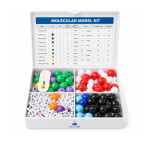
Schrodinger Atomic Model
Product Code : LSK-CL-10072
Schrodinger Atomic Model (SKU LSK-CL-10072) is a three-dimensional teaching model of the atom based on the quantum-mechanical (Schrödinger) picture of electrons in orbitals. It shows the shape of each orbital, marks positive and negative regions by colour, and uses cross sections to reveal inner regions, nodal planes and probable electron regions. It suits senior secondary and college chemistry. Institutions, tender contractors and distributors can obtain the model from Science Lab Supplies, which quotes it from Ambala, India, for schools and colleges.
Specifications
The orbital model's features are listed singly in the table below. In short, it offers a 3D view of an atom in which colour separates the positive and negative regions of each orbital, and sectioned parts expose inner orbital regions and nodal planes, where the chance of finding an electron is zero, beside the regions where electrons are most probable.
| Specification | Value |
|---|---|
| SKU | LSK-CL-10072 |
| Also known as | Quantum-mechanical atomic orbital model |
| View | Three-dimensional view of an atom |
| Orbital shapes | Shape of each orbital shown |
| Colour coding | Positive and negative regions of each orbital |
| Cross sections | Cross sections of the orbitals |
| Inner regions | Inner orbital regions pinpointed by the cross sections |
| Nodal planes | Shown |
| Electron regions | Probable electron regions shown |
| Supplied by | Science Lab Supplies, Ambala, India |
Applications and Experiments for the Schrodinger Atomic Model
The Schrodinger atomic model makes orbitals visible, so students can see why s orbitals are spherical, p orbitals have two lobes and nodal planes separate regions of opposite phase. It supports the Structure of Atom unit in NCERT Class 11 chemistry and quantum-chemistry lectures in B.Sc. courses.
- Class 11 chemistry: quantum numbers, orbital shapes and nodes, linked to shell filling on the Distribution of Electrons in Electronic Layers chart.
- Class 11–12: groundwork for hybridisation and bonding, with the Geometry of Molecules wall chart for shapes.
- B.Sc. chemistry and physics: wave functions, phase and probability density.
- Teacher demonstrations: comparing a particle picture such as the Model of The Atom with the orbital model.
Standard Scope of Supply
The Schrodinger Atomic Model is supplied as a single unit as described above; any optional accessories are listed on the quotation. Related orbital models and wall charts are separate items that can go on the same order and be packed together.
Packing, MOQ and Lead Time
Ask for a quotation for one model or for several departments. Science Lab Supplies lists packing, delivery time and price for that quantity, and orbital models or charts for the same topic can be quoted together.
Science Lab Supplies has an Importer-Exporter Code as a registered exporter and can ship to buyers in Malaysia, Peru, Egypt, Iraq, Nigeria and Kenya. Science Lab Supplies is registered for GST (GSTIN 06ADEPJ0574F2ZU). Chemistry departments can request a price for the model, alone or with orbital charts, on the contact page or via the enquiry cart, and the lab tender page sets out tender supply.
Frequently Asked Questions
What does the Schrodinger model show that a Bohr model does not?
Instead of fixed circular orbits, it shows orbitals as three-dimensional regions where an electron is likely to be found, with their shapes, phases and nodal planes.
What do the colours on the model mean?
The colours mark the positive and negative regions (phases) of each orbital, which matter when orbitals overlap to form bonds between atoms.
Who supplies the Schrodinger Atomic Model?
Science Lab Supplies, a chemistry lab instruments supplier in Ambala, India, includes this model in quotations for schools, colleges and contractors, either on its own or alongside related orbital models.
Which course level is it meant for?
It fits the atomic structure chapter of Class 11 chemistry and can also support B.Sc. lectures on quantum chemistry and wave functions.
Related Atomic Orbital and Bonding Models
These items extend the orbital topic from single orbitals to bonding: the three p orbital models, two hybridisation kits, an orbital demonstration unit, a set of carbon-carbon orbital models, and a wall chart relating quantum numbers for the n = 4 shell.
- Atomic Orbital Model Px — colour-coded plastic model with metal elements on a grey transparent display base.
- Atomic Orbital Model Py — plastic parts and links for assembling the model, with display bases.
- Atomic Orbital Model Pz — assembly parts and display bases, kept in a plastic storage box.
- Orbital Model of Sp2 Hybridization — plastic and metal kit for 3D structural formulae of organic compounds.
- Orbital Model of Sp3 Hybridization — atomic elements for building molecules in organic, inorganic and stereochemistry.
- Dynamic Model for Atomic Orbital Demonstration — 250 × 320 × 40 mm unit with display screen, key and 8 V DC supply.
- Carbon-Carbon Molecular Model — orbital models of ethane, ethylene, acetylene and benzene showing pi and sigma bonds.
- Relationships of Quantum Number Values for N=4 — laminated 70 × 100 cm wall chart.
Browse the full Chemistry Lab range or all school lab equipment.
Last updated: 9 October 2026