Graphite Crystal Model
Product Code : LSK-CL-10075
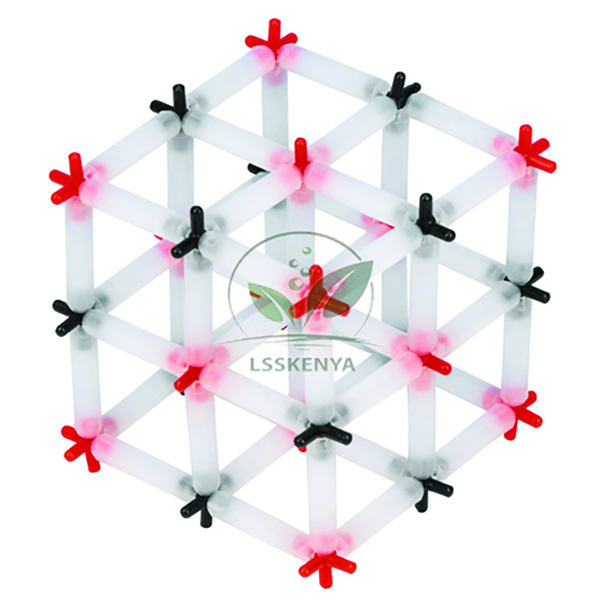
The Graphite Crystal Model is a build-it-yourself set that shows how carbon atoms join in flat hexagonal layers stacked one above another. The set has 69 connectors, 8 long black connectors, 45 black jacks and 12 red jacks, with an instruction manual for assembly.
Specifications of the Graphite Crystal Model
| Specification | Value |
|---|---|
| Model | Crystal structure model of a compound (graphite) |
| Connectors | 69 connectors plus 8 long black connectors |
| Jacks | 45 black jacks and 12 red jacks |
| Documentation | Instruction manual included |
| Supplied by | Science Lab Supplies, Ambala, India |
Teaching Carbon Allotropes with the Graphite Model
Students build each hexagonal layer on the bench first, then join the layers as the manual shows. Once built, the model can be used for demonstrations and revision.
- Count the bonds: each carbon joins three neighbours in its layer. Then build or show the Diamond Crystal Model, where each carbon joins four, and compare the two.
- Sliding layers: push the top layer sideways to show why graphite is soft, marks paper and works as a dry lubricant.
- Unit cells (Class 11–12): compare the stacked layers with the hexagonal unit cell in the Crystal Lattice Model Set.
Common errors: drawing four bonds per carbon after seeing the model, and calling the forces between layers covalent bonds.
Frequently Asked Questions
Why does graphite conduct electricity when diamond does not?
Each carbon in graphite uses three outer electrons for bonds inside its layer. The fourth electron is delocalised across the layer and can move, so it carries charge. In diamond all four electrons are held in bonds.
Why is graphite soft if its covalent bonds are strong?
The bonds inside each layer are strong covalent bonds. The forces between layers are weak, so the layers slide over each other. The model shows this when the top layer is pushed sideways.
How many bonds does each carbon atom have in graphite?
Three, all to neighbours in the same flat layer, with angles of 120 degrees between them. Students who learned diamond first often draw four; counting on the model clears this up.
Can the model show graphene?
Yes. A single hexagonal layer built on its own represents graphene, a carbon sheet one atom thick. It is a quick extension once students have built the full layered structure.
Which syllabus topics can the graphite model support?
It suits lessons on carbon allotropes, giant covalent structures and how structure explains properties such as softness, electrical conductivity and use as a lubricant. In Class 11-12 it also supports work on hexagonal layers and coordination number.
How many students can work with one set?
One set builds one graphite model. It works for a teacher demonstration or for one small group building it together. For group work across a class, plan one set per group so every group can count bonds and slide the layers itself.
Related Crystal and Molecular Models
- Sodium Chloride Crystal Model: set of 54 connectors, 13 black jacks and 14 red jacks with an instruction manual.
- Carbon-Carbon Molecular Model: orbital models of ethane, ethylene, acetylene and benzene showing pi and sigma bonds.
- Orbital Model of Sp2 Hybridization: plastic model with metal elements for organic, inorganic and stereo chemistry.
- Molecular Models Demonstration Kit: box with 40 hydrogen, 38 carbon and 12 oxygen atoms plus 55 single bonds.
- Model of The Atom: atom model table with coloured spheres for electrons, protons and neutrons, 475 x 475 mm.
Other crystal and molecular models are listed in the Chemistry Lab range, part of the School Lab Equipments catalogue.
From Ambala, graphite model sets can be shipped to Iraq, Nigeria, Kenya, Ghana, Ethiopia and Tanzania, as Science Lab Supplies exports on its own Importer-Exporter Code. Send the number of graphite sets needed through the contact page, or keep them in the enquiry cart, and a quotation can be prepared.
Last updated: 15 November 2026