Porcelain Dish
Product Code : SCL-CL-11914
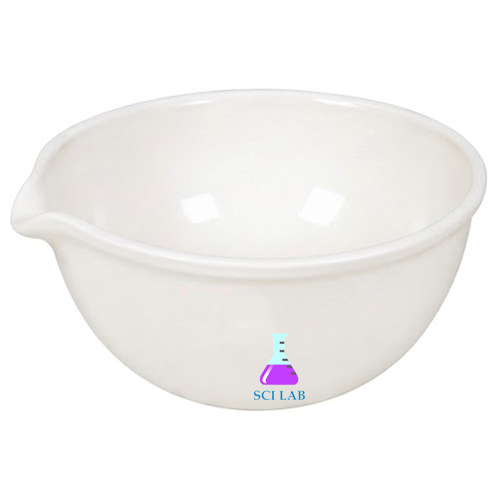
The Porcelain Dish is a 150 ml evaporating dish with a shallow, round-bottomed bowl and a wide opening. The large liquid surface speeds up evaporation, and a small spout on the rim pours concentrated solutions or recovered solids without mess. The porcelain takes high temperatures and resists most chemicals.
Specifications of the Porcelain Dish
| Specification | Value |
|---|---|
| Capacity | 150 ml |
| Material | Porcelain |
| Shape | Shallow, round-bottomed bowl with a wide opening |
| Rim | Small integrated pouring spout |
| Heat and chemical behaviour | Withstands high temperatures; resists corrosion by most chemicals |
| Supplied by | Science Lab Supplies, Ambala, India |
Evaporation and Crystallisation in the Porcelain Dish
The dish stands on a gauze over a tripod for direct heating, or over a beaker of boiling water for gentle heating. The solution is heated until it is concentrated, then left to cool so crystals form.
- Salt from rock salt (school): filter the solution through Filter Paper, then evaporate the filtrate in the dish on a Tripod Stand and Wire Gauze.
- Copper sulfate crystals: heat the solution until a drop taken out on a cold rod forms crystals, then leave the dish to cool slowly.
- Water of crystallisation: heat a weighed hydrated salt gently, cool and weigh at intervals, and stop at constant mass.
Lift the hot dish with Crucible Tongs, never by hand, and put it down on a heat-proof mat.
Frequently Asked Questions
Why should there always be liquid in the dish while it is heated?
The liquid carries heat away from the porcelain. An empty dish or a dry crust heats very fast in one spot, which can crack the dish or char the solid.
Why does a dish crack after many uses?
Repeated fast heating and cooling sets up stress in the porcelain. Let the dish cool on a heat-proof mat, never put it hot under a tap, and retire any dish that shows hairline cracks.
Why heat gently near the end of evaporation?
Strong heat at the end makes crystals spit out of the dish and can break down salts such as nitrates. Stop heating while some liquid remains and let the rest evaporate slowly.
How do I know all the water has gone from a hydrated salt?
Heat, cool and weigh the dish and solid, then repeat. When two weighings agree, no more water is being lost and the mass is constant.
Related Porcelain and Evaporation Ware
- Porcelain Evaporating Dish (Capsule), 50 ml: white porcelain dish with 50 ml capacity, chemical resistant.
- Porcelain Crucible with Lid, Low Form, 30 ml: low-shaped 30 ml porcelain pot supplied with a lid.
- Porcelain Mortar and Pestle: 80 mm porcelain mortar with a 90 mm porcelain press for grinding and mixing.
- Beaker Tong SS: stainless-steel tong that holds beakers up to 2 litres (155 mm OD).
- Glass Stirring Rod, 200 x 4 mm: solid clear glass rods, 20 cm long and 4 mm in diameter.
Browse the Chemistry Lab section for more porcelain and heating ware, or the wider School Lab Equipments range.
With an Importer-Exporter Code, Science Lab Supplies can send this dish to Zambia, Rwanda, South Africa, Qatar, Sri Lanka and Vietnam. For a quotation, write through the contact page or add it to the enquiry cart.
Last updated: 14 November 2026