Analytical Balance, 0.1 mg
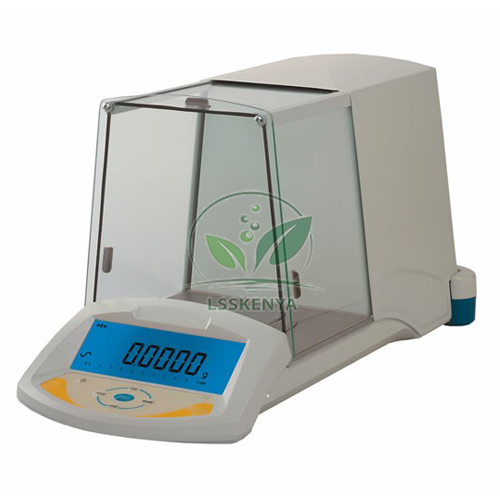
Product Code : LSK-CL-10041
This 0.1 mg electronic balance is an analytical balance for highly accurate weighing of chemicals during experiments. A force restoration mechanism does the weighing, and a large backlit display shows dual text prompts. It offers more than 16 weighing units, full range tare, zero tracking, auto calibration and a splashproof, colour-coded sealed keypad.
Specifications of the 0.1 mg Analytical Balance
| Specification | Value |
|---|---|
| Readability | 0.1 mg |
| Weighing system | Force restoration mechanism |
| Weighing pans | Stainless steel |
| Display | Large backlit LCD with dual text prompts and capacity tracker |
| Weighing units | 16 or more, including one custom unit |
| Functions | Full range tare, zero tracking, date and time, auto calibration, auto shut-off |
| Filtering | Selectable digital filtering for animal or dynamic weighing |
| Keypad | Colour-coded, sealed, splashproof against accidental spills |
| Power | 9 V battery or AC operation |
| Supplied by | Science Lab Supplies, Ambala, India |
Analytical Weighing in the Chemistry Lab
At 0.1 mg the reading reacts to air movement, warm hands and static. The balance needs a steady, level bench in a quiet corner and time to settle after switching on. Samples are handled with tongs or gloves and weighed in closed vessels.
- Primary standards: weigh a dried solid in one of the Weighing Bottles by difference, then dissolve it in a Volumetric Flask.
- Gravimetric analysis: weigh a precipitate or residue to constant mass after repeated drying.
- Small samples: weigh milligram amounts for melting point, chromatography or reagent work.
Common errors: weighing warm items, touching vessels with bare fingers, and using plastic containers that hold static charge.
Frequently Asked Questions
Is 0.1 mg readability the same as 0.1 mg accuracy?
No. Readability is the smallest step the display shows. Accuracy also depends on calibration, levelling, the room and the way the sample is handled.
How does this analytical balance differ from a 0.01 g precision balance?
It reads to 0.1 mg, a hundred times finer than a 0.01 g precision balance, and suits small samples such as primary standards and gravimetric residues. Finer readability usually comes with a lower maximum load, so heavier items belong on a precision or top-loading balance.
What extra items help a school get reliable 0.1 mg readings?
Plan for a firm anti-vibration bench away from doors and vents, a set of check weights to verify the auto calibration, forceps for handling those weights, and glass weighing bottles or metal boats. In very dry rooms an anti-static device helps with plastic containers.
Why does a plastic weighing boat give a creeping reading?
Plastic, and very dry glass, can carry a static charge that pulls on the weighing pan, so the reading drifts. Use a glass or metal vessel where you can, and avoid rubbing it with a dry cloth before weighing.
Related Analytical and Precision Balances
- Electronic Balance with RS232: stainless steel pans with an RS232 interface for PC connection.
- Analytical Balance 120g: glass draft shield with sliding side and top doors.
- Precision Balance 120g: 1 mg readability with a large backlit LCD.
- Semi-Analytical Balance, 200 g, with Milligram Weights: 200 g capacity with 100 mg sensitivity.
- Volumetric Flask with Stopper (One-Mark), 50-500 ml: glass, in 50, 100 and 500 ml.
Find more in the Chemistry Lab range and the Balances and Scales range.
Analytical balances like this one can be exported by Science Lab Supplies to the Philippines, Nepal, Bangladesh, Zambia, Rwanda and South Africa under its Importer-Exporter Code. For a quotation, write through the contact page or use the enquiry cart.
Last updated: 15 November 2026