
Relationships of Quantum Number Values for N=4
Product Code : SCL-CL-11601
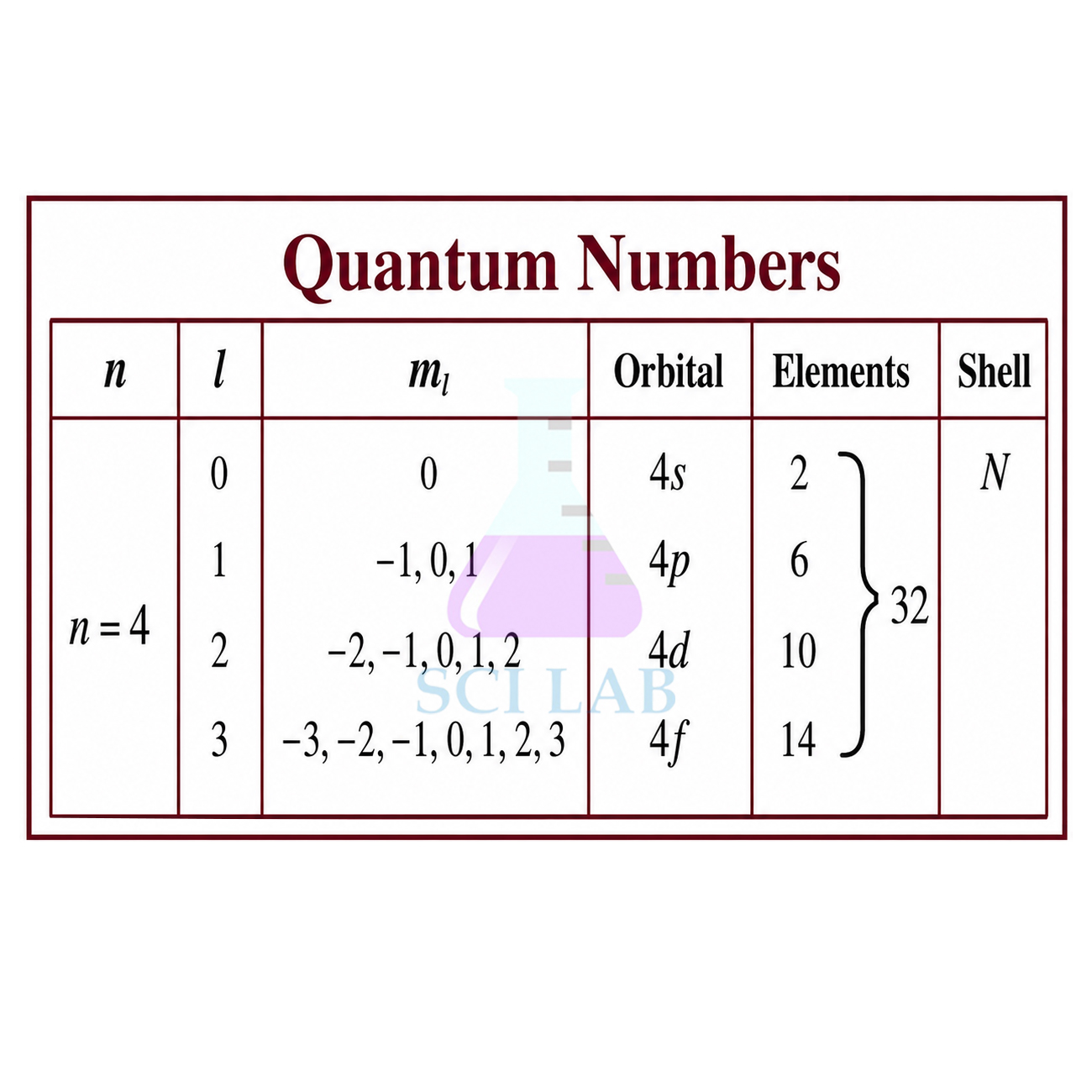
Relationships of Quantum Number Values for N=4 (SKU SCL-CL-11601) is a laminated 70 x 100 cm wall chart on how the four quantum numbers relate to one another in the fourth shell of an atom, where the principal quantum number n equals 4. It supports atomic structure lessons in Class 11 and first-year college chemistry. Science Lab Supplies in Ambala, India, can price and send the chart to schools, colleges, training institutes, tender contractors and distributors.
Specifications
Specifications of the n = 4 quantum numbers chart are listed row by row below. In short, it is a 70 x 100 cm sheet with a laminated finish, designed for fixing to a classroom or laboratory wall, where it can remain on display throughout the atomic structure unit and serve again for revision.
| Specification | Value |
|---|---|
| SKU | SCL-CL-11601 |
| Product type | Wall chart |
| Topic | Relationships of quantum number values for n = 4 |
| Size | 70 x 100 cm |
| Finish | Laminated |
| Mounting | Wall mounted |
| Use | Classrooms and laboratory |
| Supplied by | Science Lab Supplies, Ambala, India |
Applications and Experiments for the Quantum Number Values Chart
The fourth shell is the first in which all four subshell types appear, which makes n = 4 a clear example for teaching quantum number rules. For n = 4, l runs from 0 to 3, giving the 4s, 4p, 4d and 4f subshells, 16 orbitals and room for up to 32 electrons.
- NCERT Class 11 chemistry, Structure of Atom: principal, azimuthal, magnetic and spin quantum numbers.
- Class 11 chemistry: counting orbitals and electrons in a shell and the shapes of s, p, d and f orbitals, with hybrid shapes shown on the Orbital Model of Sp2 Hybridization.
- Class 11 chemistry: linking quantum numbers to electronic configuration and the Aufbau principle, using the transparent Atom Activity Model to show electron layers filling.
- B.Sc. inorganic and physical chemistry: revision of the quantum mechanical model of the atom.
Standard Scope of Supply
The supply consists of one laminated chart, Relationships of Quantum Number Values for N=4, measuring 70 x 100 cm, as described above; any optional accessories appear on the quotation. Three-dimensional orbital and atomic models are separate products that can be priced alongside it.
Packing, MOQ and Lead Time
You can ask for a price on one quantum numbers chart or on a batch for many classrooms. Science Lab Supplies replies with a quotation stating packing, delivery time and price for your quantity, and orbital models or other chemistry lab equipment in India can go on the same document.
Science Lab Supplies can ship to buyers in Saudi Arabia, Oman, the Philippines, Nepal, Bangladesh and Zambia, as it is a registered exporter holding an Importer-Exporter Code. If you are building an atomic structure display, query the chart on the contact page, combine it with orbital models in the enquiry cart, or check the lab tender page for tender purchases.
Frequently Asked Questions
Why does the chart focus on n = 4?
The fourth shell is the first to contain s, p, d and f subshells, so it shows every possible combination of l and m values in one example, which makes the rules easy to follow.
What are the chart’s dimensions?
It measures 70 x 100 cm and is laminated for wall mounting in a classroom or laboratory, the same format as other atomic structure charts in this range such as Distribution of Electrons in Electronic Layers.
Who supplies the Relationships of Quantum Number Values for N=4 chart?
Quotations for this chart are issued from Ambala, India, by Science Lab Supplies, both to individual schools and to contractors and distributors buying larger quantities, with orbital models added on request.
Which models work well with this chart?
Atomic orbital models such as the Px, Py and Pz set, and a Schrodinger atomic model, help students picture the orbitals described by the quantum numbers; each is a separate product.
Related Atomic Structure Charts and Models
Quantum numbers lead directly to orbital shapes, electron configuration and the structure of the periodic table. The items below help students picture and apply those ideas, from single p-orbital models to a full periodic table, and all of them can be quoted together with this chart.
- Schrodinger Atomic Model — colour-coded positive and negative orbital regions, with cross sections and nodal planes.
- Atomic Orbital Model Px — plastic model with metal elements on a gray transparent display base.
- Atomic Orbital Model Py — colour-coded plastic parts and links for assembling the orbital.
- Atomic Orbital Model Pz — supplied with a plastic storage box and transparent base.
- Dynamic Model for Atomic Orbital Demonstration — 250 x 320 x 40 mm, with display screen, key and 8 V DC power supply.
- Distribution of Electrons in Electronic Layers — 70 x 100 cm laminated chart on filling electron shells.
- Periodic Table of Chemical Elements — 100 x 70 cm table illustrating the s, p, d and f orbitals.
Browse the full Chemistry Lab range, the Charts & Portraits range, or all school lab equipment.
Last updated: 9 October 2026




.jpg)
