
Voltameter
Product Code : LSK-CL-10252
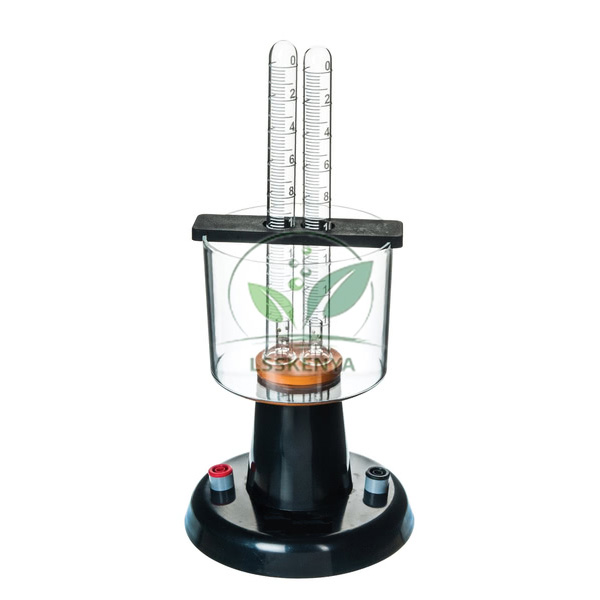
This Voltameter is a compact unit for showing the electrolysis of water in class. Platinum electrodes sit on a base with terminals, and two graduated test tubes of 10 ml capacity collect the gas given off at each electrode, so students can compare the volumes of hydrogen and oxygen.
Specifications of the Voltameter
| Specification | Value |
|---|---|
| Electrodes | Platinum |
| Gas collection | Two graduated test tubes, 10 ml capacity each |
| Mounting | Base with terminals for the supply leads |
| Supplied by | Science Lab Supplies, Ambala, India |
Electrolysis of Water with the Voltameter
Cover the electrodes with water containing a little dilute acid, fill both test tubes with the same liquid and invert them over the electrodes and connect a low-voltage DC supply to the terminals. Gas starts to collect at once: read the volume in each tube at fixed time intervals.
- Composition of water (Class 9–10): run the cell from a Power Supply Unit for DC and show that the cathode tube fills about twice as fast as the anode tube.
- Testing the gases: lift each tube and test with Wood Splints. Hydrogen burns with a squeaky pop, and oxygen relights a glowing splint.
- Faraday's first law (Class 12): run at a steady current, time each run and plot gas volume against the charge passed.
Common errors: using pure water, which carries almost no current; leaving an air bubble at the top of a tube; and reading the level with the eye above the liquid surface.
Frequently Asked Questions
Why is the hydrogen volume about twice the oxygen volume?
Each water molecule holds two hydrogen atoms for every oxygen atom, so electrolysis releases the two gases in a 2:1 ratio by volume. Oxygen is a little more soluble in water, so the measured ratio is often slightly above 2:1.
What liquid goes into the voltameter?
Water with a little dilute sulphuric acid or another suitable electrolyte added. Pure water carries almost no current, so very little gas forms. Avoid chloride solutions here, because chlorine then forms at the anode instead of oxygen.
Why are the electrodes made of platinum?
Platinum is inert. It does not react with the products or dissolve into the electrolyte, so the gases collected come only from the water. Carbon electrodes also work but wear slowly in use.
Which electrode gives which gas?
Hydrogen forms at the cathode, the electrode joined to the negative terminal of the supply. Oxygen forms at the anode, joined to the positive terminal.
How is this different from a Hoffman voltameter?
Here two 10 ml test tubes collect the gases over electrodes on a base. A Hoffman voltameter is a single glass unit with two graduated limbs, stopcocks and a central reservoir, and it collects larger volumes.
How can the gases be made to form faster?
Add a little more dilute acid to the water so it conducts better, and keep the platinum surfaces clean. A higher voltage also speeds it up but warms the liquid, so stay within the low voltage set for the practical.
Related Electrolysis Apparatus
- Hoffman Voltameter With Electrodes: two connected limbs of about 50 ml each, supplied with 2 carbon and 2 platinum electrodes.
- Hofmann Voltameter Stand: metal stand with support clamp, supplied with a 600 mm rod.
- Electrolysis Kit: two insulated stainless steel electrodes and leads with extra-large clips; glassware not included.
- Electrolysis Cells: 75 x 25 mm glass cylinder with two carbon electrodes in a rubber stopper.
- Electrode Rod Platinum: 100 x 10 mm rod in a glass tube, with a platinum leaf at the end and a terminal.
Browse the Chemistry Lab range or all School Lab Equipments.
Science Lab Supplies holds an Importer-Exporter Code and can ship to buyers in Nigeria, Kenya, Ghana, Ethiopia, Tanzania and Uganda. To ask for a quotation, use the contact page or the enquiry cart.
Last updated: 15 November 2026




.jpg)


