
Electrolysis Kit
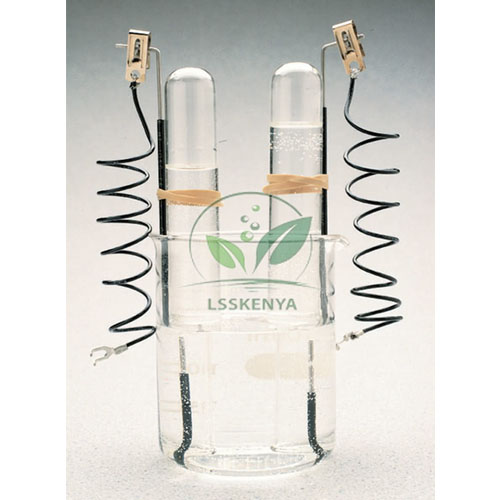
Product Code : LSK-CL-10062
Electrolysis Kit (SKU LSK-CL-10062) lets a class break water down into hydrogen and oxygen using two heavily insulated stainless steel electrodes, two connection leads with extra large clips, and two rubber gaskets that seal filled test tubes while they are inverted into a beaker. It is aimed at school chemistry and general science lessons on the composition of water. Science Lab Supplies sends the kit out from Ambala, India, to schools, colleges, training institutes, tender contractors and distributors in search of school chemistry lab equipment in India.
Specifications
Each component of the water-electrolysis kit appears as a separate row in the table. In outline, two heavily insulated stainless steel electrodes connect through leads with oversized clips, and two rubber gaskets give a positive seal on the filled test tubes during inversion; glassware is not part of the kit.
| Specification | Value |
|---|---|
| SKU | LSK-CL-10062 |
| Number of electrodes | 2 |
| Electrode material | Stainless steel |
| Electrode insulation | Heavily insulated |
| Connection leads | 2 |
| Lead clips | Extra large clips |
| Gaskets | 2, rubber |
| Gasket function | Positive seal for filled test tubes while inverted into a beaker |
| Purpose | Breaking down water into hydrogen and oxygen |
| Glassware | Not included |
| Supplied by | Science Lab Supplies, Ambala, India |
Applications and Experiments for the Electrolysis Kit
This electrolysis kit shows that water is a compound of hydrogen and oxygen. Gas collects in two inverted test tubes over the electrodes, and students compare the volumes and test each gas. It matches the electrolysis-of-water activity in NCERT Class 10 science and introductory electrochemistry in Class 12.
- Class 10 science: decomposition of water by electricity, set up with two Test Piece tubes of 16 × 150 mm inverted in a Chemical Glasses (Beaker) 500ml.
- Comparing the roughly 2:1 volume ratio of hydrogen to oxygen, then confirming oxygen with glowing Wood Splints.
- Class 12 chemistry: identifying products at the anode and cathode.
Hydrogen is flammable and a hydrogen-oxygen mixture can pop loudly, so gas tests should be done in small amounts, away from open flames, with eye protection and under supervision.
Standard Scope of Supply
Each Electrolysis Kit contains two insulated stainless steel electrodes, two connection leads with extra large clips and two rubber gaskets. Glassware is not included, so test tubes and a beaker are needed, and a DC source is also separate; all of these can be added to the quotation.
Packing, MOQ and Lead Time
You may request a price for one kit or for a quantity that equips every group. The Science Lab Supplies quotation gives packing, delivery time and price for exactly that number, and test tubes, beakers or a DC power supply can be included in the same offer.
Science Lab Supplies is registered as an exporter under an Importer-Exporter Code and is able to ship to buyers in Oman, the Philippines, Nepal, Bangladesh, Zambia and Rwanda. A quote for the kit, with or without glassware, starts with a note on the contact page or a list built in the enquiry cart; formal procurement runs through the lab tender page.
Frequently Asked Questions
Are test tubes and a beaker included?
No. Glassware is not included. You will need two test tubes and a beaker for the practical, and both can be quoted along with the kit if you ask for them.
What are the rubber gaskets for?
They seal the water-filled test tubes while you turn them upside down and place them into the beaker over the electrodes, so no air enters before gas collection starts.
Who supplies this Electrolysis Kit?
Science Lab Supplies prepares quotations for the kit and dispatches it from Ambala, India. It can be grouped with test tubes, a beaker and a power supply so that a school receives everything the practical needs together.
How is this kit different from a Hoffman voltameter?
This kit uses ordinary test tubes to collect the gases, while a Hoffman voltameter has graduated glass limbs with a stopcock on each limb for reading gas volumes directly.
Related Electrolysis Equipment
Pair the kit with these items to run and extend the electrolysis practical: a DC supply to drive the reaction, graduated voltameters and a stand for measured gas volumes, small carbon-electrode cells and a U-tube for salt solutions, and a wall chart that summarises electrolytic decomposition.
- Power Supply Unit/ Block for DC — regulated 0–9 V DC at 2.5 A, protected by a thermal circuit breaker.
- Hoffman Voltameter With Electrodes — two connected limbs of about 50 ml each with a stopcock on top; needs a 12 V supply.
- Hoffman Voltameter Stand — metal stand and support clamp on a 600 mm rod.
- Apparatus for Water Electrolysis (Hoffman Voltmeter) — three glass tubes 600 mm high, with 25 ml tubes graduated in 1 mm steps.
- Voltameter — base with terminals, platinum electrodes and two 10 ml graduated test tubes.
- Electrolysis Cells — 75 × 25 mm glass cylinder with a 2-hole stopper carrying 2 carbon electrodes.
- Apparatus for the Electrolysis of Salts — 15 mm U glass pipe with a 60 mm graphite electrode.
- Electrolytic Breakdown — laminated 70 × 100 cm wall chart.
Browse the full Chemistry Lab range, the Lab Glassware range for test tubes and beakers, or all school lab equipment.
Last updated: 9 October 2026

.jpg)


