Hofmann Voltameter with Electrodes, 50 ml Limbs
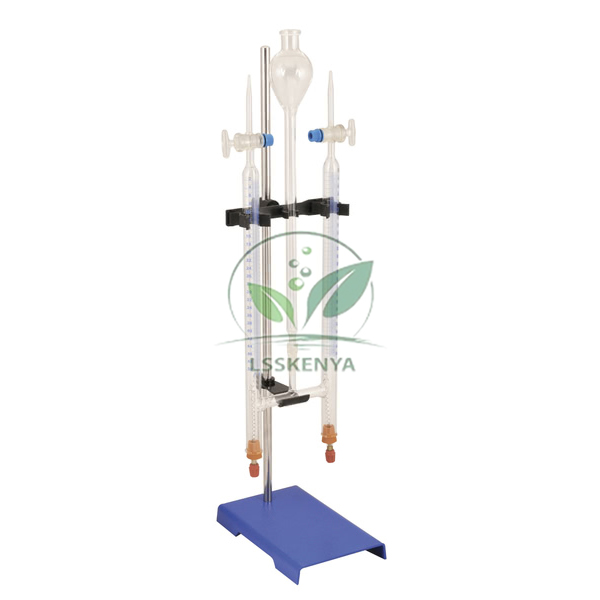
Product Code : LSK-CL-10242
The Hofmann Voltameter with Electrodes splits water into hydrogen and oxygen and collects each gas in its own graduated limb. The glass unit has two limbs of about 50 ml, a central reservoir with a funnel bulb, and comes with carbon and platinum electrodes.
Specifications of the Hoffman Voltameter
| Specification | Value |
|---|---|
| Glass unit | Two connected limbs, each about 50 ml, graduated 2–50 ml |
| Reservoir | Integral reservoir tube with funnel-shaped bulb |
| Stopcocks | One at the top of each limb |
| Electrodes | 2 carbon and 2 platinum |
| Power | Needs a 12 V DC supply |
| Electrolyte | Water with molar sodium or potassium sulphate, or sulphuric acid (required for use) |
| Supplied by | Science Lab Supplies, Ambala, India |
Electrolysis of Water with the Hoffman Voltameter
Clamp the voltameter upright on the Hofmann Voltameter Stand. Fill it through the reservoir with electrolyte until both limbs are full, then close the stopcocks. Connect the terminals to a 12 V DC source. Hydrogen collects above the cathode and oxygen above the anode.
- Composition of water (Class 10): dissolve Sodium Sulphate in water as the electrolyte and compare the gas volumes in the two limbs.
- Faraday's laws (Class 12): run from the 12 V step of an AC/DC Laboratory Power Supply, record current and time, and relate them to the hydrogen volume.
- Electrochemical equivalent of hydrogen (B.Sc.): use the measured volume, current and time to find the mass of hydrogen set free per coulomb.
- Gas tests: release a little gas through each stopcock and test it with a lit or glowing splint from the Wood Splints pack.
Precautions: sulphuric acid is corrosive and hydrogen is flammable. Wear eye protection, keep flames away from the open stopcocks and test only small amounts of gas.
Frequently Asked Questions
Why does the water need sodium sulphate or acid?
Pure water has very few ions, so it carries almost no current. Dissolved sodium sulphate, potassium sulphate or sulphuric acid adds ions, so electrolysis runs at a useful rate without changing the gases produced.
When should the platinum electrodes be used instead of carbon?
Platinum is inert and gives the cleanest gas volumes, so use it for measured work. A carbon anode can slowly react with oxygen to form some carbon dioxide, which upsets the volume ratio.
Why is the oxygen volume often less than half the hydrogen volume?
Oxygen is more soluble in water than hydrogen, so some of it dissolves at first. Running the apparatus for a few minutes before taking readings saturates the electrolyte and brings the ratio closer to 2:1.
How are the two gases identified?
Hydrogen burns with a squeaky pop when a lit splint is held near it. Oxygen relights a glowing splint. Release only a small amount of gas through the stopcock for each test.
Is Hoffman the same as Hofmann voltameter?
Yes. The apparatus is named after the chemist August Wilhelm von Hofmann. Hoffman is a common catalogue spelling for the same three-tube water electrolysis apparatus.
Related Electrolysis Apparatus and Electrodes
- Platinum Foil Electrodes (Pair): pair of rectangular platinum foil electrodes fused into glass tubes with screw terminals.
- Electrode Rod Carbon Voltameter: 100 x 10 mm carbon rod in a glass tube with terminal.
- Hofmann Voltameter: limbs graduated 50 x 0.2 ml, with removable carbon electrodes.
- Hofmann Voltameter, 25 ml Tubes, 600 mm: three glass tubes, two of them graduated, with ground glass taps.
- Electrolysis Kit: two insulated stainless steel electrodes with rubber gaskets for inverted test tubes.
- Voltameter: platinum electrodes on a base with two 10 ml graduated test tubes.
See the full Chemistry Lab range or all school lab equipment.
Science Lab Supplies holds an Importer-Exporter Code and can ship to buyers in Zambia, Rwanda, South Africa, Qatar, Sri Lanka and Vietnam. To ask for a quotation, use the contact page or the enquiry cart.
Last updated: 15 November 2026