Visible Spectrophotometer
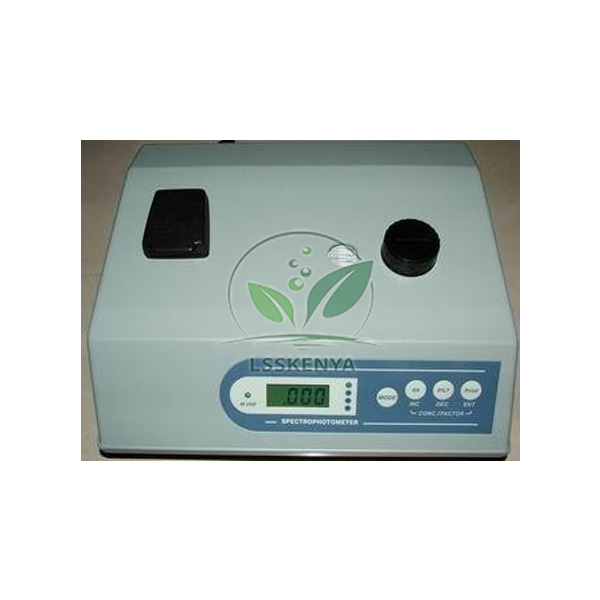
Product Code : LSK-CL-10087
The Visible Spectrophotometer passes a beam of monochromatic light through a solution and measures how much of it is absorbed. It covers 330–1000 nm with a 10 nm bandwidth and reads 0–125.0 %T or 0–2.0 absorbance, so students can find concentrations from a calibration graph.
Specifications of the Visible Spectrophotometer
| Specification | Value |
|---|---|
| Wavelength range | 330–1000 nm |
| Wavelength accuracy | 2 nm |
| Bandwidth | 10 nm |
| Photometric range | 0–125.0 %T; 0–2.0 Abs |
| Photometric accuracy | 2 %T |
| Principle | Monochromatic beam through the sample; light absorbed is measured |
| Supplied by | Science Lab Supplies, Ambala, India |
Colorimetric Analysis with the Spectrophotometer
Switch on and let the lamp settle. Fill a clean cuvette with the solvent, set it as the blank at the chosen wavelength, then read each sample in the same cuvette or a matched one.
- Absorption spectrum: read a coloured solution every 10–20 nm across the range and plot absorbance against wavelength to find the peak.
- Calibration curve (Beer-Lambert law): weigh the solute on an Analytical Balance, make standards with a Graduated Pipette, plot absorbance against concentration and read off the unknown.
- Reaction rate: follow the colour fading in a reaction by taking absorbance readings at fixed times.
- Method comparison: repeat a calibration on the filter-based Colorimeter Photo Digital and compare the two graphs.
Common errors: fingerprints or scratches on the light path of the cuvette, skipping the blank and measuring solutions that are too concentrated.
Frequently Asked Questions
Why do I need to run a blank first?
The cuvette and solvent absorb a little light too. Setting the blank to 100 %T removes their effect, so later readings show only the absorbance of the dissolved substance.
How do I choose the wavelength?
Use the wavelength where the solution absorbs most strongly, found from its absorption spectrum. It usually lies in the colour complementary to the colour of the solution: a blue solution absorbs orange light.
Why are very high absorbance readings unreliable?
At high absorbance only a tiny fraction of light reaches the detector, so small errors make a large difference. Dilute the sample by a known factor and keep readings in the lower part of the scale.
Can I measure near the 330 nm end of the range?
Yes, but check the cuvettes first. Polystyrene and ordinary glass cuvettes start to absorb below about 340-350 nm, so readings near 330 nm need quartz or UV-grade plastic cuvettes.
What does the 10 nm bandwidth mean when choosing an instrument?
Bandwidth is the spread of wavelengths in the beam that reaches the sample. A 10 nm band suits coloured solutions with broad absorption peaks, which covers most school and college assays, but it cannot separate sharp, narrow peaks that an instrument with a 1-2 nm band would resolve.
Which practicals can the spectrophotometer run?
Beer-Lambert calibration curves and finding the concentration of an unknown, reaction rates from absorbance against time, enzyme activity, and colorimetric tests such as iron, nitrite or protein assays. Readings taken in steps through 330-1000 nm also give a full absorption spectrum.
Related Analysis and Measuring Equipment
- Laboratory Spectrometer: optical instrument for angular measurements, refractive index and spectral lines.
- Laboratory Scales Electronic: 0–1000 g range with 0.01 g accuracy and backlit display.
- Volumetric Pipette, Amber-Stain Marked, 5-50 ml: borosilicate pipette for fixed-volume transfer, in 5 to 50 ml sizes.
- Glass Beaker, Low Form, 250 ml: graduated low-form glass beaker, chemical and heat resistant.
- Wash Bottle, LDPE, 500 ml, Pack of 6: 500 ml squeeze bottle for rinsing labware and sensors with distilled water.
Balances, volumetric glassware and other analysis items are in the Chemistry Lab range, with every school subject under School Lab Equipments.
Science Lab Supplies, registered for export with an Importer-Exporter Code, is able to supply the spectrophotometer to laboratories in Bangladesh, Zambia, Rwanda, South Africa, Qatar and Sri Lanka. A written quotation for the spectrophotometer can be asked for from the contact page or by sending the enquiry cart.
Last updated: 15 November 2026