Porcelain Pestle with Mortar
Product Code : SCL-CL-11936
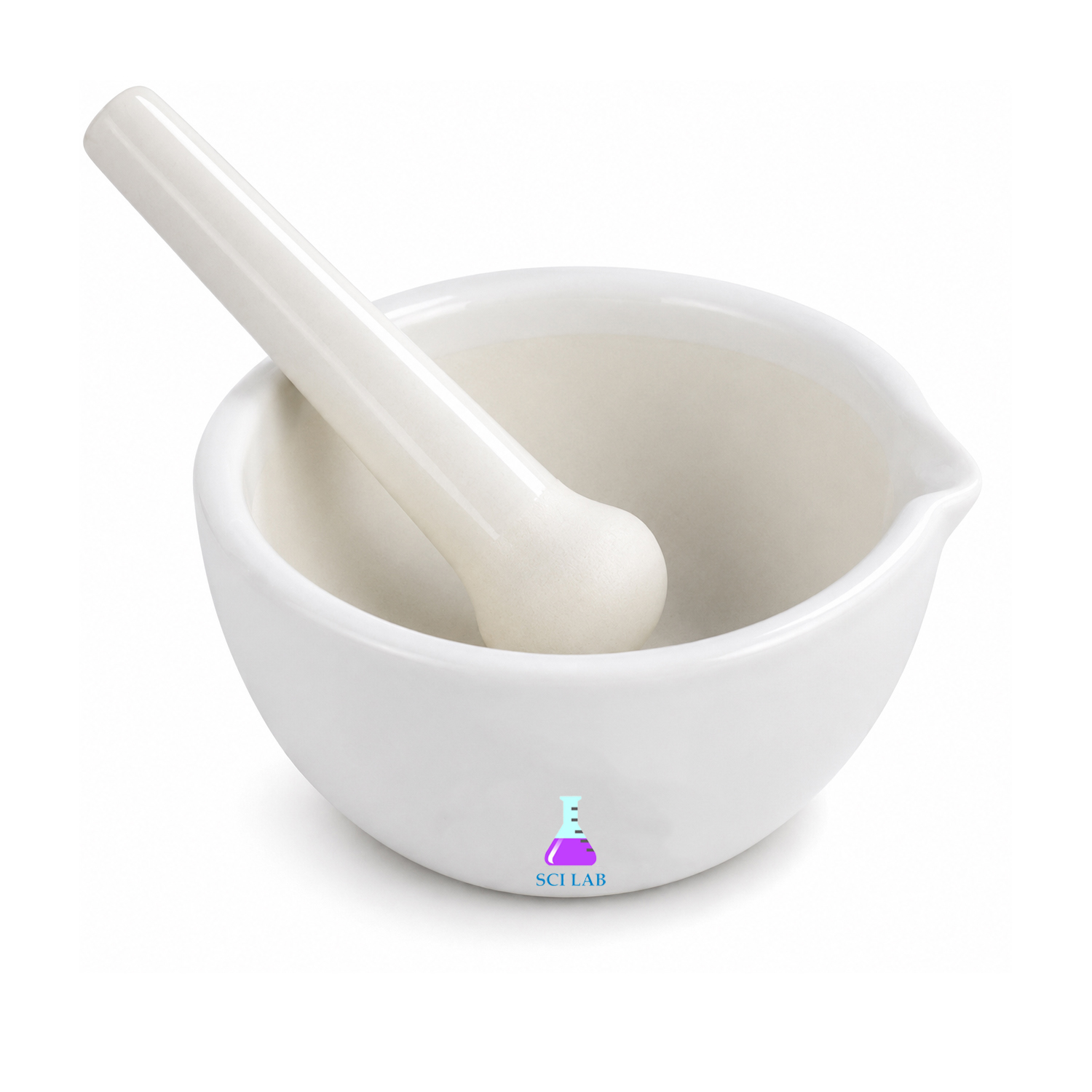
The Porcelain Pestle with Mortar is a 100 mm set in high-density white porcelain for crushing and grinding solids. The deep, thick-walled bowl has a wide mouth and a pouring spout on the rim. The pestle has a smooth glazed handle and a rounded, unglazed head with a rough surface that grips the material.
Specifications of the Porcelain Mortar and Pestle
| Specification | Value |
|---|---|
| Diameter | 100 mm |
| Material | High-density white porcelain |
| Mortar | Deep, thick-walled bowl with wide mouth and pouring spout |
| Pestle | Glazed handle, rounded unglazed textured grinding head |
| Supplied by | Science Lab Supplies, Ambala, India |
Grinding Tasks with the Mortar and Pestle
Put in a small amount at a time, no more than a third of the bowl. Crush large lumps with a pressing action first, then grind with a circular motion against the bowl wall.
- Leaf pigments: grind chopped leaves with a little sand and solvent for paper chromatography, and pour the extract into a Watch Glass.
- Surface area and rate: powder some marble chips and compare how fast lumps and powder react with dilute acid.
- Sample preparation: grind a salt before dissolving it, then tip it out through the spout onto a clean Petri Dish.
Wear safety glasses when crushing hard solids, as fragments can fly. Never grind oxidisers together with fuels or other reactive mixtures.
Frequently Asked Questions
Why is the pestle head unglazed?
The rough, unglazed surface creates friction against the material, so it breaks up instead of sliding. The glazed handle stays smooth and easy to hold and clean.
Can it grind very hard materials?
Porcelain suits salts, crystals, leaves and most school samples. If the sample is harder than porcelain, the bowl wears and porcelain grit gets into the sample. Very hard minerals need a harder mortar such as agate.
Why add sand when grinding leaves?
Sand acts as an abrasive that tears the leaf cells open, so the pigments pass into the solvent. Grind for a few minutes until the mixture is a dark green paste.
Is it safe to grind with a solvent?
A little solvent helps, but solvents such as propanone are highly flammable. Put out all flames nearby, work with good ventilation and wear eye protection.
Related Porcelain and Bench Ware
- Porcelain Mortar and Pestle: 80 mm porcelain mortar with a 90 mm porcelain press.
- Gooch Crucible: filtration crucible for collecting, washing and weighing precipitates.
- Crucible Tongs: scissor-like metal tongs with a 4 cm jaw opening.
- Glass Dropper Pipette 6 inch (150 mm): 6-inch tapered glass tube with a rubber bulb.
- Wash Bottle, LDPE, 500 ml, Pack of 6: 500 mL squeeze bottle for rinsing labware.
Browse the Chemistry Lab apparatus or the Lab Glassware range.
With an Importer-Exporter Code, Science Lab Supplies can supply buyers in Zambia, Rwanda, South Africa, Qatar, Sri Lanka and Vietnam. Quote requests for the mortar and pestle go through the contact page or the enquiry cart.
Last updated: 14 November 2026


.jpg)