
Le Chatelier's Principle Kit
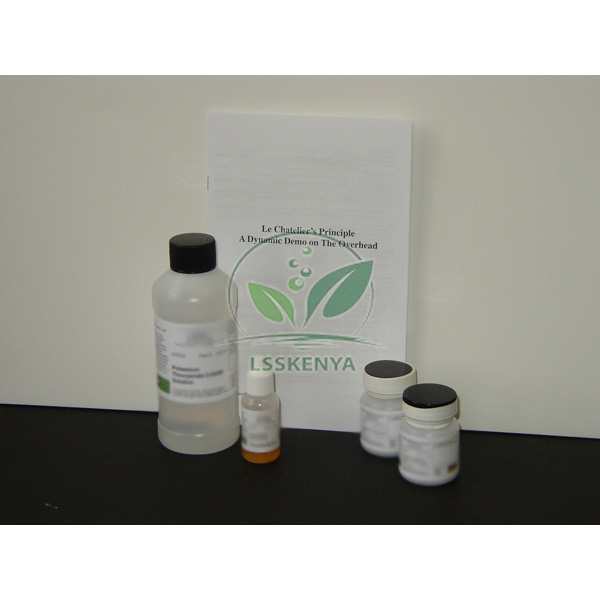
Product Code : LSK-CL-10066
The Le Chatelier's Principle Kit lets students test Le Chatelier's principle for themselves. They encourage one of two simultaneous chemical reactions in a mixture and watch the equilibrium change. The principle: when a system at equilibrium is put under stress, the equilibrium shifts in the direction that eases that stress.
Specifications of the Le Chatelier Principle Kit
| Specification | Value |
|---|---|
| Principle tested | Le Chatelier's principle, tested by experiment |
| Method | Students encourage one of two simultaneous chemical reactions, which changes the equilibrium of the mixture |
| Supplied by | Science Lab Supplies, Ambala, India |
Testing Le Chatelier's Principle in the Lab
Students first set up the mixture at equilibrium and note its appearance. They then favour one of the two reactions and record how the mixture responds, comparing it with an untouched sample.
- Concentration stress: add a little more of one reactant and record the change, then explain it with the equilibrium equation.
- Temperature extension: warm one sample in a Glass Beaker water bath, cool another, and read the bath with Laboratory Thermometers to see which way heat shifts the mixture.
- Write-up: state the stress, the shift and the reason for each test.
Common errors: not keeping a reference sample, and describing the shift as going towards the stress rather than against it.
Frequently Asked Questions
What does Le Chatelier's principle say?
When a system at equilibrium is disturbed, the equilibrium shifts in the direction that partly undoes the disturbance. Add a reactant and more product forms; remove a product and the forward reaction is favoured.
Which kinds of stress can shift an equilibrium?
Changes in concentration, temperature and, for gas reactions, pressure. A catalyst does not shift the equilibrium; it only helps the system reach it faster.
Which level of chemistry course is the kit meant for?
It is meant for upper secondary and introductory college chemistry, where students first meet reversible reactions and equilibrium. They test Le Chatelier's principle by experiment rather than only learning the rule from a textbook.
Does the reaction ever go fully to completion?
No. At equilibrium the forward and reverse reactions run at the same rate, so reactants and products are both present. A stress only changes their balance.
How does temperature show whether a reaction is exothermic?
If heating favours the products, the forward reaction absorbs heat (endothermic). If cooling favours the products, the forward reaction gives out heat (exothermic).
How does this kit differ from the Equilibrium Shifts Kit?
This kit centres on one mixture: students favour one of two simultaneous reactions and watch the equilibrium of the mixture change. The Equilibrium Shifts Kit works through six separate systems, from acetic acid with sodium acetate to silver acetate, with predictions made first.
Related Equilibrium and Reaction Resources
- Equilibrium Shifts Kit: covers six systems, including iron(III) thiocyanate and chromate/dichromate.
- Thermodynamic Data for Some Substances: laminated wall chart, 70 cm x 100 cm.
- Elementary Reactions and Rate Equation: laminated wall chart, 70 cm x 100 cm.
- Dropper Bottle 10 ml: polypropylene microscale bottle with removable dropper and leakproof lid.
- Solubility Product: laminated wall chart, 70 cm x 100 cm.
See the Chemistry Lab range for further equilibrium and reaction kits, or School Lab Equipments for every school range.
Science Lab Supplies holds an Importer-Exporter Code and can ship to Zambia, Rwanda, South Africa, Qatar, Sri Lanka and Vietnam. The contact page and the enquiry cart both lead to a quotation for the Le Chatelier kit.
Last updated: 15 November 2026



.png)