
Density Cube Set
Product Code : LSK-CL-10275
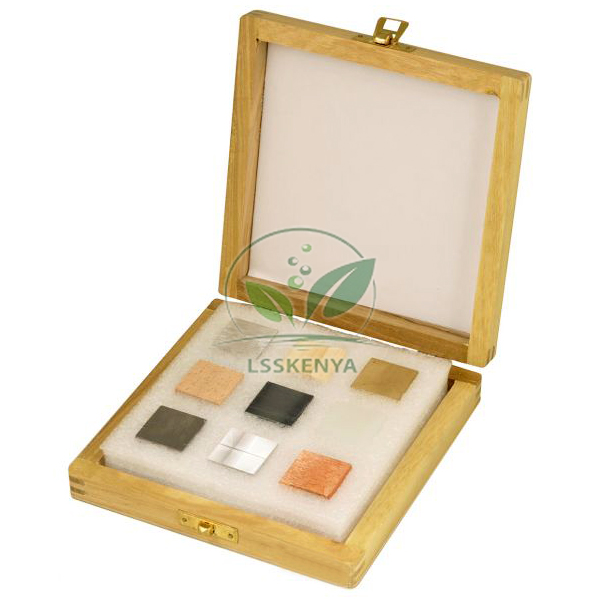
Density Cube Set (SKU LSK-CL-10275) is a set of nine cubes, each 25 mm along every side, made from nine different materials, from brass and copper to pine and acrylic. Because every cube has the same volume, students can compare materials simply by weighing them and then calculate density. It suits middle-school science and Class 9–11 lessons on mass, volume and density. Science Lab Supplies prices the set in Ambala, India, and can send it on to schools, colleges, training institutes, tender contractors and distributors.
Specifications
All nine materials and the cube size are logged as separate rows below. In short, the set holds nine 25 mm cubes, four metals, two woods and three plastics, each with a volume of 15.625 cm³, packed in a wooden storage box so the same-volume comparison is ready for every lesson.
| Specification | Value |
|---|---|
| SKU | LSK-CL-10275 |
| Number of cubes | 9 |
| Cube size | 25 mm sides |
| Volume per cube | 15.625 cm³ |
| Metal | Brass |
| Metal | Iron |
| Metal | Copper |
| Metal | Aluminium |
| Wood | Hardwood (beech) |
| Wood | Softwood (pine) |
| Plastic | Nylon |
| Plastic | PVC |
| Plastic | Acrylic |
| Storage | Wooden box |
| Application | Density investigations and comparison of materials |
| Supplied by | Science Lab Supplies, Ambala, India |
Applications and Experiments for the Density Cube Set
The set is used for density investigations and for comparing materials. With equal volumes, the heavier cube is always the denser material, so students can rank all nine by mass before calculating density as mass divided by volume and checking which cubes should float in water.
- Middle-school science (Class 6–8): comparing materials and their properties.
- NCERT Class 9 science: density, relative density and why some objects float, weighing each cube on a Triple Beam Balance 610g.
- Class 11 physics: measuring cube dimensions with vernier calipers, confirming volume by displacement in a Measuring Cylinder Glass, and calculating density with error estimates.
- Identifying an unknown material from its measured density, then comparing liquid densities found with a Specific Gravity Bottle.
Standard Scope of Supply
Each set includes nine 25 mm cubes, one each of brass, iron, copper, aluminium, beech, pine, nylon, PVC and acrylic, packed in a wooden box. A balance, calipers and a water container for flotation tests are not part of the set.
Packing, MOQ and Lead Time
Sets can be quoted individually or in multiples so every group works with its own box. The quotation covers packing, delivery time and price for your quantity; if you also need a digital weighing balance in India for the same class, it can be added to the same quotation.
Science Lab Supplies is registered as an exporter and holds an Importer-Exporter Code, so it can ship to buyers in Kenya, Ghana, Ethiopia, Tanzania, Uganda and the UAE. Ask for a quotation on the contact page, park the set in the enquiry cart beside your balances, or submit a tender schedule through the lab tender page.
Frequently Asked Questions
Which materials are in the Density Cube Set?
Nine materials: brass, iron, copper, aluminium, hardwood (beech), softwood (pine), nylon, PVC and acrylic, one 25 mm cube of each, stored together in a wooden box.
Why are all the cubes the same size?
Equal volumes mean any difference in mass comes from the material alone, so students can compare densities directly on a balance before doing the calculation.
Who supplies the Density Cube Set?
The set comes through Science Lab Supplies, which prepares quotations in Ambala, India, for schools, colleges, contractors and distributors and can add balances and calipers to the same document.
Which cubes float in water?
The two wooden cubes are normally less dense than water and float; the metal cubes sink. Testing the plastics is a useful extension for students.
Related Density and Specific Gravity Equipment
These items turn the cubes into a full density practical: further cube and cylinder sets, a balance for mass, calipers for side length, a cylinder and overflow can for displacement, and a hydrometer for solid and liquid densities. Ordering them together gives each group everything needed for the experiment.
- Cubes — 1 cm cubes of rubber, wood, opaque plastic, iron and transparent plastic for same-volume comparisons.
- Metal Cubes — copper, aluminium, iron, zinc and lead cubes for specific gravity measurements.
- Metal Cylinder — solid aluminium, brass, zinc, copper, iron and lead cylinders with turned ends.
- Balance Electronic — stainless steel pans, LCD, auto calibration and 9 V battery or AC operation.
- Mechanical Caliper — 15 cm metal caliper with metric and inch scales for internal, external and depth readings.
- Volume Measuring Cylinder — transparent plastic cylinders in 10, 50 and 100 ml sizes.
- Overflow Vessel (Eureka Can) — G.I. sheet can with a flared top edge for Archimedes experiments.
- Nicholson Hydrometer — brass hollow cylinder with loading pan and bucket for solid and liquid density, in medium and large sizes.
Browse the full Chemistry Lab range, the Properties of Matter range, or all school lab equipment.
Last updated: 9 October 2026


