
Orbital Model of Sp3 Hybridization
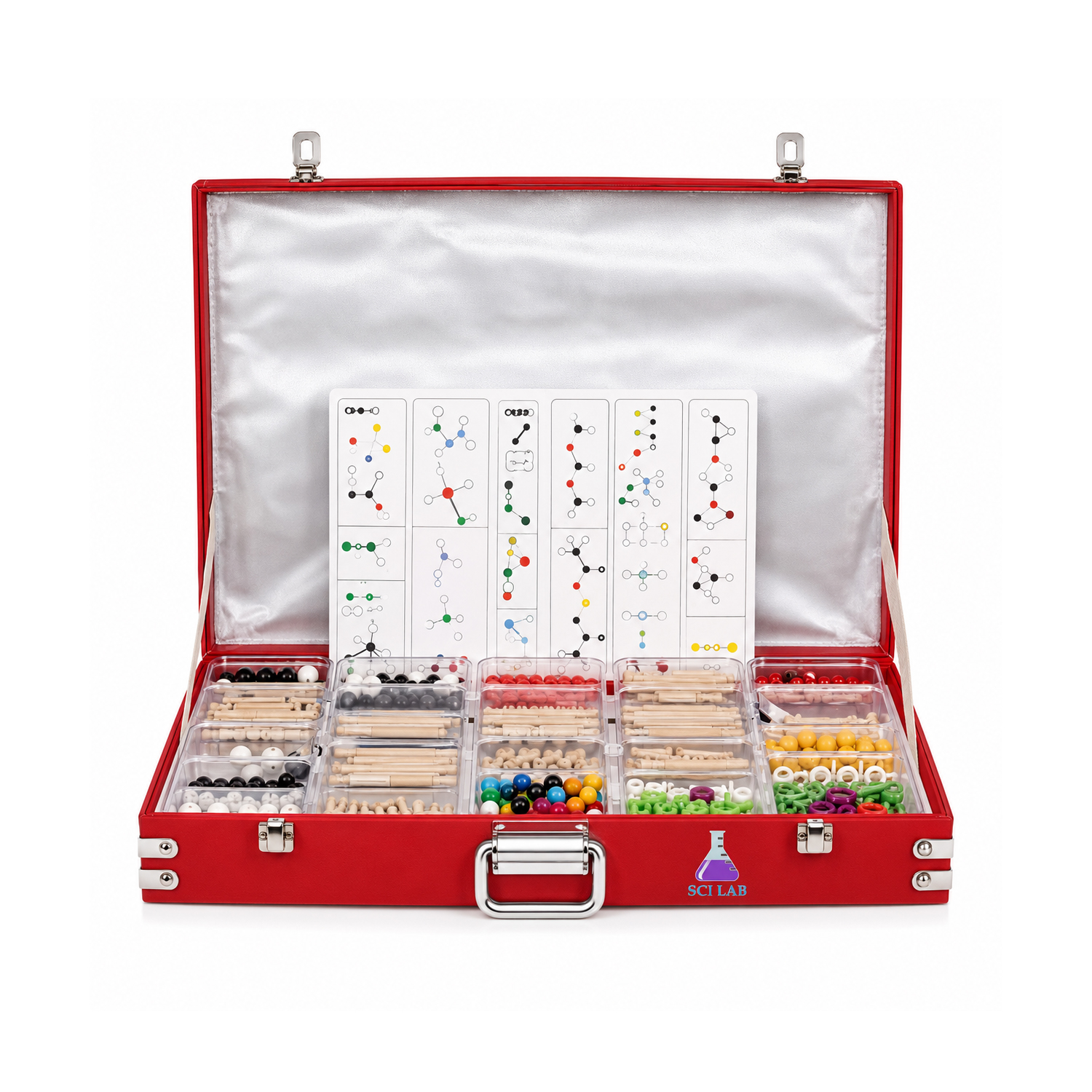
Product Code : SCL-CL-11540
The Orbital Model of Sp3 Hybridization is a plastic model with metal elements for showing sp3 hybridization. One s and three p orbitals combine into four sp3 orbitals that point to the corners of a tetrahedron. Its atomic elements let teachers and students build molecules in three dimensions rather than on a flat board.
Specifications of the Sp3 Orbital Model
| Specification | Value |
|---|---|
| Material | Plastic with metal elements |
| Topic | sp3 hybridization |
| Contents | A number of atomic elements for building different molecules |
| Subjects | Organic, inorganic and stereochemistry |
| Supplied by | Science Lab Supplies, Ambala, India |
Tetrahedral Bonding Practicals with the Sp3 Model
Build four sp3 orbitals around one centre and show that each pair sits about 109.5 degrees apart. Then replace bonds with lone pairs to move from methane to ammonia and water.
- Methane and ethane: show single sigma bonds and free rotation, then compare with the Diamond Molecular Model, where every carbon is bonded the same way.
- Ammonia and water: show how lone pairs close the angle to about 107 and 104.5 degrees.
- Chirality: place four different groups on one carbon and build its mirror image with the Molecular Models Demonstration Kit.
Frequently Asked Questions
Why does methane not have 90 degree bond angles?
Pure 2p orbitals lie at 90 degrees, but methane has four identical C–H bonds 109.5 degrees apart. Mixing one s and three p orbitals into four equal sp3 orbitals explains this tetrahedral shape.
Why are ammonia and water not 109.5 degrees?
Their central atoms are close to sp3, but lone pairs take up more room than bonding pairs and push the bonds together. Ammonia is near 107 degrees and water near 104.5 degrees.
What is the difference between electron-pair shape and molecular shape?
The electron-pair shape counts lone pairs, while the molecular shape describes only the atoms. Ammonia has four pairs arranged tetrahedrally but a trigonal pyramidal shape, and water is bent.
How much s character does an sp3 orbital have?
One quarter, or 25 percent, since it is made from one s and three p orbitals. With less s character than sp2 or sp orbitals, its C–H bonds are slightly longer than those in alkenes or alkynes.
Related Hybridization and Structure Models
- Orbital Model of Sp2 Hybridization: plastic model with metal elements for sp2 bonding.
- Atomic Orbital Model Pz: pz orbital model with plastic parts, links and storage box.
- Diamond Crystal Model: 84 connectors and 57 jacks with instruction manual.
- Molecular Model Kits for Teachers: teacher version with about 108 atoms.
Other structure models sit in the Chemistry Lab category of School Lab Equipments.
Under its Importer-Exporter Code, Science Lab Supplies can deliver to buyers in Zambia, Rwanda, South Africa, Qatar, Sri Lanka and Vietnam. A quotation can be requested through the contact page or the enquiry cart.
Last updated: 14 November 2026
.jpg)




.jpg)
