
Burettes with Schellbach stripe
Product Code : LSK-GB-10416
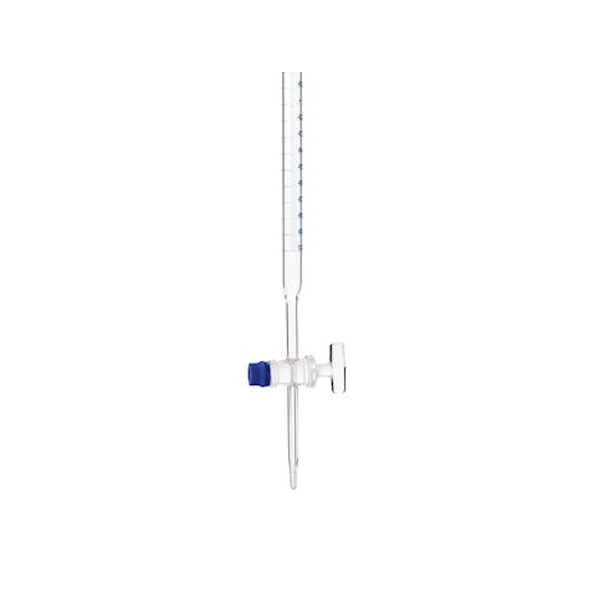
The Burettes with Schellbach stripe are 50 ml Class B titration burettes in borosilicate glass 3.3, with a tolerance of ±0.10 ml, 0.1 ml divisions printed in blue, a Schellbach stripe at the back of the scale and a matched PTFE stopcock. Seen through a clear liquid, the stripe appears pinched into two points at the meniscus, which gives a sharp, repeatable reading for acid-base and other titrations with colourless solutions.
Specifications of the Schellbach Stripe Burettes
| Specification | Value |
|---|---|
| Capacity | 50 ml, 0.1 ml divisions |
| Glass | Borosilicate glass 3.3 |
| Scale | Schellbach rear stripe for accurate meniscus reading |
| Graduations | Blue scale |
| Stopcock | Matched PTFE stopcock |
| Calibration | To deliver (TD, Ex) at 20 °C |
| Accuracy class | Class B, tolerance ±0.10 ml |
| Manufacturer | Science Lab Supplies, Saha, Ambala, India |
Reading Titrations on the Schellbach Stripe
Hold the burette upright in Burette Clamps with Fasteners on a Laboratory Retort Stand, with the scale towards the reader and the stripe at the back. After each run, bring the eye level with the liquid and read the scale where the two points of the stripe meet.
- Neutralisation (Class 10 to 12): titrate sodium hydroxide with hydrochloric acid using Phenolphthalein Solution Indicator, where clear liquids make the stripe easy to see.
- Reading practice: set the burette at several levels and let each pupil record the reading, then compare results to show how eye position changes them.
- Unknown acid: titrate a sample of unknown concentration three times and use the concordant titres to work out its molarity.
Rinse the burette after use, and keep the stripe side free of scratches from brushes and racks.
Frequently Asked Questions
What does a Schellbach stripe add to a burette?
It is a narrow coloured line on a white band behind the scale. The curved surface of the liquid works like a lens and pinches the line into two points, so every reader finds the same reading point. This makes readings in a large class more consistent.
Which details should be stated when ordering Schellbach burettes?
Check the capacity and graduation interval, the stopcock type and the accuracy class. These Class B burettes hold 50 ml in 0.1 ml divisions with a tolerance of ±0.10 ml, are calibrated to deliver at 20 °C and have a matched PTFE stopcock. The Schellbach stripe makes the reading easier but does not set the accuracy class.
Where on the Schellbach stripe is the reading taken?
Bring the eye level with the liquid surface. The stripe then shows two arrow points touching at the meniscus, and the reading is taken where they meet, against the nearest scale mark. If the points look uneven, the eye is too high or too low.
Is a dark reading card needed with a Schellbach burette?
Usually not. On a plain burette, a dark card held just below the meniscus makes its curve stand out. The Schellbach stripe does that job for clear liquids, so a card is only needed for solutions in which the stripe cannot be seen.
Related Burettes and Supports
- Automatic Burette in Schellbach Stripe: self-zeroing borosilicate burette with an intermediate PTFE stopcock.
- Burette Class B With Glass Stopcock: Class B borosilicate burette with a glass tap and amber printing.
- Burettes Class B: Class B borosilicate burettes with a PTFE needle valve.
- Burette Class-B with PTFE Key Stopcock: PTFE key with amber enamel graduations.
- Borosilicate Glass Burette 50ml: 0.1 mL subdivisions, fused enamel graduations and a ground delivery tip.
- Double Burette Clamp, Scissor Type (Pack of 2): holds two burettes side by side on one rod.
Every burette style on the site, from Schellbach to automatic, appears in Glassware Burette, and indicators for titration are under Chemistry Lab.
Schellbach burettes are exported by Science Lab Supplies, holder of an Importer-Exporter Code, to Nepal, Bangladesh, Zambia, Rwanda, South Africa and Qatar. A request for a quotation can be sent through the contact page, or the burettes can be kept in the enquiry cart while an order list is built.
Last updated: 26 November 2026


