
Burette Clamp Aluminium
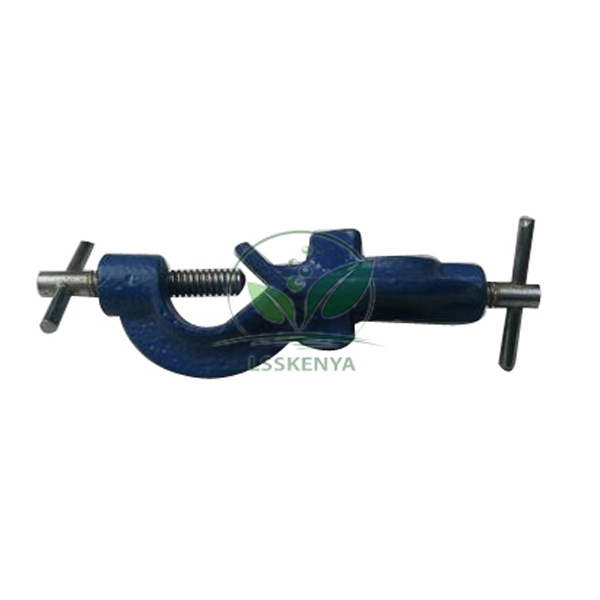
Product Code : LSK-GB-10412
The Burette Clamp Aluminium holds two burettes upright on a retort stand during titrations. Its die-cast aluminium body has a blue painted, corrosion-resistant finish, and adjustable spring-type jaws with black rubber sleeves open to a maximum of 30 mm. A thumbscrew fixes the clamp to support rods up to 16 mm in diameter.
Specifications of the Aluminium Burette Clamp
| Specification | Value |
|---|---|
| Configuration | Double: holds two burettes |
| Jaw opening | Up to 30 mm (maximum clearance) |
| Jaws | Adjustable, spring type |
| Grip | Black rubber sleeves on the jaws |
| Rod fitting | Thumbscrew, for support rods up to 16 mm diameter |
| Body | Die-cast aluminium, blue painted corrosion-resistant finish |
| Manufacturer | Science Lab Supplies, Saha, Ambala, India |
Setting Up Titrations and Gas Collection with the Clamp
Slide the clamp onto the rod of a Laboratory Retort Stand with the jaws over the base, and tighten the thumbscrew. Open one spring jaw, set a burette in it below the top end, and let the rubber sleeves close on the barrel. The second jaw takes another burette.
- Titration (Class 10 to 12): hold a Burette for Acids, 50 ml, Glass Stopcock above a Borosilicate Conical Flask on a white tile and titrate to the end point.
- Gas volume: clamp a water-filled burette upside down in a trough and collect the hydrogen given off by magnesium ribbon in dilute acid, reading the volume every 30 seconds.
- Two burettes: hold an acid burette and an alkali burette side by side for a back titration, each labelled so they are not mixed up.
Check the thumbscrew before each lesson, and keep the stand on a level bench so a full burette cannot pull it over.
Frequently Asked Questions
Which measurements should be compared when choosing a burette clamp?
Compare the widest burette the jaws accept, the thickest rod the fixing screw fits and the jaw lining, and decide between a single or double clamp. On this double clamp each rubber-sleeved spring jaw opens to 30 mm, and the screw fits rods up to 16 mm. The opening is clearance only: a firm grip also depends on the shape of the burette.
Why is the clamp body die-cast in aluminium?
Die-cast aluminium is light but rigid, so the jaws keep their shape and the clamp adds little weight high up on the stand rod. The blue painted, corrosion-resistant finish protects the metal from bench splashes and is easy to wipe clean after a practical.
How high should the burette be clamped above the flask?
Set it so the tip sits just inside the neck of the flask, or a little above it, with room to swirl the flask underneath. Then no drops miss the flask, and the scale stays at a comfortable reading height.
How is a burette fitted into a spring clamp without breaking it?
Hold the burette by the barrel, not the tip, and open the jaws fully before sliding it in from the side. Let the sleeves close gently on the glass rather than pushing the burette against them, and never grip it at the stopcock.
Related Clamps and Burette Stands
- Burette Clamp: one-piece acetal clamp for one 50 ml burette on 12 mm rods.
- Burette Clamps with Fasteners: die-pressed mild steel with self-closing rubber-covered jaws.
- Double Burette Clamp, Scissor Type (Pack of 2): two independent jaws on one zinc-aluminium alloy body.
- Burette Clamp Chemistry Lab: single scissor-action clamp, sold in a pack of 4.
- Boss Head Clamp: right-angle boss heads for rods of 8 to 16 mm.
- Burette Stand with Double Burette Clamp: cast iron base with a 600 mm stainless steel rod.
Clamps, racks and burettes for titration benches are collected in Glassware Burette, and stands and bosses also appear under Chemistry Lab.
Burette clamps reach the UAE, Saudi Arabia, Oman, the Philippines, Nepal and Bangladesh through the export trade of Science Lab Supplies, registered under an Importer-Exporter Code. The clamp count for each lab can be sent on the contact page, or the clamp can wait in the enquiry cart until a quotation is requested.
Last updated: 26 November 2026


