
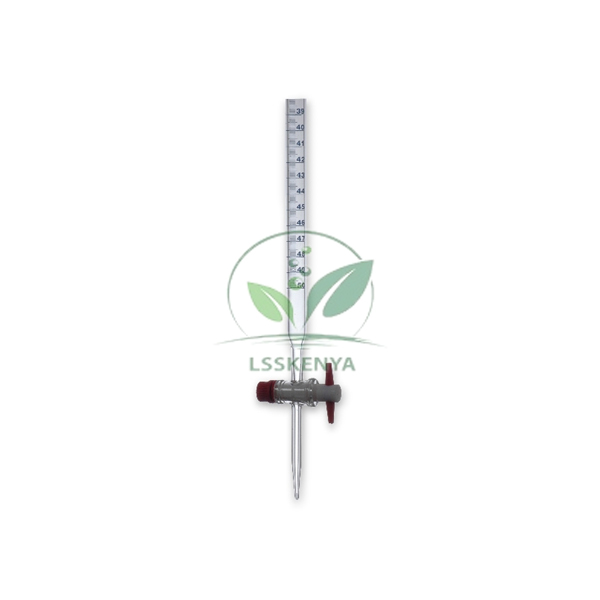
Burette Class-B with PTFE Key Stopcock
Product Code : LSK-GB-10413
The Burette Class-B with PTFE Key Stopcock is a 50 ml Class B titration burette in borosilicate glass 3.3, graduated in 0.1 ml, for schools and institutional laboratories. Its scale is printed in amber enamel, and a PTFE key stopcock controls the flow from a steady stream down to single drops. It suits routine titration where the tighter tolerance of Class A/AS glassware is not required.
Specifications of the Class B PTFE Key Burette
| Specification | Value |
|---|---|
| Capacity | 50 ml nominal, 0.1 ml graduations |
| Accuracy class | Class B: maximum permissible error ±0.10 ml at 20 °C, to deliver (TD, Ex) |
| Glass | Borosilicate glass 3.3 |
| Stopcock | PTFE key |
| Graduations | Printed in amber enamel |
| Intended use | Routine titration in schools and institutional laboratories |
| Pack | One complete burette; stand and clamp are ordered separately |
| Manufacturer | Science Lab Supplies, Saha, Ambala, India |
Class Titrations with the Class B Burette
Clamp the burette upright in a Burette Clamp Aluminium on a Laboratory Retort Stand, both ordered separately. Rinse it with a little of the titrant, fill it above zero, and turn the PTFE key to run the level down to the first reading.
- Acid-alkali titration (Class 10): titrate 25 mL of sodium hydroxide in a Borosilicate Conical Flask with dilute hydrochloric acid and phenolphthalein, then repeat until titres agree.
- Making a pure salt: note the titre, repeat with no indicator, then evaporate part of the water and leave sodium chloride to crystallise.
- Calculation practice: use the mean titre and the known concentration to work out the unknown concentration in mol/dm3.
Wear eye protection, and wash the burette with water after each lesson so no salt dries in the tip.
Frequently Asked Questions
Is a Class B burette accurate enough for school titrations?
Yes, for routine teaching. Class B glassware is allowed about twice the error of Class A, and this 50 ml burette has a maximum permissible error of ±0.10 ml at 20 °C. That is close to the reading error of a student, which is why schools buy Class B and keep Class A for analytical work.
Why are the graduations printed in amber enamel?
Amber marks stand out clearly against clear and most coloured solutions and against a white background, so the scale is easy to read under bright bench lighting. Enamel is fired onto the surface, so the marks resist ordinary washing.
Why does the burette scale start at zero at the top?
A burette measures the liquid run out, not the liquid left. Readings grow larger as the level falls, so the titre is the final reading minus the first. Pupils who read the scale upwards, as on a measuring cylinder, record wrong volumes.
Related Burettes for School Titrations
- Burettes Class B: borosilicate glass with a PTFE needle valve stopcock and amber printing.
- Burette Class B With Glass Stopcock: borosilicate glass with a glass stopcock and amber printing.
- Burettes with Schellbach stripe: Schellbach stripe for reading the meniscus, printed in blue.
- Borosilicate Glass Burette 50ml: 0.1 mL subdivisions, calibrated to deliver at 20 °C, with a straight-bore PTFE plug.
- Burette for Bases, 50 ml: 0.1 ml divisions and a PTFE or latex tap with a valve.
- Burette Storage Rack: wood and metal wall rack for up to 12 burettes.
All burette types and their clamps are listed in Glassware Burette, with indicators and reagents for titration in Chemistry Lab.
Class B burettes are part of the school glassware Science Lab Supplies exports to Saudi Arabia, Oman, the Philippines, Nepal, Bangladesh and Zambia, as an Importer-Exporter Code holder. Schools can send their burette count on the contact page, or collect the burettes in the enquiry cart, to receive a quotation.
Last updated: 20 November 2026


