
Burette Class B With Glass Stopcock
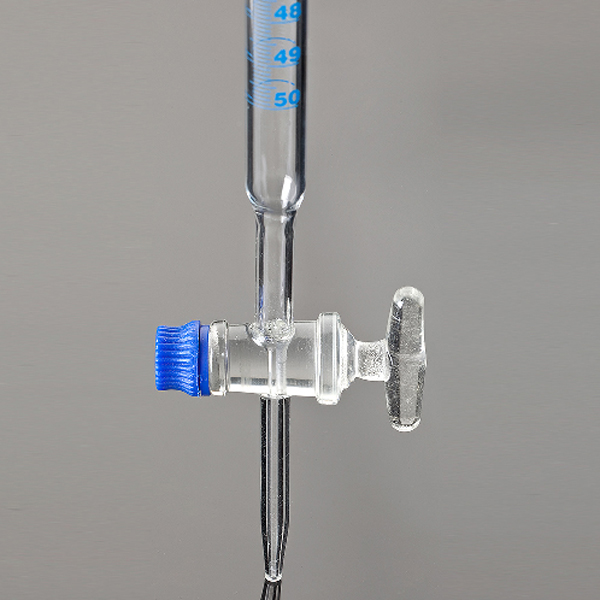
Product Code : LSK-GB-10415
The Burette Class B With Glass Stopcock is a 50 ml burette in borosilicate glass 3.3 with 0.1 ml divisions, amber markings and a matched solid-glass stopcock. The all-glass tap suits acids, oxidising titrants such as potassium permanganate and routine class titrations. It is a Class B burette, ±0.10 ml at 20 °C, for school and college laboratories.
Specifications of the Glass Stopcock Burette
| Specification | Value |
|---|---|
| Capacity | 50 ml, 0.1 ml divisions |
| Accuracy class | Class B: maximum permissible error ±0.10 ml at 20 °C, to deliver (TD, Ex) |
| Stopcock | Matched solid-glass key in a ground-glass barrel |
| Glass | Borosilicate glass 3.3 |
| Graduations | Amber markings |
| Manufacturer | Science Lab Supplies, Saha, Ambala, India |
Acid and Redox Titrations with the Glass-Tap Burette
Mount the burette in a Burette Stand with Double Burette Clamp. Turn the tap with the fingers of one hand wrapped round the barrel, pressing the key gently into its seat so it cannot work loose, and swirl the flask with the other hand.
- Standardising acid (Class 11): titrate sodium carbonate solution in a Borosilicate Conical Flask with dilute hydrochloric acid and methyl orange.
- Permanganate titration (Class 12): run potassium permanganate into acidified oxalic acid kept warm in the flask, and stop at the first lasting pink.
- Delivery check: run water from the zero mark to the 25 mL mark into a weighed beaker, weigh it again and convert the mass of water to volume.
Grease the key very lightly, keep grease away from the bore, and rinse the burette with water from a Wash Bottle, LDPE, 500 ml, Pack of 6 after each class.
Frequently Asked Questions
When is a glass stopcock chosen instead of a PTFE one?
A glass tap stands up well to acids and oxidising titrants and can be cleaned with strong reagents. PTFE keys resist the widest range of chemicals, need no grease and seldom stick, so they suit alkalis. Many schools keep glass-tap burettes for acid and permanganate work.
How is the key of a glass stopcock held in place?
The tapered solid-glass key is ground to match its own barrel and is held by a clip or threaded retainer. Set it so the key turns smoothly without leaking. Keep each key with its own burette when sets are unpacked, washed or stored, and never fit a PTFE key into the glass barrel in its place.
How is white alkali scale removed from a burette?
Alkali left in a burette can dry to a white film on the inner wall and around the tap. Flush the burette with dilute hydrochloric acid, then rinse well with tap water and distilled water. In future, drain alkali out soon after each titration.
How can students check the true volume a burette gives out?
Run water between two marks into a weighed beaker and weigh the beaker again. One gram of water is very nearly 1 mL at room temperature, so the mass shows the true volume delivered and any error from liquid held in the tap or tip.
Related Glass-Tap and PTFE Burettes
- Burette for Acids, 50 ml, Glass Stopcock: 50 ml glass-tap burette with 0.1 ml divisions.
- Burette for Acids, 25 ml: 25 ml burette with a glass stopcock.
- Burette Class-B with PTFE Key Stopcock: PTFE key and amber enamel graduations.
- Burettes Class B: borosilicate burettes with a PTFE needle valve stopcock.
- Burettes with Schellbach stripe: borosilicate glass with a Schellbach stripe and blue printing.
- Burette Storage Rack: holds up to 12 burettes of up to 20 mm diameter.
Glass-tap, PTFE-tap and automatic burettes are all in Glassware Burette; conical flasks, pipettes and bottles are in Lab Glassware.
Buyers in the Philippines, Nepal, Bangladesh, Zambia, Rwanda and South Africa can import these burettes from Science Lab Supplies, an exporter with an Importer-Exporter Code. Message the team on the contact page or keep a list in the enquiry cart to have a quotation prepared.
Last updated: 20 November 2026


