Human Blood Circulation Chart
Product Code : SCL-BLE-11764
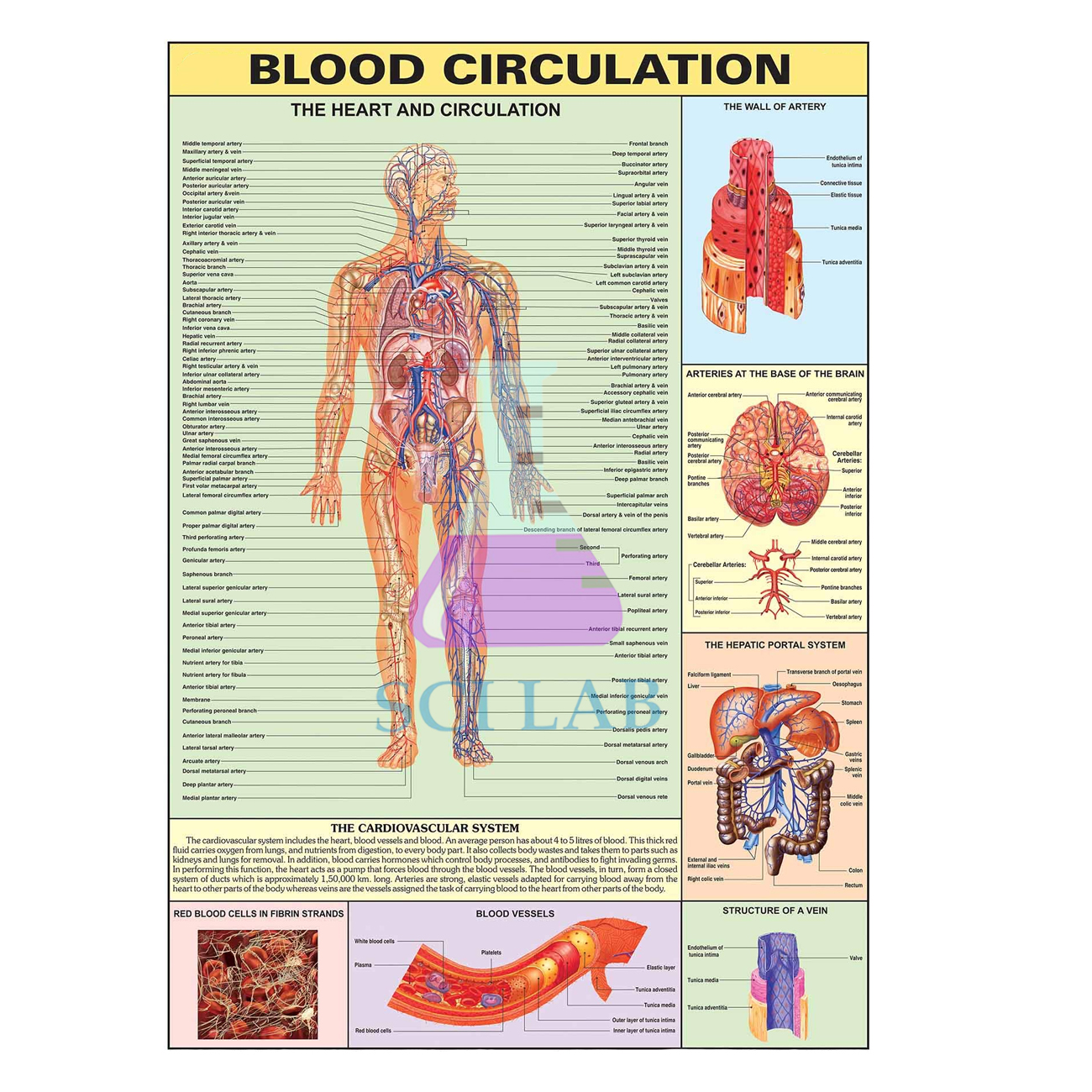
The Human Blood Circulation Chart is a laminated 70 x 100 cm wall chart on the route blood takes around the body. It supports lessons on the heart as a double pump, the lung and body circuits, and the arteries, veins and capillaries that link them.
Specifications of the Blood Circulation Chart
| Specification | Value |
|---|---|
| Subject | Human blood circulation system |
| Finish | Laminated |
| Size | 70 x 100 cm |
| Mounting | Wall mounted |
| Use | Laboratory and classroom |
| Supplied by | Science Lab Supplies, Ambala, India |
Circulation Lessons and Pulse Practicals
Students trace one drop of blood from the right atrium through the lungs, back to the heart and out to the body. The chart keeps both circuits in view.
- Two circuits (Class 10 to 12): compare the chart with the Human Circulatory System Model, which shows the arterial and venous system with the heart, lungs, liver and kidneys.
- Pulse and exercise: measure resting pulse, then pulse after one minute of stepping, with a Digital Blood Pressure Meter or by counting at the wrist.
- Vessel walls: relate the thick, elastic artery wall to the high pressure produced by the left ventricle.
Common errors: saying all arteries carry oxygen-rich blood, and leaving the lungs out of the route.
Frequently Asked Questions
What should a buyer check about vessel names before a bulk order?
School syllabi use a core set of names: aorta, venae cavae, pulmonary artery and vein, hepatic portal vein and renal vessels. Older charts may use outdated terms, so compare the labels with the exam board's list first.
Can one chart serve group work as well as whole-class teaching?
Yes. Hung at the front, it guides whole-class teaching. Taken down and laid on a table, the laminated sheet lets a small group trace the circuits with a finger or a pointer without harming the print.
Which side of the heart pumps oxygen-poor blood?
The right side. It receives oxygen-poor blood from the body through the venae cavae and pumps it to the lungs. The left side receives oxygen-rich blood from the lungs and pumps it to the body.
Why is blood pressure lower in the lung circuit than in the body circuit?
The lungs are close to the heart and their capillaries are delicate, so the right ventricle pumps at low pressure. The left ventricle must push blood round the whole body, so it pumps at much higher pressure.
Which vessel carries blood from the gut to the liver?
The hepatic portal vein. It takes blood rich in absorbed food from the stomach and intestines to the liver. The liver processes it before the blood returns towards the heart through the hepatic vein.
Related Heart and Vessel Teaching Aids
- External View of the Heart Chart: laminated, wall-mounted chart, 70 x 100 cm.
- Heart Model, Giant: extra-large heart that separates into 4 parts, numbered with an English key card.
- Artery and Vein, Cross Section: coloured borosilicate glass slide, 25.4 x 76.2 mm, in a plastic box.
- Human Heart Model 4 Parts: dissectible into 4 parts and numbered with a key card.
- Human Blood Components Chart: laminated chart in the same 70 x 100 cm size.
- Human Cardiac Beat And Blood Circulation Model: flexible heart wall shows the beat, with an enlarged sectioned heart and a circulation diagram.
Body-system charts like this one are collected in Charts & Portraits; three-dimensional circulation models are in Human System Model.
Sri Lanka, Vietnam, Malaysia, Peru, Egypt and Iraq can all be reached by export from Science Lab Supplies, which is registered under an Importer-Exporter Code. For a quotation on the circulation chart, use either the contact page or the enquiry cart.
Last updated: 15 November 2026
.jpg)