Plant Cell Structure Chart
Product Code : SCL-BLE-11767
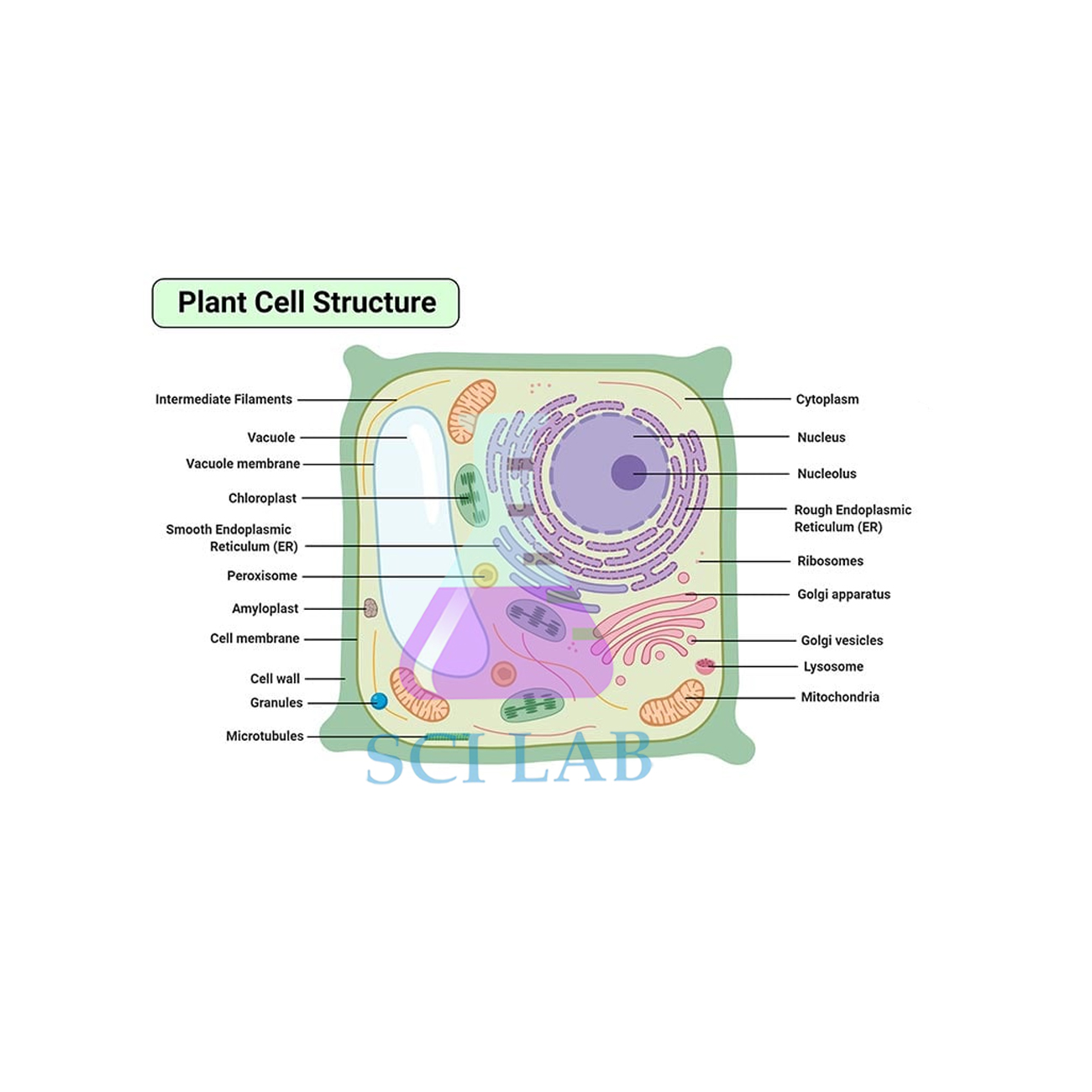
The Plant Cell Structure Chart is a laminated wall chart, 70 x 100 cm, showing a typical plant cell with English labels for the cell wall, cell membrane, nucleus, chloroplasts, central vacuole, cytoplasm and mitochondria. It has rods and a top hanging cord, so it can hang in a laboratory or classroom as the reference during microscope practicals. As a flat laminated chart, it is distinct from the three-dimensional plant cell model listed below.
Specifications of the Plant Cell Chart
| Specification | Value |
|---|---|
| Subject | Structure of the plant cell |
| Parts labelled | Cell wall, cell membrane, nucleus, chloroplasts, central vacuole, cytoplasm, mitochondria |
| Labels | English |
| Surface | Laminated |
| Chart size | 70 x 100 cm |
| Fixing | Wall mounted, with rods and a top hanging cord |
| Setting | Laboratory and classroom |
| Supplied by | Science Lab Supplies, Ambala, India |
Onion Peel Practical with the Plant Cell Chart
Students compare the cells under the microscope with the chart. A school light microscope shows the wall, nucleus and vacuole clearly; the mitochondria drawn on the chart need far higher magnification, and onion skin cells have no chloroplasts.
- Onion peel mount (Class 9): lift one thin layer of onion skin, lay it in a drop of water on one of the Glass Microscope Slides, stain it and lower a cover glass with a Preparatory Needle.
- Observation and drawing: focus at low power on a Biological Microscope, move to high power and draw a few cells with their walls, nuclei and vacuoles labelled.
- Plant and animal comparison: set the onion cells beside a cheek-cell mount and list the parts found only in the plant cell.
Common errors: flooding the peel with stain, which hides the nucleus, and drawing cells from memory of the chart instead of from the slide.
Frequently Asked Questions
Should the plant cell chart be ordered with a matching animal cell chart?
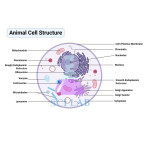
Usually, yes. Cell lessons nearly always compare the two cell types, so many schools hang them side by side. The Animal Cell Structure Chart in this series has the same laminated 70 x 100 cm format, so the pair matches on the wall.
Is a drawn diagram or a microscope photograph more useful on a plant cell chart?
A drawn diagram shows every organelle clearly, including those only an electron microscope can resolve. A photograph shows what students will really see in an onion peel. This chart is drawn artwork of a typical plant cell with seven labelled parts; pair it with onion peel slides for the real view.
Why is the onion peel stained before viewing?
Onion skin cells are almost colourless, so their outlines are hard to see. Safranin colours the walls and nuclei red, and iodine solution turns the nucleus yellow-brown. One or two drops are enough; extra stain is drawn off with blotting paper.
How are air bubbles kept out from under the cover glass?
Touch one edge of the cover glass to the drop at about 45 degrees, then lower it slowly on a needle. The water front pushes the air out. Trapped bubbles show as dark-ringed circles that students often draw as cells.
Why must the peel be a single, flat layer?
Light has to pass through the specimen. A folded or double layer looks dark and blurred, and the walls of cells in two layers cross each other, so single cells cannot be traced or drawn.
Related Cell Biology Models and Charts
- Animal Cell Structure Chart: laminated wall chart, 70 x 100 cm, for laboratory and classroom use.
- Plant Cell Model, 180 x 300 x 60 mm: 180 x 300 x 60 mm PVC model with part of the wall removed to show the vacuoles, plastids and nucleus.
- Leaf Transverse Section Model, 300 x 400 mm: three-dimensional PVC model with palisade and spongy mesophyll, stomata and guard cells.
- Cell Reproduction (Mitosis) Chart: laminated, wall-mounted chart in the same 70 x 100 cm size.
The plant cell chart is one of the cell-biology charts in Charts & Portraits, while blank slides for the onion peel work are kept in Microscope Slides and Cameras.
The plant cell chart can travel in an export consignment to Peru, Egypt, Iraq, Nigeria, Kenya or Ghana, as the Importer-Exporter Code of Science Lab Supplies covers such shipments. Distributors who want a quotation for a set of cell charts can send their list through the contact page or build it in the enquiry cart.
Last updated: 19 November 2026
.jpg)
.jpg)