
Human Muscles Chart
Product Code : SCL-BLE-11753
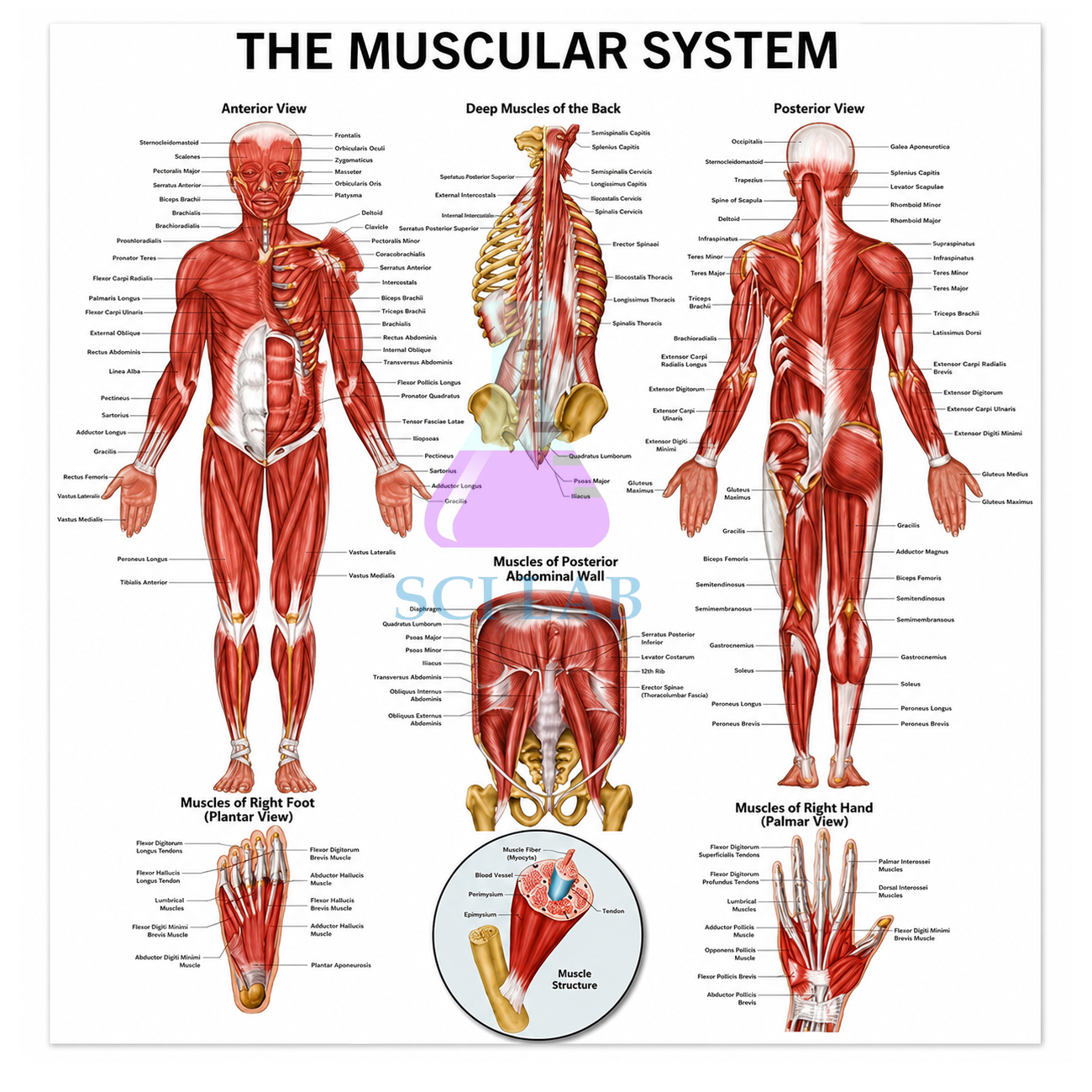
The Human Muscles Chart is a laminated 70 x 100 cm wall chart of the muscular system in anterior and posterior views, with the major superficial muscles keyed in English. It hangs from top and bottom rods on a top cord and supports lessons on how skeletal muscles pull on bones through tendons and work in pairs to move joints.
Specifications of the Human Muscles Chart
| Specification | Value |
|---|---|
| Subject | Human muscular system |
| Views | Anterior (front) and posterior (back) |
| Muscles shown | Major superficial muscles, keyed |
| Labels | English key |
| Finish | Laminated |
| Size | 70 x 100 cm (700 x 1000 mm) |
| Mounting | Wall mounted: top and bottom rods with a top hanging cord |
| Use | Laboratory and classroom |
| Manufacturer | Science Lab Supplies, Saha, Ambala, India |
Muscle and Movement Lessons
Students name the keyed muscles on the front and back views, then find the bones each one moves. The chart is the shared reference while hands-on tasks run at the benches.
- Antagonistic pairs (Class 6 to 11): bend and straighten the elbow of a Human Skeleton Model, Economy while classmates name the biceps as it contracts and the triceps as it relaxes, then swap roles.
- Muscle tissue: compare the chart's overview with real striated fibres seen under the microscope in Skeletal Muscle, Longitudinal and Transverse Sections.
- PE and sports science: students feel their own quadriceps and hamstrings during a slow squat and record which muscle shortens at each stage.
Common errors: saying a muscle pushes a bone back, and mixing up tendons (muscle to bone) with ligaments (bone to bone).
Frequently Asked Questions
Is the chart suited to PE and sports-science classes as well as biology?
Yes. Naming the major muscles, antagonistic pairs and tendon attachments is core content in PE and sports-science courses. The 70 x 100 cm wall format lets a coach point to each group while the class performs the movement.
What is the difference between a surface muscle chart and a deep muscle chart?
A surface chart shows the outer layer, the muscles that can be felt under the skin, such as the deltoid, biceps and quadriceps. A deep chart removes that layer to show the muscles beneath, such as those along the spine. This is a surface chart: it keys the major superficial muscles in front and back views.
Can a muscle push a bone back into place?
No. Muscles can only pull by contracting. To straighten the arm the triceps contracts while the biceps relaxes, so every joint movement needs a pair of muscles working against each other.
What does a fixator muscle do?
A fixator holds a nearby bone steady so the working muscle, the agonist, has a firm base to pull from. In a biceps curl, muscles around the shoulder act as fixators while the biceps and triceps form the antagonistic pair.
Why does skeletal muscle tire faster than heart muscle?
Skeletal muscle contracts quickly and with force under voluntary control, and fatigues quickly when worked hard. Cardiac muscle contracts in a steady rhythm, has many mitochondria and a constant blood supply, and resists fatigue.
Related Muscle and Skeleton Models
- Human Torso with Muscles and Open Back, 27 Parts: 27 parts, including half of the brain, one eye with its muscles and optic nerve, and two lungs.
- Human Skeleton with Internal Organs & Muscles: all limbs, the rib cage, a two-part heart, liver, lungs, stomach and intestines are removable.
- Human Skeleton Chart: laminated wall chart, 70 x 100 cm, for laboratory and classroom use.
- Bone Structure Chart: wall-mounted laminated chart in the same 70 x 100 cm size.
- Human Skeleton Model 45 cm: 450 mm PVC skeleton on a metal base, with a moving lower jaw and hinged feet.
Skeleton models are grouped under Skeleton, Bones and Joints Model, while this muscle chart belongs to the Charts & Portraits range.
Buyers in Uganda, the UAE, Saudi Arabia, Oman, the Philippines and Nepal can receive this muscle chart by export under the Importer-Exporter Code held by Science Lab Supplies. Biology and PE departments can ask for a quotation on the muscle chart through the contact page or by filling the enquiry cart.
Last updated: 19 November 2026



.jpg)

.jpg)
.jpg)