
Mendelian Inheritance Chart (Mendel's Third Law), 70 x 100 cm
Product Code : SCL-BLE-11772
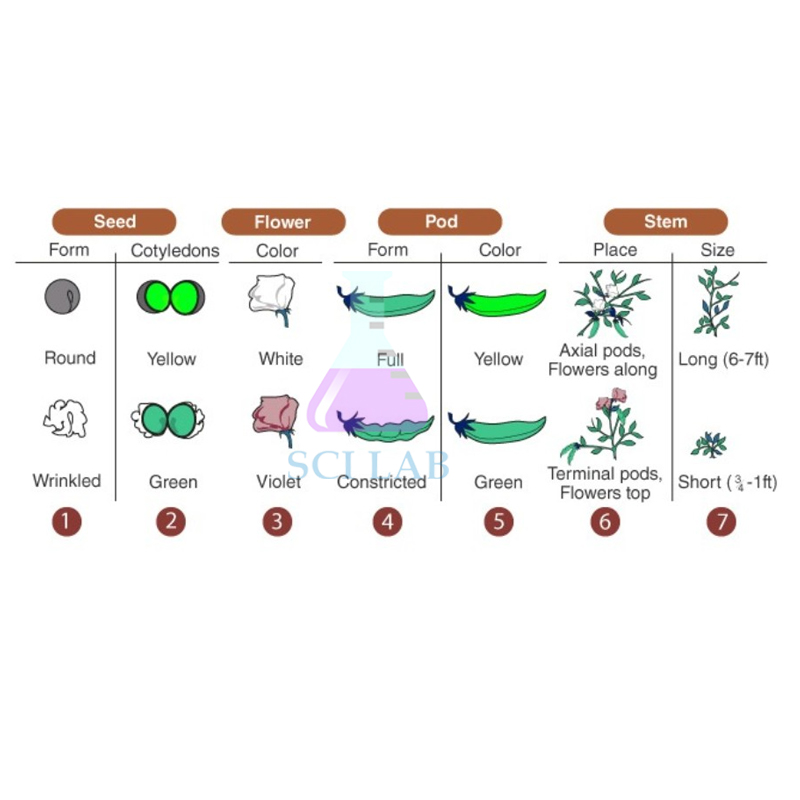
The Mendelian Inheritance Chart (Mendel's Third Law) is a printed wall chart, 70 x 100 cm, on Mendel's work with the pea plant and the 7 main contrasting traits he compared. In the common three-law numbering of dominance, segregation and independent assortment, the third law is the law of independent assortment: in a two-trait cross, the alleles of one gene pass to gametes independently of those of the other.
Specifications of the Third Law Chart
| Specification | Value |
|---|---|
| Topic | Mendelian inheritance: Mendel's third law |
| Principle | Law of independent assortment (called the second law where two laws are counted) |
| Organism studied | Pea plant |
| Traits | 7 main contrasting traits |
| Experiments | Both experiments Mendel used to establish the inheritance laws |
| Format | Printed wall chart |
| Size | 70 x 100 cm (700 x 1000 mm) |
| Supplied by | Science Lab Supplies, Ambala, India |
Two-Trait Crosses and Independent Assortment in Class
Teachers display the chart while moving from one-trait crosses to two traits at once, usually seed shape and seed colour. Students build the cross step by step and then tie each step to the way chromosomes behave in meiosis.
- Dihybrid cross (Class 12): cross round yellow (RRYY) with wrinkled green (rryy) peas, obtain round yellow RrYy plants in F1, then fill a 4 x 4 Punnett square for F2.
- Meiosis link: show on the Meiosis Model 3D Cell that each chromosome pair lines up at metaphase I independently of the other pairs, which is why the genes assort independently.
- Slide work: find metaphase I and anaphase I on the Laboratory Meiosis Slide Set (12 Pieces) and sketch how the chromosome pairs are arranged.
Common errors: writing gametes such as RR or Yy, which hold two alleles of one gene, and forgetting that every gamete gets one allele of each gene.
Frequently Asked Questions
Which cross and syllabus topic does the third law chart cover?
The law of independent assortment, taught with Mendel's two-trait (dihybrid) pea crosses in Class 12 and college genetics. Syllabuses listing dominance, segregation and independent assortment call it the third law; books that count two laws call it the second.
How should the printed chart be hung and stored?
Fix it flat on a wall or display board at about eye height, away from direct sun and damp, which fade the print and can warp the sheet. When it comes down, roll it loosely instead of folding it and keep it in a tube or a dry cupboard, so the crosses and ratios stay free of creases.
How many kinds of gametes does an RrYy plant form?
Four: RY, Ry, rY and ry, in equal numbers. Each gamete receives one allele of the seed-shape gene and one of the seed-colour gene, and the two genes are sorted independently of each other.
Where does the 9:3:3:1 ratio come from?
Each gene alone gives 3:1 in F2. Because the genes assort independently, the two ratios multiply: (3:1) x (3:1) gives 9 round yellow, 3 round green, 3 wrinkled yellow and 1 wrinkled green in every 16 plants.
Do all pairs of genes assort independently?
No. Genes on different chromosomes assort independently, but genes close together on the same chromosome tend to be inherited together. Such linkage gives far more parental combinations than the 9:3:3:1 ratio predicts.
Related Genetics and Cell Division Aids
- Mendelian Inheritance Chart (Mendel's First Law), 70 x 100 cm: laminated wall chart, 70 x 100 cm, on Mendel's pea experiments.
- Mendelian Inheritance: Law of Segregation Chart, 70 x 100 cm: printed wall chart built on the pea plant and its 7 main contrasting traits.
- Biology Genetics & Evolution Wall Charts: charts for teaching heredity, DNA structure, meiosis and Mendelian inheritance.
- Sex Cell Formation (Meiosis) Chart: laminated wall chart, 70 x 100 cm, for laboratory and classroom.
- Model of DNA (Helical): PVC model whose two chains coil round each other in a double helix.
Heredity and other wall charts are kept together in Charts & Portraits, which sits under Educational Lab Equipment.
Science Lab Supplies exports under its Importer-Exporter Code, and this genetics aid can go to Ghana, Ethiopia, Tanzania, Uganda, the UAE and Saudi Arabia. A quotation can be requested on the contact page; the enquiry cart gathers several items into one request.
Last updated: 16 November 2026
.jpg)
.jpg)
.jpg)
