
Liver as an Accessory Digestive Organ Chart
Product Code : SCL-BLE-11752
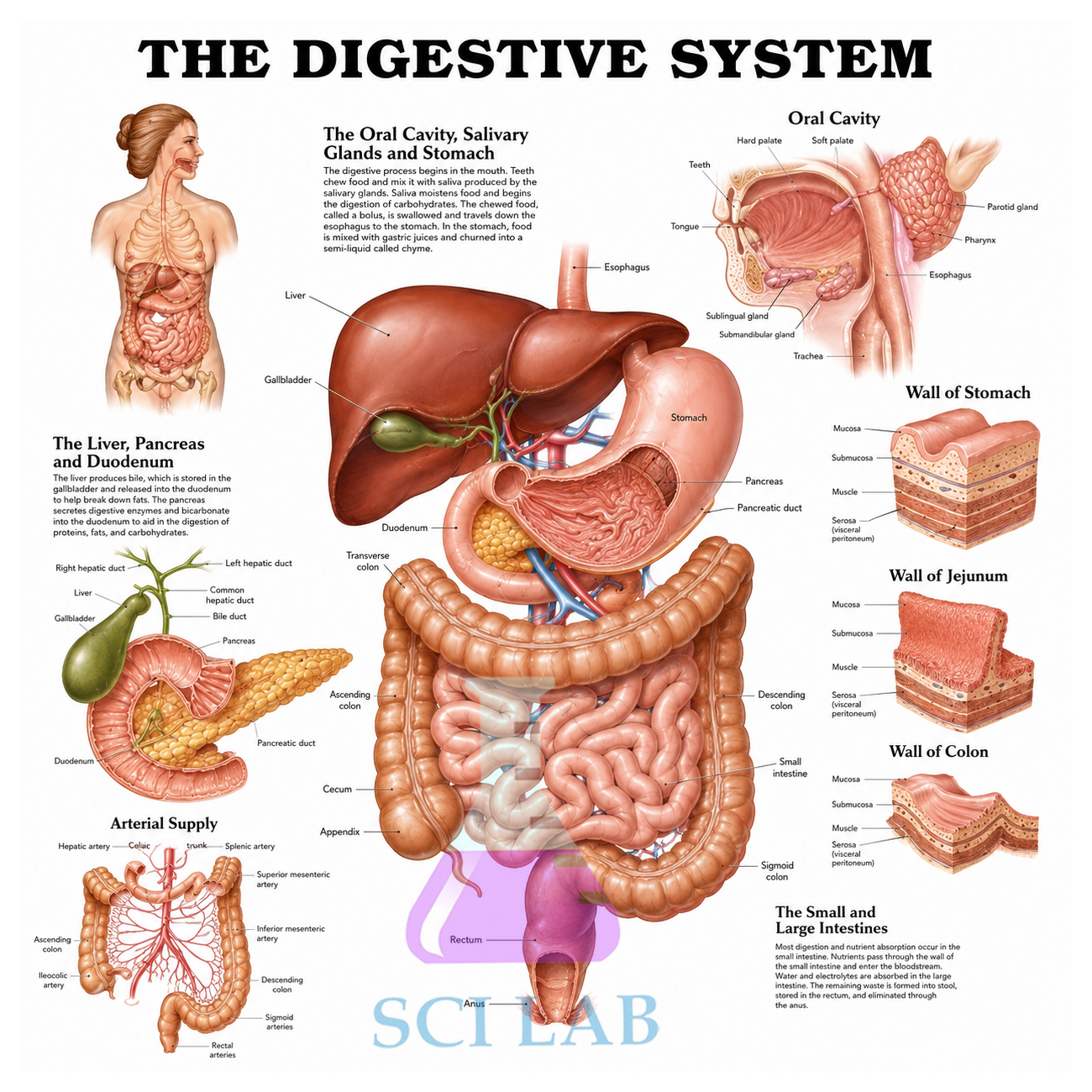
The Liver as an Accessory Digestive Organ Chart is a laminated wall chart about the liver as an accessory organ of digestion. The topic covers bile, which helps digest fats, and the liver's handling of absorbed food. The chart measures 70 x 100 cm for laboratory and classroom walls.
Specifications of the Liver Chart
| Specification | Value |
|---|---|
| Subject | The liver as an auxiliary (accessory) organ of digestion |
| Finish | Laminated |
| Size | 70 cm x 100 cm (700 x 1000 mm) |
| Mounting | Wall mounted |
| Use | Laboratory and classroom |
| Supplied by | Science Lab Supplies, Ambala, India |
Digestion Lessons with the Liver Chart
Teachers use the chart to place the liver beside the gut it serves. Food never passes through the liver, yet its bile and its control of absorbed nutrients are part of digestion.
- Bile and fat (Class 10 and IGCSE): shake a few drops of oil with water in test tubes from the Kit for Digestion Experiments, with and without a little bile salt or detergent. Compare how finely the oil breaks up.
- Organ positions: find the four lobes, the gall bladder and the bile ducts on a Human Liver With Gall Bladder Model, then mark the route bile takes to the duodenum.
- Whole-gut context: set the chart next to a Human Digestive System Model so students see where the bile duct meets the small intestine.
Common errors: drawing the gall bladder as the organ that makes bile, and placing the liver mainly on the left side of the abdomen.
Frequently Asked Questions
Which views of the liver do teaching charts usually include?
Liver charts commonly show the organ from the front and from below, with the gall bladder and bile ducts, and often a magnified lobule. For lessons on the liver as a digestive organ, the bile route to the duodenum matters most, so check that this view is drawn before a bulk order.
Is the chart meant for a classroom or a clinic display?
It is listed for laboratory and classroom use. Its subject, the liver's part in digestion, matches school and college biology rather than the disease and lobule detail found on clinical charts.
Does bile digest fat the way enzymes do?
No. Bile contains no digestive enzymes. Its bile salts break large fat globules into small droplets, which gives lipase from the pancreas a much larger surface to work on. The chemical breakdown is done by lipase.
Why is the liver called an accessory organ if food never passes through it?
Accessory organs add secretions to the gut without forming part of the tube. The liver sends bile to the duodenum and processes nutrients arriving through the hepatic portal vein, so its role goes well beyond removing poisons.
Related Liver and Digestion Models
- Liver Model with Spleen, Bile, Pancreas and Duodenum: enlarged three-dimensional model in PVC, coloured with non-toxic dyes.
- Human Liver, Spleen and Pancreas Model: also shows the abdominal aorta, the inferior vena cava and the pancreatic duct.
- Digestive System Chart: laminated, wall-mounted chart in the same 70 x 100 cm size.
- Human Stomach Model: magnified 2 times, with a longitudinal section showing the gastric folds and pyloric sphincter.
- Human Liver Model: liver with gall bladder, cystic duct, hepatic ducts, duodenum and pancreas, numbered with a key card.
See the Human System Model range for liver and other organ models, or return to the printed series in Charts & Portraits.
Export of the liver chart is possible to Tanzania, Uganda, the UAE, Saudi Arabia, Oman and the Philippines, as Science Lab Supplies holds an Importer-Exporter Code. To get the liver chart quoted, write a line on the contact page or keep it in the enquiry cart with other digestion charts.
Last updated: 15 November 2026
.png)

.jpg)
.jpg)
.jpg)

.jpg)