Glass Beakers, Assorted Capacities
Product Code : SCL-BLE-11644
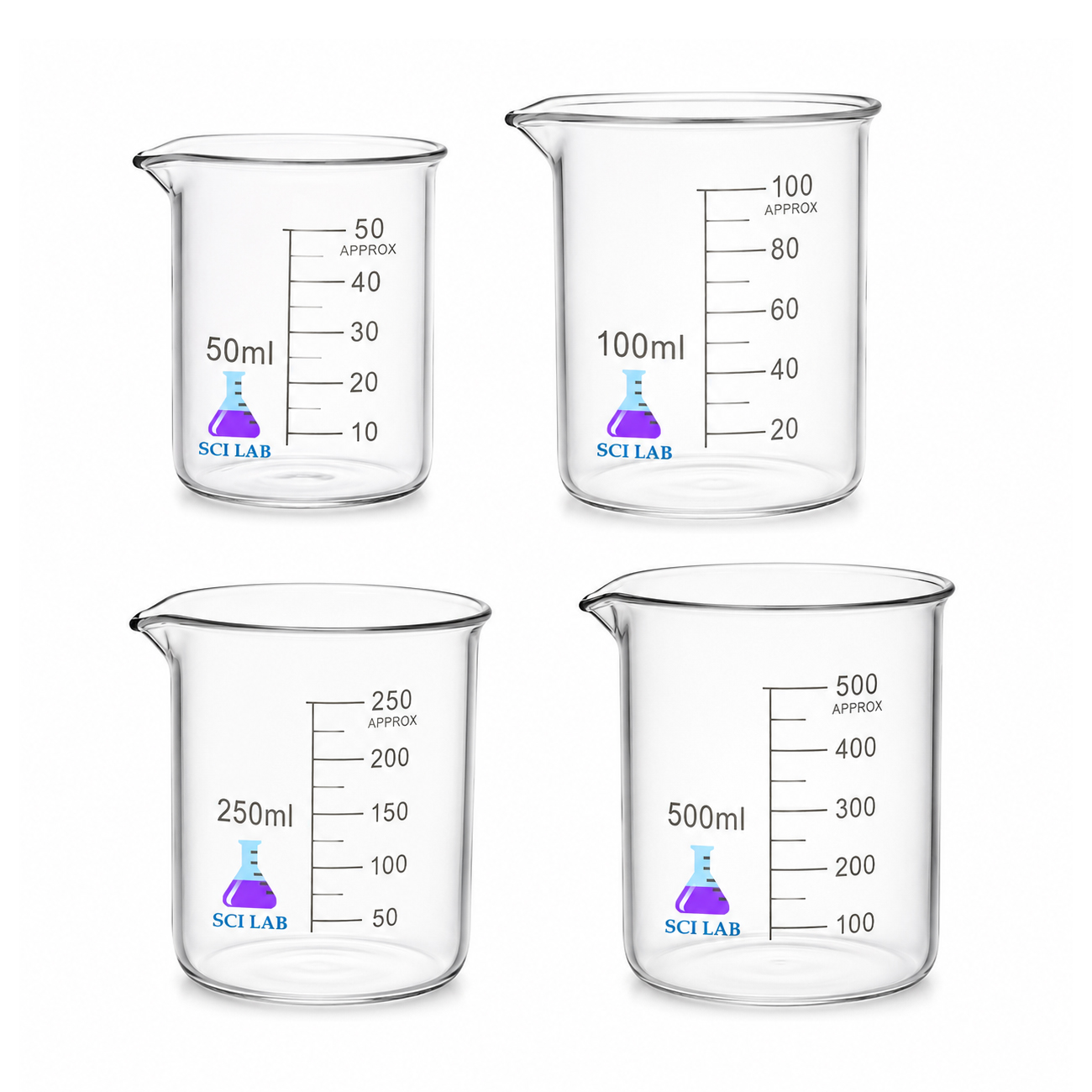
This set of Glass Beakers, Assorted Capacities, holds four low-form borosilicate 3.3 glass beakers in 50, 100, 250 and 500 ml sizes, each with a flared rim, a pouring spout and approximate fired-on graduations. The glass resists chemicals and heat, so the set covers mixing, warming and holding samples in biology and chemistry practicals.
Specifications of the Glass Beakers Set
| Specification | Value |
|---|---|
| Contents | 4 beakers |
| Capacities | 50, 100, 250 and 500 ml |
| Form | Low form, flared rim with pouring spout |
| Glass | Borosilicate 3.3, chemical and heat resistant |
| Graduations | Approximate, fired on: every 10 ml (50 ml beaker), 20 ml (100 ml), 25 ml (250 ml) and 50 ml (500 ml) |
| Supplied by | Science Lab Supplies, Ambala, India |
Using the Beaker Set in Practicals
Each size has its own job: the 50 ml beaker for small amounts of stain or indicator, the 100 and 250 ml beakers for mixing and soaking samples, and the 500 ml beaker for water baths and rinsing.
- Food tests: stand test tubes of sample and Benedict's solution in hot water in the 250 ml beaker, heated over a burner on a Tripod Stand and Wire Gauze, Non-Asbestos.
- Osmosis: soak potato strips in sugar solutions of different strengths in the 100 ml beakers and compare their mass afterwards.
- Enzyme work: keep the 500 ml beaker at body temperature as a water bath and stir it with a Glass Stirring Rod, 350 x 8 mm.
Heat a beaker only with liquid in it, over a gauze or on a hot plate, and never set a hot beaker on a cold, wet bench. The graduations show rough volumes only, so measure exact amounts in a measuring cylinder.
Frequently Asked Questions
How should glass beakers be checked when they arrive and before use?
Look at each rim for chips and hold the base up to the light to spot star cracks or deep scratches. Damaged glass can break on heating, so set aside any faulty beaker and store glass so pieces do not knock together.
Should glass or plastic beakers be ordered for school practicals?
Glass beakers like these resist heat and most chemicals, so they serve for warm water baths as well as cold mixing. These are borosilicate 3.3, the usual glass for repeated heating over a flame, as it takes sudden temperature change better than ordinary soda-lime glass. Plastic beakers do not shatter and suit cold work with young classes, but most cannot be heated.
Why buy the four sizes as a set instead of single beakers?
One set puts all four working sizes on a bench, from 50 ml for a few drops of stain or indicator to 500 ml for a water bath. Single beakers in the same sizes can then replace breakages.
Related Beakers and Glassware
- Glass Measuring Cylinders, Assorted Capacities: five glass measuring cylinders from 10 to 250 ml on plastic bases.
- Beakers: borosilicate beakers from 25 to 1000 ml with permanent graduations and a pouring spout.
- Beakers, Tall form, Without Spout: tall beakers with clear metric graduation and a large labelling field.
- Conical Flasks Set (50-500 ml): four narrow-mouth graduated borosilicate flasks, 50 to 500 ml.
- Beaker Brush: extra-large brush with wire-wound polyester bristles for cleaning beakers.
- Beaker Tong SS: stainless steel tongs for beakers up to 2 litres, 155 mm outside diameter.
The Glassware Beaker range holds single beakers in more sizes, and the Biology Lab Equipment range lists the other sets.
Science Lab Supplies can export this glassware under its Importer-Exporter Code, including to the UAE, Saudi Arabia, Oman, the Philippines, Nepal and Bangladesh. To have the set quoted, message the team through the contact page or keep it in the enquiry cart.
Last updated: 19 November 2026

.jpg)