Acids and Bases Kit
Product Code : LSK-CL-10061
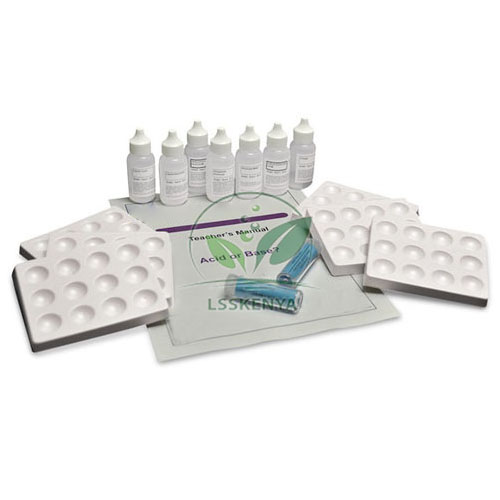
The Acids and Bases Kit takes students through the main reactions of acids and bases. They react metals with acids, make hydrogen in safe quantities, make carbon dioxide, watch indicator dyes change, titrate an unknown acid and carry out a neutralisation. A worksheet and teacher's guide are included.
Specifications of the Acids and Bases Kit
| Specification | Value |
|---|---|
| Reactions | Metals with acids; hydrogen produced in safe quantities; carbon dioxide produced |
| Indicator work | Effect of acids and bases on indicator dyes |
| Quantitative work | Titration of an unknown to find acid concentration; neutralisation experiment |
| Materials | Safe, easy-to-use materials for students |
| Included | Worksheet and teacher's guide |
| Supplied by | Science Lab Supplies, Ambala, India |
Acid and Base Practicals with the Kit
Students work through the activities in the order of the worksheet: first the qualitative tests, then the titration. The teacher's guide sets out the steps and the expected results.
- Metals and acids: add a metal to acid, collect the gas and hold a lit splint from the Wood Splints pack at the mouth of the tube. Hydrogen burns with a squeaky pop.
- Indicators: add acid, then base, to indicator dye and record each colour change.
- Titration of an unknown: run base from a Burette for Bases into the acid in a Conical (Erlenmeyer) Flask until the indicator just changes colour, then work out the acid concentration.
- Neutralisation: mix acid and base step by step and follow the change with indicator.
Common errors: reading the burette from above the meniscus, adding base too fast near the end point, and not swirling the flask.
Frequently Asked Questions
What is the difference between a strong acid and a concentrated acid?
Strength tells how fully the acid splits into ions in water. Concentration tells how much acid is dissolved in a given volume. A weak acid can be concentrated, and a strong acid can be dilute.
How do students know when neutralisation is complete?
The indicator changes colour at the end point. In a titration, students add the base drop by drop near the end and stop at the first lasting colour change.
Why should the titration of the unknown acid be repeated?
One run can be off by a drop or a misread scale. Repeat the titration until two or more results agree closely, then average only those close results to work out the acid concentration.
Which materials are used up, and what does a school reorder for later classes?
The chemicals are used up as students work: the metals, the acids and the indicator dyes, and the unknown acid for titration. The worksheet and teacher's guide stay with the school. A school running these practicals with a new class each year should plan fresh chemicals for each run.
How is the hydrogen made in the kit tested?
Collect the gas in a test tube and bring a lit splint to its mouth. A squeaky pop shows hydrogen. The kit makes hydrogen only in safe quantities.
What should an importer check before shipping a kit that contains acids?
Even small, dilute amounts of acids and other chemicals can fall under dangerous-goods transport rules. An importer should check the national rules for school chemicals, how the carrier classes small chemical quantities, and whether the goods may travel by air, sea or road.
Related Indicators and Titration Items
- Blue Litmus Paper: acids turn it red; bases and neutral substances leave it blue.
- Red Litmus Paper: bases turn it blue; acids leave it red.
- Universal Ph Indicator: paper test strip covering pH 0–14.
- Pipette Filler Bulb: creates suction for pipettes up to 25 ml.
- The Acid-Basic Environment of The Solution: laminated wall chart, 70 cm x 100 cm.
Browse the Chemistry Lab range or the wider School Lab Equipments section.
Science Lab Supplies holds an Importer-Exporter Code and ships to schools and labs in Saudi Arabia, Oman, the Philippines, Nepal, Bangladesh and Zambia. For a quotation, send a message through the contact page or add the kit to the enquiry cart.
Last updated: 15 November 2026