The Relationships of The Mole
Product Code : SCL-CL-11602
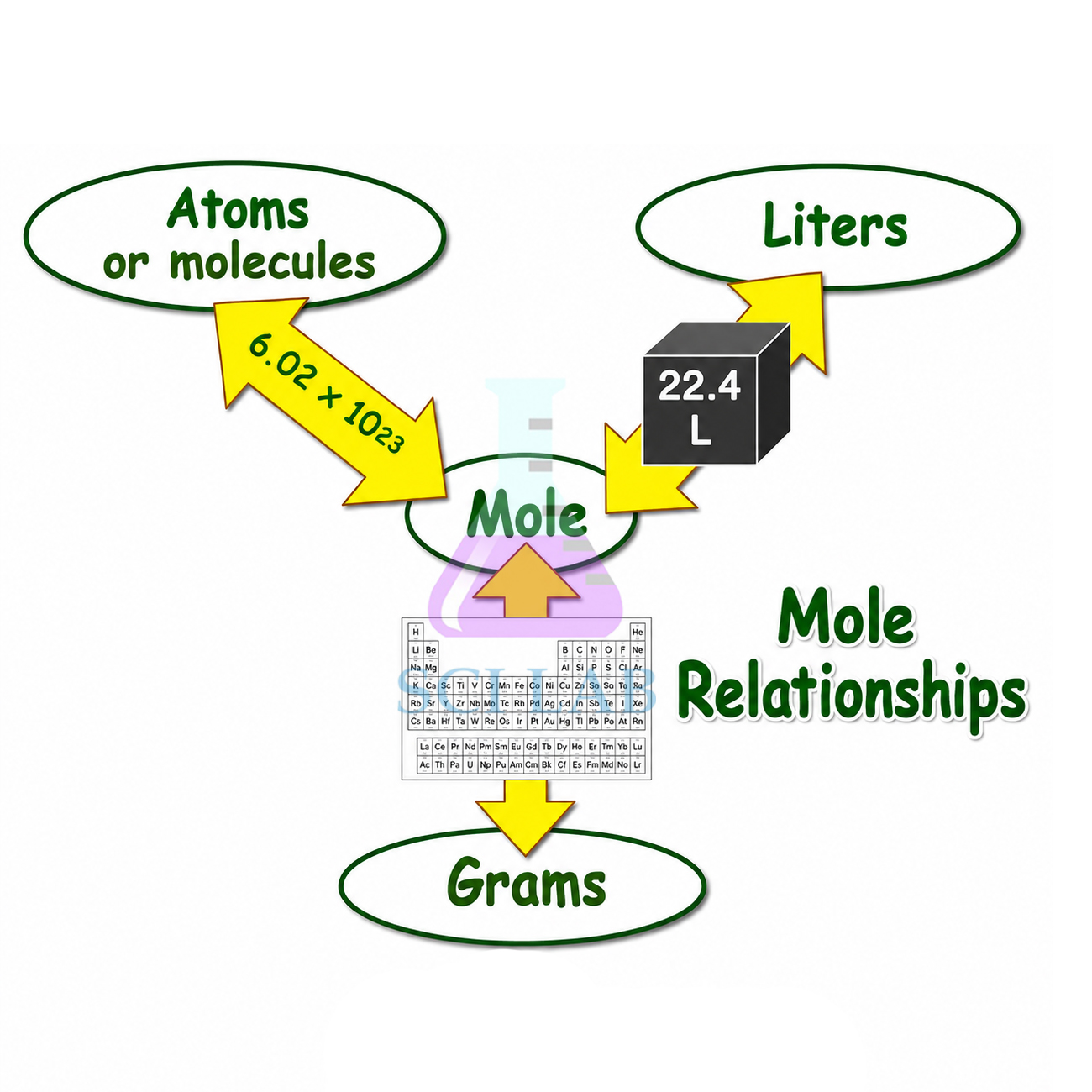
The Relationships of The Mole is a laminated wall chart, 70 cm x 100 cm, for teaching the mole concept. It covers how amount of substance links mass, number of particles and, for gases, volume, so students can move between grams, moles and particles.
Specifications of the Mole Chart
| Specification | Value |
|---|---|
| Format | Laminated wall chart |
| Size | 70 cm x 100 cm |
| Mounting | Wall mounted |
| Use | Classrooms and laboratory |
| Supplied by | Science Lab Supplies, Ambala, India |
Mole Calculations in Practical Work
Students weigh or measure a sample, convert it to moles with the chart, and then use the moles to predict a product mass.
- Weighing in moles: weigh out 0.1 mol of sodium chloride and of sugar on an Electronic Balance and compare the two masses.
- Formula of an oxide: heat magnesium ribbon in a Porcelain Crucible with Lid and use the mass gain to find the mole ratio.
- Solutions: dissolve a weighed solid and make it up in a Measuring Cylinder 250ml to find its concentration in mol/dm3.
Common errors: using the atomic mass of one element instead of the molar mass of the compound, and mixing grams with kilograms.
Frequently Asked Questions
Do 10 g of two different substances contain the same number of moles?
No. Equal masses only contain equal moles if the molar masses are the same. Ten grams of hydrogen gas is about 5 mol, while 10 g of oxygen gas is about 0.31 mol.
Does the mole only count molecules?
No. A mole can count atoms, ions, electrons or formula units. For ionic solids such as sodium chloride, the particle counted is the formula unit, since there are no separate molecules.
How is a mass in grams turned into a number of particles?
Divide the mass by the molar mass to get moles, then multiply by the Avogadro constant, 6.022 x 10²³ per mole. Two steps are needed, with moles in the middle.
Do equal volumes always contain equal numbers of moles?
Only for gases at the same temperature and pressure. Equal volumes of liquids or solids, such as water and ethanol, contain different numbers of moles.
Related Quantitative Chemistry Resources
- SI Base Units: laminated wall chart, 70 cm x 100 cm.
- Chemical Symbols and Formulas: 70 cm x 100 cm chart.
- Semi-Analytical Balance, 200 g, with Milligram Weights: 200 g capacity, 100 mg sensitivity, with weights from 10 mg.
- Porcelain Evaporating Dish (Capsule), 50 ml: white porcelain dish, 50 ml.
- Volumetric (One-Mark) Pipette, 25 ml: sealed glass pipettes, 25 ml capacity.
Look through the Chemistry Lab pages for more balances and glassware.
With its Importer-Exporter Code, Science Lab Supplies sends goods to Oman, the Philippines, Nepal, Bangladesh, Zambia and Rwanda. Get a quotation through the contact page or by using the enquiry cart.
Last updated: 14 November 2026


.jpg)