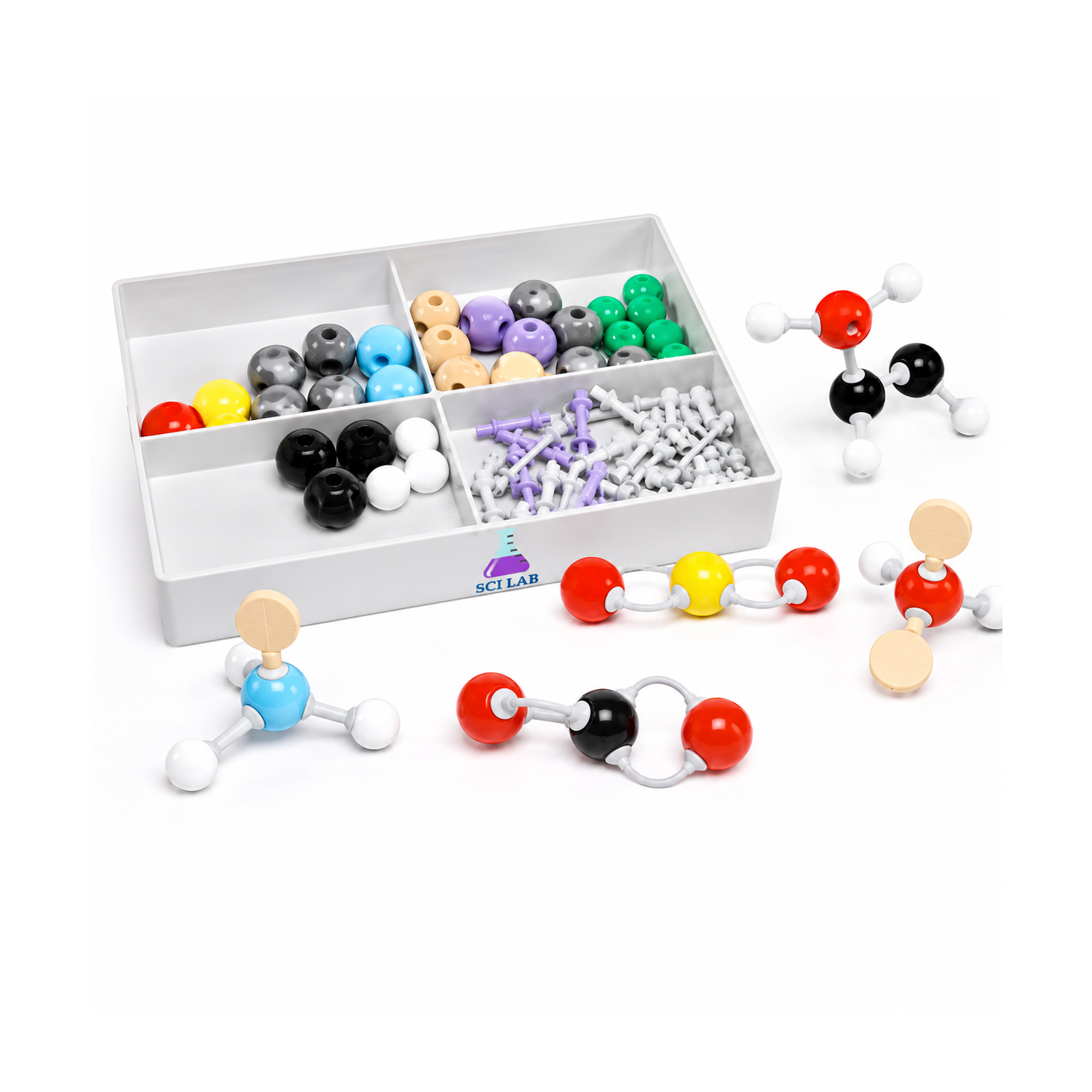
Molecular Micro-Models, Organic and Inorganic Set
Product Code : SCL-CL-11688
Molecular Micro-Models is a boxed set of moulded balls in different colours and sizes for carbon, hydrogen and oxygen atoms, with connecting lugs of different sizes and metal bars. Students use it to build models of organic and inorganic compounds.
Specifications of the Molecular Micro-Models
| Specification | Value |
|---|---|
| Atoms | Moulded balls of different colours and sizes: carbon, hydrogen, oxygen |
| Connectors | Connecting lugs of different sizes, metal bars |
| Packing | Boxes |
| Use | Models of organic and inorganic compounds |
| Supplied by | Science Lab Supplies, Ambala, India |
Building Molecules with the Micro-Models
Pick the atom balls for the formula, join them with lugs, and check that every atom has its usual number of bonds. Compare each finished model with a structural formula on the board or a wall chart.
- Alkanes: build methane to butane and compare them with the Alkanes chart.
- Isomers: make two models with the formula C4H10 and decide whether they are the same, with help from the Isomer chart.
- Shapes: build water and methane and compare their shapes with the Geometry of Molecules chart.
Frequently Asked Questions
How many bonds should each atom have in a model?
Carbon forms four bonds, oxygen two and hydrogen one. A correct model has every atom with exactly that number of links and no empty holes.
What do the different ball colours mean?
Colour and size mark the element, so atoms can be told apart at a glance. A widely used convention is black for carbon, white for hydrogen and red for oxygen.
Does twisting a model make a new isomer?
No. Parts of a molecule can turn about a single bond, so twisted forms are the same compound. An isomer needs the atoms joined in a different order, which means taking links apart.
Are a straight chain and a bent chain the same compound?
Yes, if the atoms are joined in the same order. A zigzag or U-shaped chain of four carbons is still butane; only the drawing or the view has changed.
Why should pieces not be forced together?
Forcing a lug into the wrong hole can split it or widen the hole, and the joints then fall apart. If a piece does not fit, check you have the right atom and link.
Related Molecular and Atomic Models
- Molecular Models Demonstration Kit: 40 hydrogen, 38 carbon and 12 oxygen atoms, with single, double and triple bonds.
- Carbon-Carbon Molecular Model: orbital models of ethane, ethylene, acetylene and benzene.
- Orbital Model of Sp3 Hybridization: plastic model with metal parts for organic and stereo chemistry.
- Diamond Crystal Model: 84 connectors and 57 jacks with an instruction manual.
- Atomic In/Organic Junior Model: molecular model set with white lugs for valency bonds, in a storage box.
More models are found in the Chemistry Lab range, part of the School Lab Equipments section.
Science Lab Supplies holds an Importer-Exporter Code and can ship sets to the UAE, Saudi Arabia, Oman, the Philippines, Nepal and Bangladesh. To get a quotation, fill in the contact page or send the item from the enquiry cart.
Last updated: 14 November 2026


.jpg)