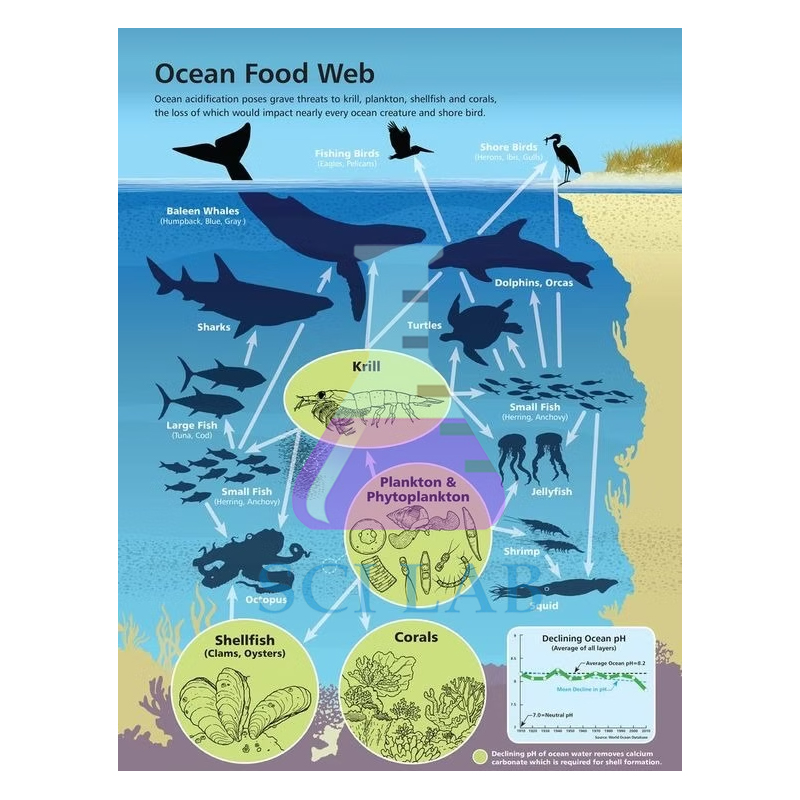
Marine Food Chain Chart
Product Code : SCL-BLE-11794
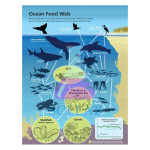
The Marine Food Chain Chart is a laminated 70 x 100 cm wall chart of one feeding chain in the sea: phytoplankton capture sunlight, zooplankton graze on them, fish eat the zooplankton and a predator takes the fish. The labels are in English. With a rod along the top and bottom and a hanging cord, laboratories and classrooms can put it up for lessons on ocean life.
Specifications of the Marine Food Chain Chart
| Specification | Value |
|---|---|
| Subject | Food chain in the sea |
| Chain shown | Phytoplankton, zooplankton, fish, predator |
| Labels | English |
| Size | 70 x 100 cm |
| Finish | Laminated |
| Mounting | Wall mounted: rod at the top and bottom edges, hanging cord at the top |
| Place of use | Laboratory and classroom |
| Supplied by | Science Lab Supplies, Ambala, India |
Marine Food Chain Lessons with Fish Specimens
The chart gives the order of feeding. Specimens and a fish chart then show how the animals in the chain are built to catch and eat their food.
- Order the chain (Class 6 to 9): write the chart's chain from producer to top predator and label each link with its feeding level.
- Predator features: use the Fish Anatomy Educational Chart to find the fins, gills and body regions that suit a fish to hunting in open water.
- Inside a fish: study the gut and gills of the Fish Dissection, sealed in a 200 x 70 x 40 mm glass container, and discuss what the fish may have eaten.
- Pollutant game: pass counters up the chain, doubling them at each level, to model how a toxin builds up in the top predator.
Keep the sealed specimen closed at all times. Common errors: leaving the plankton out of the chain, and treating all plankton as plants.
Frequently Asked Questions
How can a buyer judge the print quality of a marine chart before a bulk order?
View a full-size sample or a close photo: small labels should stay sharp from two or three metres, colours should not look washed out, and the laminate should lie evenly with no bubbles or lifting at the edges.
Does a sea food chain chart also cover ocean zones and reefs?
No. This chart follows a single chain, from phytoplankton through zooplankton and fish to a predator. Ocean zones, tides, coral reefs and coastal wetlands are taught as separate topics, so schools with a full marine unit plan other charts or lessons for them.
Why do top predators such as tuna carry the most pollutants?
Some toxins, such as mercury and certain plastic chemicals, are stored in body tissue instead of being broken down. Each predator eats many contaminated prey, so the amount builds up at each level. This is called biomagnification.
How do plastics get into the marine food chain?
Large pieces break into microplastics that plankton feeders and small fish swallow, and the particles pass to the animals that eat them. Larger animals also mistake whole items for food, as when a turtle swallows a bag that looks like a jellyfish.
What happens to a sea food chain when one prey species is overfished?
Many sea predators eat several kinds of prey and can switch. Those that depend heavily on one prey, such as seabirds feeding on small shoaling fish, may fail to raise young, and the effect can spread through the web.
Related Food Chain and Water Charts
- Lake Food Web Chart: freshwater web with arrows marking each feeding link.
- Forest Food Chain Chart: plant to herbivore to predator, with the decomposers added.
- Water Cycle and Water Pollution Chart: evaporation through to runoff, plus the pollution paths.
- Disruption of the Natural Balance Chart: causes, examples and effects of imbalance in nature.
- Ecological Pyramid Chart: laminated chart in the same size, wall mounted.
Sea, lake and forest ecology charts are grouped under Charts & Portraits in the Educational Lab Equipment section.
Under an Importer-Exporter Code, Science Lab Supplies sends school charts such as this marine food chain abroad, including to Ghana, Ethiopia, Tanzania, Uganda, the UAE and Saudi Arabia. Quotation enquiries are taken on the contact page and through the enquiry cart.
Last updated: 19 November 2026
.png)
.jpg)
.jpg)