Van De Graaff Generator

Product Code : LSK-PL-10330
Van De Graaff Generator (SKU LSK-PL-10330) is a belt-type electrostatic generator that builds up a high voltage on a 220 mm conducting dome for classroom demonstrations of static electricity, charge distribution and sparks. It suits Class 8–12 electrostatics lessons and college demonstration labs. Each generator is built by Science Lab Supplies, its manufacturer, at Plot 448, HSIIDC Industrial Area, Saha, Ambala, India, and quoted from there to schools, colleges, tender contractors and distributors.
Specifications
The generator's belt drive, dome, output and base are documented row by row below. In short, a rubber belt driven by a motor hidden in the metal base rubs on a polythene and an acrylic roller to make charge, which a metal gauze lifts off the belt and stores on the dome above an acrylic pillar.
| Specification | Value |
|---|---|
| SKU | LSK-PL-10330 |
| Dome | Conducting sphere, 220 mm diameter |
| Dome support | Acrylic pillar |
| Belt | Rubber, driven by an electric motor concealed in the metal base |
| Rollers | One polythene, one acrylic |
| Charge collection | Metal gauze |
| Output | 200,000–400,000 V, depending on humidity levels |
| Maximum spark length | 50 mm (approx.) |
| Dome capacitance | 15 pF (approx.) |
| Maximum intermittent current | 6 µA (approx.) |
| Conducting spheres | 100 mm diameter |
| Base socket | 4 mm, for a sphere on a cranked rod or a wire to a separate sphere on an acrylic rod |
| Base dimensions (max) | 218 x 182 x 93 mm |
| Total height | 500 mm |
| Operating voltage | 220–240 V AC mains, three-wire cable |
| Fuse | 315 mA / 250 V |
| Supplied with | Accessory kit and dust cover |
| Manufacturer | Science Lab Supplies, Saha, Ambala, Haryana |
| Country of origin | India |
Applications and Experiments for the Van De Graaff Generator
The generator produces a large static charge so that electrostatic effects can be seen by the whole class: sparks jumping to an earthed sphere, charge collecting on the outside of a conductor, and like charges repelling. Dry conditions give the highest voltages and the longest sparks.
- Class 8 science: static charge and electric discharge (lightning), after first charging rods by rubbing with the Electrostatics Friction Rods Set.
- Class 12 electrostatics: charge residing on the outer surface of a conductor and the action of points, extended with the Electricity EL2+ Set of 21 experiments.
- Showing electric fields with paper strips or light objects repelled from the dome.
The dome reaches several hundred thousand volts and gives sparks up to about 50 mm. Operate it only under teacher supervision, discharge the dome before touching it and keep electronic devices well away.
Standard Scope of Supply
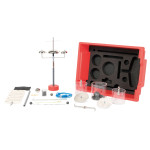
Each generator comes with an accessory kit and a dust cover to keep it free from dust when not in use. The base socket takes a conducting sphere on a cranked rod support or a separate sphere on an acrylic rod; the quotation lists the kit's contents.
Packing, MOQ and Lead Time
One generator or several for different physics rooms can be quoted, and every quotation states the packing, delivery time and price for that quantity. A discharge sphere and other electrostatics items can join the same quotation, direct from a science apparatus manufacturer in India.
With an Importer-Exporter Code as a registered exporter, Science Lab Supplies can ship to buyers in Zambia, Rwanda, South Africa, Qatar, Sri Lanka and Vietnam. An electrostatics bench can be requested on the contact page, with the generator and its companions placed in the enquiry cart; tenders proceed through the lab tender page.
Frequently Asked Questions
What voltage does the Van De Graaff Generator produce?
Its output is 200,000–400,000 V, depending on humidity, with sparks of up to about 50 mm. The current is very small, around 6 µA maximum.
What power supply does it need?
The belt motor runs from 220–240 V AC mains through a three-wire cable, protected by a 315 mA / 250 V fuse. Use an earthed socket within that voltage range.
Is Science Lab Supplies the manufacturer or a trader?
The belt-driven generator, its dome and its base are assembled at the Science Lab Supplies factory in Saha, Ambala, India, so the manufacturer itself answers technical questions and issues the quotation.
Why does the output depend on humidity?
Moist air lets charge leak away from the dome, so the highest voltages, up to 400,000 V, and the longest sparks are reached in dry conditions.
Related Electrostatics Equipment
These six items build an electrostatics demonstration around the generator: a sphere for safe discharge, two hand-driven influence machines for comparison, a set of accessories showing charge effects, a charge-distribution kit with electroscope and a variable parallel-plate capacitor, all on one quotation.
- Discharge Sphere — 10 cm stainless steel sphere on a 41 cm rod, for sparks up to 10 cm.
- Wimshurst Machine — influence machine needing no electrical power, 50 mm sparks.
- Wimshurst Influence Machine — 31 cm counter-rotating discs with two Leyden jars, 75,000 V.
- Electrostatics Apparatus Set — 30 mm spheres, electrodes, paper-strip rod and bells for charge effects.
- Apparatus for Distributing Electric Charges — metal spheres on insulating handles and a 200 mm gold leaf electroscope.
- Parallel-Plate Capacitor — 20 cm plates with adjustable spacing and height.
Browse the full Physics Lab range, the Electrical and Electronics range, or all physics lab equipment.
Last updated: 22 October 2026