Bench Signal Generator
Product Code : LSK-PL-10279
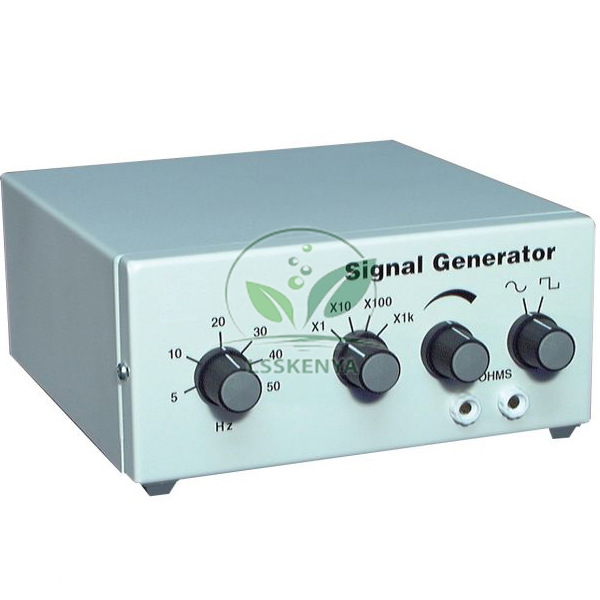
Bench Signal Generator (SKU LSK-PL-10279) produces sine and square waves from 5 Hz to 50 kHz, up to 8 V peak to peak and 1 W into 8 ohms. Schools use it for sound lessons, colleges for waves and electronics practicals. Science Lab Supplies manufactures the generator in Saha, Ambala, India (Plot 448, HSIIDC Industrial Area) and quotes it direct to schools, colleges, contractors and distributors.
Specifications
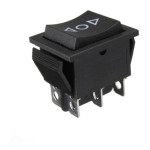
Frequency is set with a four-position range switch plus a fine control, and the amplitude is continuously variable from zero. The signal leaves through two 4 mm sockets on the front panel, while the illuminated mains switch and fused inlet sit on the rear of the powder-coated metal case.
| Parameter | Value |
|---|---|
| SKU | LSK-PL-10279 |
| Waveforms | Sine and square |
| Frequency range | 5 Hz to 50 kHz, four switched ranges plus fine control |
| Frequency accuracy | Typically ±10% |
| Output amplitude | 0 to 8 V peak to peak, continuously variable |
| Output power | 1 W maximum into 8 Ω |
| Output | Two 4 mm sockets, front panel |
| Dimensions (L x W x H) | 179 x 190 x 85 mm |
| Manufacturer | Science Lab Supplies, Saha, Ambala, Haryana |
| Country of origin | India |
Applications and Experiments for the Bench Signal Generator
Teachers use the generator to drive a small loudspeaker or a vibrator and to feed test signals into circuits viewed on an oscilloscope. Its 5 Hz to 50 kHz span covers the audible range, which suits sound, resonance and AC circuit work in secondary schools, polytechnics and B.Sc. labs.
- Class 9 physics: pitch and frequency of sound through a loudspeaker.
- Class 11 waves: resonance and standing waves at a chosen frequency.
- B.Sc. and diploma labs: frequency response of RC and LCR circuits.
- Comparing sine and square waves on an oscilloscope.
Standard Scope of Supply
The Bench Signal Generator is supplied as a single unit as described above, in its powder-coated metal case with front-panel 4 mm output sockets and a rear fused mains inlet. Loudspeakers, oscilloscopes and connecting leads are separate items that can be added to the quotation.
Packing, MOQ and Lead Time
Send the number required, whether one generator for a demonstration bench or several for student groups; the quotation sets out packing, delivery time and price for that quantity. Matching loudspeakers and vibration generators can be quoted alongside it on the same document.
Science Lab Supplies is registered as an exporter with an Importer-Exporter Code and can ship to buyers in Uganda, the UAE, Saudi Arabia, Oman, the Philippines and Nepal. Enquiries go through the contact page or the enquiry cart, and details for institutional buyers are on the lab tender page.
Frequently Asked Questions
What waveforms and frequencies does it produce?
Sine and square waves from 5 Hz to 50 kHz, chosen with a four-position range switch and a fine control. Frequency accuracy is typically ±10%, adequate for teaching use.
Can it drive a loudspeaker?
Yes, for classroom use. The output delivers up to 1 W into an 8 ohm load, with the amplitude adjustable from zero to 8 V peak to peak, suitable for a small demonstration loudspeaker.
Is Science Lab Supplies the manufacturer or a trader?
Science Lab Supplies is a science apparatus manufacturer in India, not a trading house. The generator is assembled in its own Saha, Ambala factory, and your quotation comes straight from there.
How is it powered?
It runs from the mains through a fused inlet on the rear panel, beside an illuminated on/off switch, leaving the front panel for the controls and output sockets.
Related Signal and Sound Equipment
The generator is normally paired with something that turns its signal into sound or movement, or with a second source for comparison. These four Physics Lab items are the usual companions on a sound and waves bench and can share one quotation.
- Demonstration Loudspeaker — 8 Ω, 10 W RMS speaker with front 4 mm sockets.
- Vibration Generator — turns a signal into mechanical vibration; 6 V/1 A maximum input.
- Microphone — crystal microphone for showing voice waveforms on an oscilloscope.
- Audio-Frequency Generator — alternative audio source with 0–10 V amplitude.
Browse the full Physics Lab range or all physics lab equipment.
Last updated: 25 September 2026