Metal Cylinders
Product Code : LSK-PL-10313
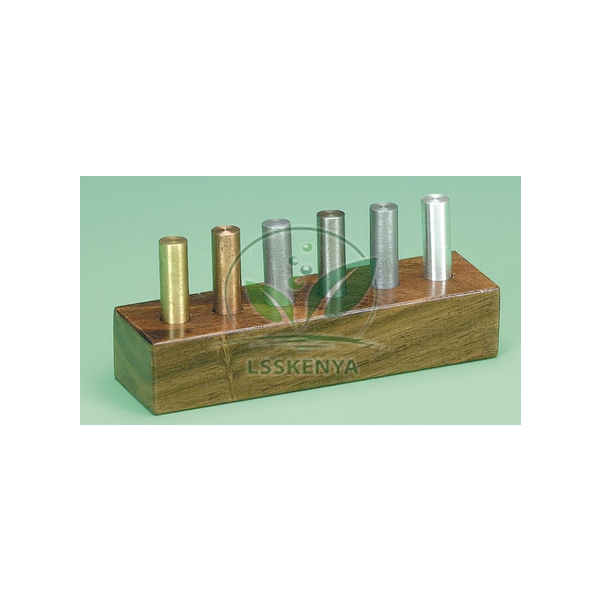
Metal Cylinders (SKU LSK-PL-10313) are a set of six precision cylinders in brass, lead, copper, iron, aluminium and zinc, supplied in a wooden block, for density experiments. Students measure each cylinder, weigh it and compare the densities of common metals. The set suits Class 9–11 physics and introductory college practicals. It is manufactured by Science Lab Supplies in Saha, Ambala, India (Plot 448, HSIIDC Industrial Area) and quoted directly to schools, colleges, tender contractors and distributors.
Specifications
The six cylinders are made as precision pieces for density work, one in each of brass, lead, copper, iron, aluminium and zinc. They sit in a wooden block that keeps the set together, so each metal is easy to find, check and return after the practical.
| Parameter | Value |
|---|---|
| SKU | LSK-PL-10313 |
| Cylinders | 6, precision made |
| Metals | Brass, lead, copper, iron, aluminium, zinc |
| Storage | Wooden block |
| Manufacturer | Science Lab Supplies, Saha, Ambala, Haryana |
| Country of origin | India |
Applications and Experiments for the Metal Cylinders
The cylinders are used to find density as mass divided by volume. Students take the volume from diameter and length readings or by water displacement, weigh each cylinder on a balance, and then compare the six results to see how strongly density varies from one metal to another.
- NCERT Class 9 science: density and relative density.
- Class 11 physics practicals: measuring cylinder dimensions with a vernier caliper.
- Archimedes' principle: comparing loss of weight in water for different metals.
One cylinder is lead: ask students to wash their hands after handling the set.
Standard Scope of Supply
The set consists of six metal cylinders, one each of brass, lead, copper, iron, aluminium and zinc, held in a wooden block. A balance, a vernier caliper and a measuring cylinder are needed for the experiment but are separate items; they can be quoted together with the set.
Packing, MOQ and Lead Time
Quotations cover anything from a single set for demonstration to one set per student group. Each quotation states packing, delivery time and price for the quantity you specify, and density cubes or calipers from the same range can sit on it too.
As a registered exporter, Science Lab Supplies holds an Importer-Exporter Code and can ship to buyers in Vietnam, Malaysia, Peru, Egypt, Iraq and Nigeria. Contact the team via the contact page, shortlist items in the enquiry cart, or see the lab tender page before a tender.
Frequently Asked Questions
Which metals are in the set?
Six: brass, lead, copper, iron, aluminium and zinc, one cylinder of each. This mix gives students a wide spread of densities to compare in a single practical.
How is the set stored?
The cylinders are supplied in a wooden block, which keeps all six together between lessons and makes it easy to check that the set is complete before it goes back into the store.
Is Science Lab Supplies the manufacturer or a trader?
Manufacturer. Science Lab Supplies produces the set as a science apparatus manufacturer in India, working from its own factory in Saha, Ambala, and every quotation comes straight from that factory.
Is the lead cylinder safe for students?
Lead is toxic, so the set should be used under teacher supervision, the cylinders should not be put in the mouth, and students should wash their hands after the practical.
Related Density Equipment
These four items support the same density practical: other sample sets for comparison, a stand-based apparatus for measuring solid densities and a caliper for taking dimensions. All four can be quoted with the cylinders, making it simple to source school physics lab equipment in India for a full density bench.
- Metal Density Cubes — 20 mm cubes in the same six metals.
- Equal-Volume Blocks of Different Materials — same-volume blocks in wood, metal and plastic.
- Apparatus for Measuring the Density of Solids — stand, scales and bodies of different materials.
- Caliper Vernier — 0–12.5 cm x 0.1 mm for measuring cylinder dimensions.
Browse the full Physics Lab range or all physics lab equipment.
Last updated: 25 September 2026


.jpg)