Galvanometer
Product Code : LSK-LM-11125
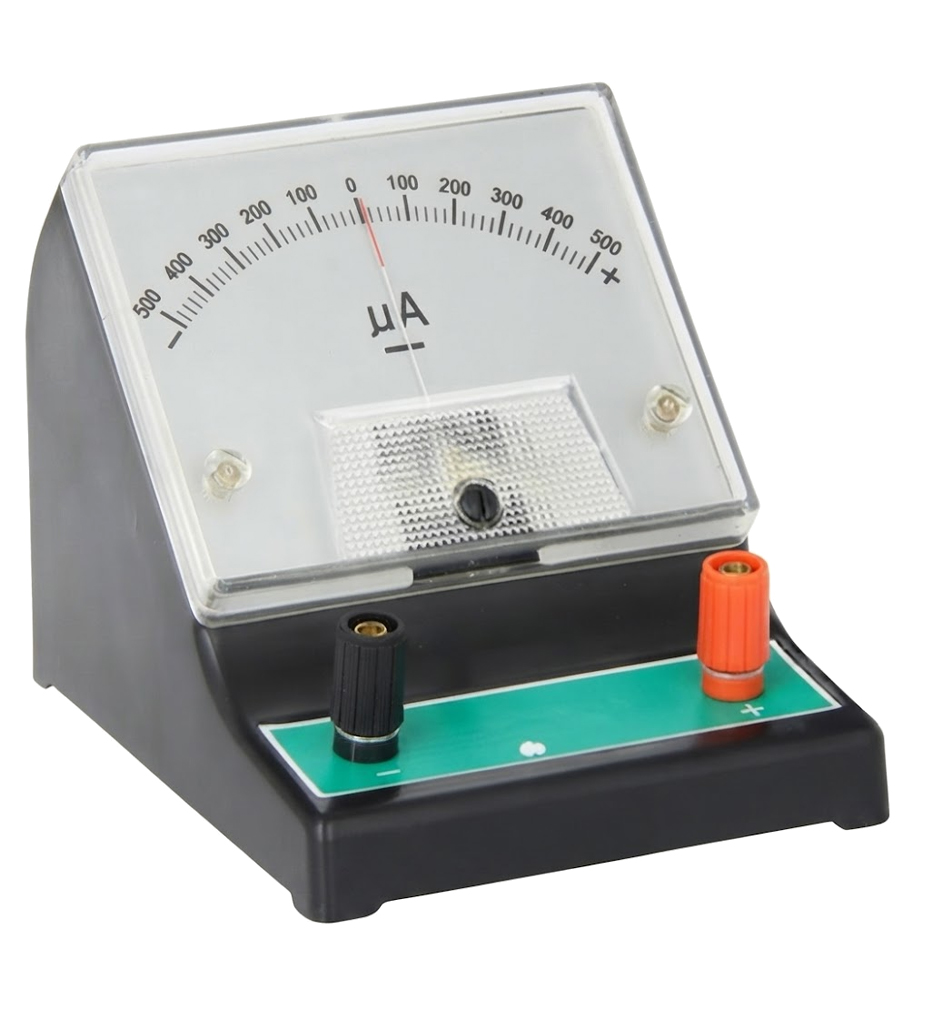
Galvanometer (SKU LSK-LM-11125) is an analogue centre-zero demonstration meter reading −500–0–500 µA, used to detect small direct currents and show which way they flow. Physics and electronics teachers use it in school, college and diploma laboratories. Science Lab Supplies manufactures this meter in Saha, Ambala, India, at the company's factory on Plot 448, HSIIDC Industrial Area, and supplies it without agents to schools, colleges, tender contractors and distributors.
Specifications
The meter has a centre-zero scale of −500–0–500 µA with an accuracy of ±2.5%. It is housed in a sloped plastic desk-stand casing, so the scale faces the class, and has positive and negative binding posts for connection.
| Parameter | Value |
|---|---|
| SKU | LSK-LM-11125 |
| Type | Analogue centre-zero galvanometer (demonstration microammeter) |
| Range | −500–0–500 µA DC |
| Accuracy | ±2.5% |
| Casing | Sloped plastic desk stand |
| Terminals | Positive and negative binding posts |
| Manufacturer | Science Lab Supplies, Saha, Ambala, Haryana |
| Country of origin | India |
Applications and Experiments for the Centre-Zero Galvanometer
Because the pointer rests at the centre, the galvanometer shows both the size and the direction of a small current. That makes it the standard detector for induction demonstrations and null-point experiments in Class 12 physics, and a useful teaching meter in B.Sc. and diploma electrical labs.
- Class 12 physics: Faraday's experiments, showing induced current as a magnet moves in a coil.
- Finding the balance point in meter bridge and potentiometer experiments.
- Demonstrating that reversing a connection reverses the current direction.
- Diploma and B.Sc. labs: introducing microampere-level DC measurement.
Standard Scope of Supply
The Galvanometer is supplied as a single meter in its sloped plastic desk-stand casing with positive and negative binding posts, as described above. Connecting leads, coils and resistance boxes are separate items that can be added to the quotation.
Packing, MOQ and Lead Time
Ask for a quote for one galvanometer or for enough meters to equip every bench. We state packing, delivery time and price for the quantity you give, and leads, resistance boxes and other physics lab equipment in India from our catalogue can be combined on that quotation.
Registered as an exporter under an Importer-Exporter Code, Science Lab Supplies can ship to buyers in Qatar, Sri Lanka, Vietnam, Malaysia, Peru and Egypt. Reach us from the contact page, add the meter to the enquiry cart, or follow the lab tender page for tender purchases.
Frequently Asked Questions
What is the range of this galvanometer?
It reads from −500 µA through zero to +500 µA DC, with an accuracy of ±2.5%, so small currents in either direction can be seen on the same scale.
Why is a centre-zero meter used for induction experiments?
Induced current changes direction as a magnet enters or leaves a coil. A centre-zero pointer swings left or right, so students see the direction change as well as the size of the current.
Is Science Lab Supplies the manufacturer or a trader?
Science Lab Supplies is the maker. The galvanometer is manufactured at its factory in Saha, Ambala, India, and every price and delivery date is quoted by the manufacturer directly.
Can it measure AC?
The meter is specified for small direct currents in microamperes. For AC work, ask through the contact page about a suitable meter from the range.
Related Electrical Meters and Accessories
A galvanometer is rarely used alone; most circuits also need resistance, leads and a second meter for larger currents. These Physics Lab items complete an electrical practical set and can share one quotation.
- Galvanometer 30-0-30 mA — colour-coded meter with 4 mm socket terminals.
- Demonstration Meter — large moving-coil meter for showing ammeter and voltmeter principles.
- Resistance Box — decade resistance for bridge and shunt experiments.
- Connecting Leads with Alligator Clips — ten red and black leads.
Browse the full Physics Lab range or all physics lab equipment.
Last updated: 25 September 2026