Conductivity Ring
Product Code : LSK-PL-10361
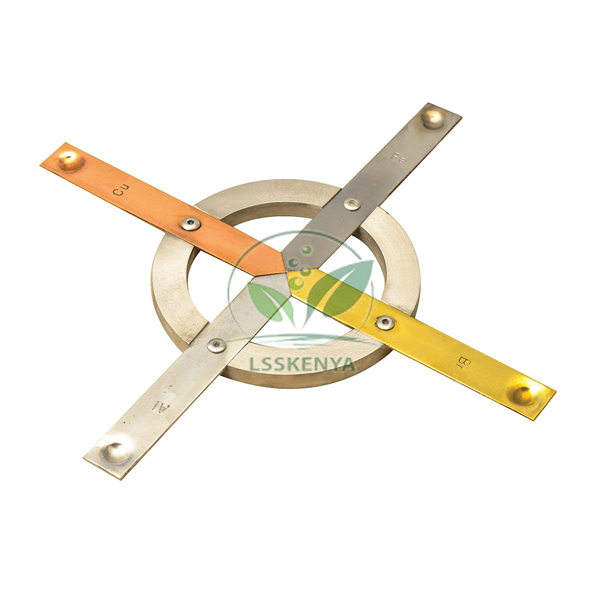
Conductivity Ring (SKU LSK-PL-10361) is a simple heat-conduction demonstration in which strips of copper, brass, steel and aluminium are mounted on a ring, each with a cup of wax at its end. Gentle heating at the centre melts the wax in turn, letting a class compare how quickly each metal conducts heat. It suits middle-school and senior physics lessons on heat transfer. This apparatus is a Science Lab Supplies product, made at Plot 448, HSIIDC Industrial Area, Saha, Ambala, India, and offered at factory level to schools, colleges, tender contractors and distributors.
Specifications
Four metal strips of copper, brass, steel and aluminium are mounted on a ring. Each strip ends in a cup that holds a small piece of wax, so gentle heating at the centre produces a visible melting order across the four metals.
| Parameter | Value |
|---|---|
| SKU | LSK-PL-10361 |
| Metals | Copper, brass, steel, aluminium |
| Construction | Metal strips mounted on a ring |
| Strip ends | Cup at the end of each strip for wax |
| Heating | Gentle heating at the centre |
| Manufacturer | Science Lab Supplies, Saha, Ambala, Haryana |
| Country of origin | India |
Applications and Experiments for the Conductivity Ring
The ring turns thermal conductivity into something students can watch: the wax on the most conductive strip softens first and the others follow. It supports the heat chapter of CBSE Class 7 science and the conduction section of NCERT Class 11 physics, and works as a quick starter demonstration.
- Class 7 science: conduction of heat in solids and good versus poorer conductors.
- Class 11 physics: comparing thermal conductivity of common metals qualitatively.
- Prediction exercises: students rank the four metals before heating, then check against the melting order.
Heat only gently at the centre, keep hands away from the hot strips and let the ring cool fully before clearing the wax.
Standard Scope of Supply
The Conductivity Ring is supplied as a single piece as described above: copper, brass, steel and aluminium strips on the ring, each with its wax cup. Wax and a heat source are not listed as part of the item; optional accessories appear on the quotation.
Packing, MOQ and Lead Time
Ask for one ring for the teacher's bench or enough for each student group. Your quotation will state packing, delivery time and price for that quantity, and other heat-transfer items can be added to it.
Science Lab Supplies, a registered exporter with an Importer-Exporter Code, is able to ship to buyers in Iraq, Nigeria, Kenya, Ghana, Ethiopia and Tanzania. Questions go through the contact page; item lists can be built in the enquiry cart, and tender buyers will find guidance on the lab tender page.
Frequently Asked Questions
Which metals are on the ring?
Copper, brass, steel and aluminium. One strip of each is mounted on the ring, with a wax cup at the end of every strip.
How does the Conductivity Ring differ from the Conductometer?
The ring carries four metal strips heated gently at the centre. The Conductometer, For Thermal Conductivity has five rods (brass, copper, aluminium, iron and stainless steel) on a brass hub with a wooden handle.
What heat source is used?
Gentle heating at the centre of the ring is enough to melt the wax. Use a low flame or small heater under teacher supervision.
Who manufactures the Conductivity Ring?
Science Lab Supplies does, at its own factory in Saha, Ambala, India. Because it is the manufacturer and not a reseller, quotations are issued by the factory itself.
Related Heat Apparatus
A conduction demonstration pairs naturally with apparatus on thermal expansion and temperature sensing. These four items from the same physics range extend a heat lesson beyond conduction and can be quoted with the ring.
- Conductometer, For Thermal Conductivity — five metal rods on a brass hub.
- Ball and Ring Apparatus — brass ball and ring for thermal expansion.
- Heat Sensitive Paper — thermochromic sheets that change colour as they warm.
- Bimetallic Strip — brass and steel strip showing differential expansion.
Browse the full Physics Lab range or all physics lab equipment.
Last updated: 25 September 2026