Peak Expiratory Flow Meter, Piston Type
Product Code : SCL-BLE-11637
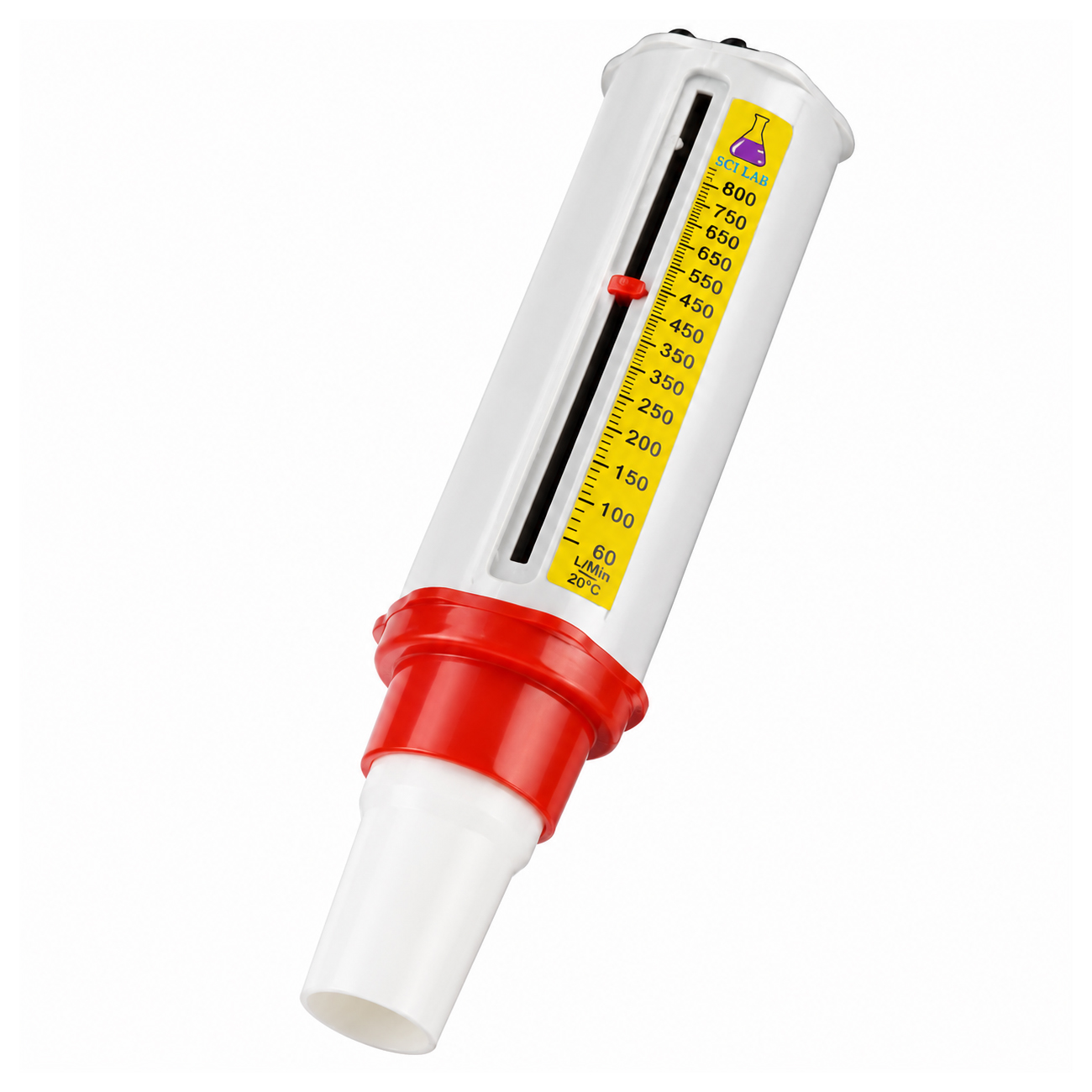
The Peak Expiratory Flow Meter measures how fast air leaves the lungs in one hard breath out, known as peak expiratory flow. It does not measure lung capacity, a volume in litres that needs a spirometer. It is built from a cylinder, a piston and a pipe, comes with a mouthpiece, gives its reading in L/min on a scale that starts at 60 L/min, and is used in human-biology and physical-education practicals.
Specifications of the Peak Expiratory Flow Meter
| Specification | Value |
|---|---|
| Construction | Cylinder, piston and pipe |
| Reading | Peak expiratory flow in L/min; the scale starts at 60 L/min |
| Mouthpiece | Supplied with the meter |
| Storage temperature | −20 to +40 °C |
| Manufacturer | Science Lab Supplies, Saha, Ambala, India |
Breathing Practicals with the Peak Expiratory Flow Meter
The student stands, takes the deepest breath possible, seals the lips round the mouthpiece and blows out as hard and fast as possible. The air drives the piston along the cylinder and the reading is noted in L/min. The meter is reset before each blow.
- Rest and exercise (Class 10 and 11 breathing): record three blows at rest and again after two minutes of stepping, then compare the values.
- Class survey: plot each student's reading against height and find the range and mean for the group.
- How breathing works: link the force of a blow to the diaphragm movement modelled by the Lung Model Demo Kit.
- Flow and volume: fill Lung Volume Bags, Plastic Transparent with one full breath to show exhaled volume alongside the flow readings.
Each student needs a clean mouthpiece; clean it between users by a method that suits its material and let it dry. Readings are for class comparison only and are not a health check.
Frequently Asked Questions
How is the meter kept hygienic when a whole class uses it?
Students should never share a mouthpiece that has not been cleaned. The meter comes with a mouthpiece: clean it between users by a method suited to its material, or give each student a personal mouthpiece where the school stocks them, then let every part dry fully before the meter is put away.
How should the meters be stored between terms?
Store each meter clean and fully dry in a closed box, away from direct sun, heaters and damp, and within the stated storage range of −20 to +40 °C. A meter put away wet can keep moisture inside the cylinder, so let every part air-dry after cleaning.
How should a student blow into the meter?
Stand up, breathe in as deeply as possible, seal the lips round the mouthpiece and blow out as hard and fast as possible in one short blast. Coughing, spitting or blocking the mouthpiece with the tongue gives a false reading.
Why are three readings taken?
The first blow is often weaker while students learn the technique. Take three good blows and record the highest or the mean, as the teacher directs, so one poor attempt does not decide the result.
Why do readings differ between students?
Taller and older students usually blow higher values because their lungs and airways are larger. Fitness, effort, technique and smoking also change readings, so class comparisons show general trends only.
Related Breathing and Lung Teaching Aids
- Peak Flow Meter: uses a universal reusable mouthpiece and comes with instructions, a self-monitoring chart and a storage container.
- Kit for Experiments with Breathing: bell-jar lung model and lime water to show carbon dioxide in exhaled air.
- Human Lung Model with Dissectible Lobe and Alveoli: three-dimensional PVC model with removable parts at 3–4 times magnification.
- Reaction Timer: measures response time to light, sound and touch.
- Simple Respirometer: two corked tubes with three-way taps connected to a graduated manometer.
Find further breathing aids in the Biology Lab Equipment range or the Human System Model range.
Science Lab Supplies holds an Importer-Exporter Code, so consignments of this meter can travel to Iraq, Nigeria, Kenya, Ghana, Ethiopia and Tanzania. A quotation can be asked for on the contact page; the enquiry cart takes several items at once.
Last updated: 26 November 2026