
Kjeldahl Flask with Ground Socket, 50-800 ml
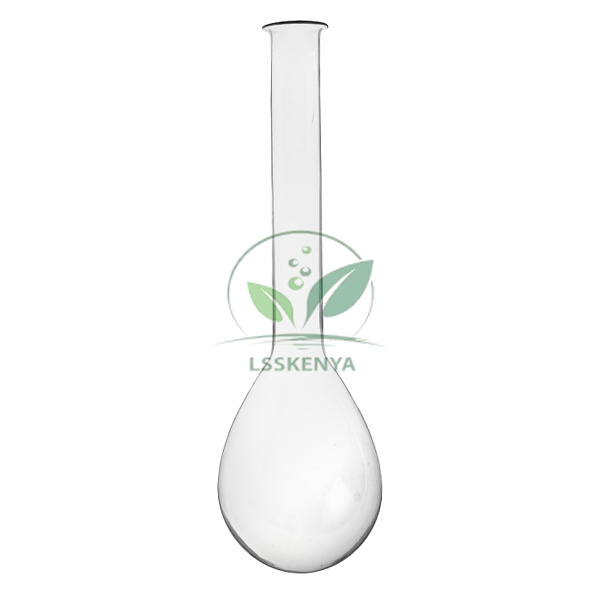
Product Code : LSK-LF-10426
The Kjeldahl Flask is a borosilicate 3.3 glass flask with a ground glass socket, used for the determination of nitrogen. After acid digestion the socket connects straight to a splash head and condenser of the same joint size, so the ammonia can be distilled without a rubber stopper. Six versions in five capacities cover 50 ml to 800 ml, each with its own 19/26 or 24/29 socket.
Specifications of the Jointed Kjeldahl Flask
| Specification | Value |
|---|---|
| Material | Borosilicate glass 3.3 |
| Neck | Ground glass socket |
| 50 ml | 19/26 socket; 200 mm height; bulb about 45 mm |
| 100 ml | Two versions, one with a 19/26 and one with a 24/29 socket; 200 mm height; bulb about 58-60 mm |
| 300 ml | 24/29 socket; 295 mm height |
| 500 ml | 24/29 socket; 300 mm height; bulb about 95-105 mm |
| 800 ml | 24/29 socket; 340 mm height; bulb about 110-120 mm |
| Use | Determination of nitrogen |
| Manufacturer | Science Lab Supplies, Saha, Ambala, India |
Digestion and Ammonia Distillation in the Jointed Kjeldahl Flask
The sample is digested with sulfuric acid, potassium sulfate and a copper catalyst until the liquid is clear. After cooling, dilution and the addition of alkali, the flask is joined through its socket to the distillation train, and the ammonia that boils off is caught in an acid receiver for titration.
- Protein in milk or cereal: digest the sample, then distil the ammonia through a Liebig Condenser with the outlet tip under the receiving acid.
- Receiving and titrating: collect the distillate in boric acid with indicator in a Conical (Erlenmeyer) Flask, 250 ml and titrate with standard acid from a Burette, 50 ml, with Sampler Nozzles.
- Blank and check samples: run a blank with sugar in place of the sample, and a known nitrogen standard to confirm the method.
Safety: digest only in a fume cupboard or under fume extraction, wear a face shield and acid-resistant gloves, and keep the heat off the bare glass above the liquid level.
Frequently Asked Questions
Which socket size should be ordered?
Choose the socket that matches the splash head or distillation unit in use. The 50 ml flask and one 100 ml version have a 19/26 socket. The other 100 ml version and the 300 ml, 500 ml and 800 ml flasks have a 24/29 socket.
What does the long neck of a Kjeldahl flask do?
It works as an air condenser. Acid vapour cools on the neck wall and runs back into the bulb, so less acid is lost during the long boil and spray stays inside the flask.
How should the flask be heated for digestion?
Use a digestion heater whose well fits the bulb, or a burner with the flame kept under the liquid. Avoid direct flame on dry glass and do not put a hot flask on a cold or wet surface.
Why is the ammonia collected in boric acid?
Boric acid holds the ammonia as ammonium borate but is too weak to disturb the titration. The ammonia can then be titrated directly with one standard acid, so the volume of boric acid need not be exact.
How is the nitrogen result turned into protein?
Multiply the nitrogen percentage by a conventional conversion factor for the type of sample, commonly about 6.25 for general foods. The result is called crude protein, because non-protein nitrogen is counted too.
What are common errors in Kjeldahl distillation?
Leaving the condenser tip above the receiving acid, stopping before all the ammonia has distilled, letting the digest solidify before dilution, and foam carrying digest over into the condenser.
Related Kjeldahl and Distillation Items
- Kjeldahl Flask without Joint: plain-neck borosilicate flask in 100 ml, 300 ml, 500 ml and 800 ml.
- Distiller for Distilled Water: 1 to 2 litres per hour on a single-phase 220 V supply.
- Copper Sulphate Blue Crystal: copper(II) sulfate reagent for supervised chemistry work.
- Adapter (Allonge), Glass, 150 mm: heat and chemical resistant adapter tube.
- Glass Reagent Bottle With Screw Cap: 250 ml clear borosilicate 3.3 bottle with a graduation scale.
The full set of digestion and boiling flasks is in Laboratory Flasks; burettes and adapters are in Lab Glassware.
For laboratories in Egypt, Iraq, Nigeria, Kenya, Ghana and Ethiopia, Science Lab Supplies can arrange export of jointed Kjeldahl flasks under its Importer-Exporter Code. Send the socket and capacity through the contact page, or list them in the enquiry cart, and a quotation can be prepared.
Last updated: 20 November 2026

.jpg)


