
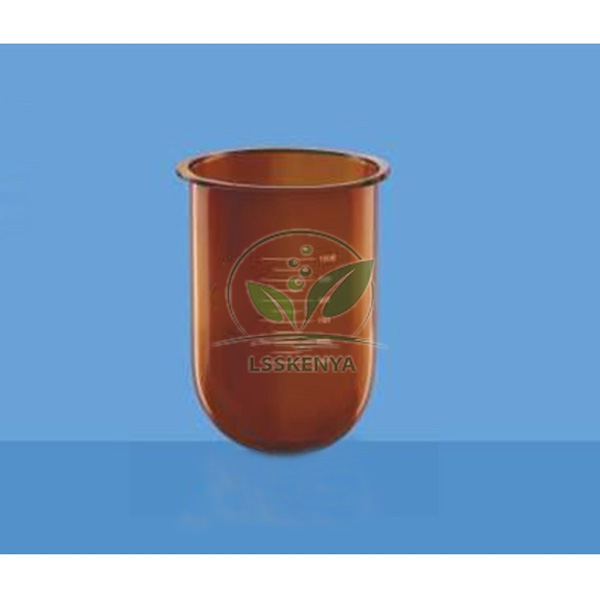
Amber Dissolution Vessel, Flask E, 1000 ml, Without Side Cut
Product Code : LSK-LF-10431
The Amber Dissolution Vessel, Flask E, is a 1000 mL amber borosilicate dissolution vessel without side cut, used to test light-sensitive tablets and capsules. The amber colour is integral to the heat-resistant, low-expansion glass, and the vessel has a smooth hemispherical base and graduations every 50 ml. It measures 131 mm in diameter and 173 mm in height.
Specifications of the Flask-E Amber Dissolution Vessel
| Specification | Value |
|---|---|
| Glass | Integral amber borosilicate glass, heat-resistant and low-expansion |
| Capacity | 1000 ml |
| Diameter and height | 131 mm diameter, 173 mm height |
| Graduation | Marked at 50 ml intervals |
| Base | Smooth, hemispherical |
| Rim | Without side cut |
| Manufacturer | Science Lab Supplies, Saha, Ambala, India |
Testing Light-Sensitive Products in the Amber Vessel
Some drugs break down under room light, so a clear vessel can lose part of the dissolved drug before it is measured. The amber glass cuts out most ultraviolet and blue light, while the hemispherical base keeps the flow pattern under the paddle or basket even.
- Release test of a light-sensitive tablet: bring the medium to the test temperature, confirm it with one of the Laboratory Thermometers, then add the tablet and start the paddle.
- Protecting the samples: run each withdrawn sample into one of the Amber Glass Reagent Bottles with Stoppers, 60-500 ml until it is analysed.
- Stability check: hold a known solution of the drug in the vessel for the length of the test and assay it at the start and end.
Common errors: placing the bath under strong window light, and judging tablet break-up by eye through amber glass without extra lighting.
Frequently Asked Questions
When should an amber vessel be ordered instead of a clear one?
Choose amber when the drug or its medium breaks down in ultraviolet or blue light. The amber glass filters out much of that light during the run, so the measured release reflects the product and not light damage.
Does the amber glass make the test harder to watch?
Yes, a little. The darker glass makes tablet break-up, bubbles and coning harder to see. Use a bright lamp beside the bath for checks, or keep clear vessels for methods that rely on watching the dosage form.
When is the basket used instead of the paddle?
The paddle is the usual choice for tablets that sink. A basket holds floating tablets and soft capsules below the surface. Where a method keeps the paddle, a sinker can hold a floating capsule down instead.
What are sink conditions in a dissolution test?
The medium volume must be able to dissolve several times the full dose. Then the dissolution rate is set by the product, not by the medium becoming saturated. A large 1000 ml vessel helps meet this for poorly soluble drugs.
Why is the drug's stability in the medium checked first?
If the drug breaks down in the medium at the test temperature, the amount measured falls over time and looks like slow release. A short stability test before the method is fixed shows whether light protection or a different medium is needed.
Which room conditions can upset dissolution results?
Temperature drift in the bath, vibration from nearby equipment and strong light on light-sensitive products are common causes. Regular calibration and maintenance of the tester also keep results consistent between runs.
Related Dissolution and Pharmacy Lab Items
- Dissolution Vessel, Flask D, 1000 mL, Borosilicate Glass, Without Side Cut: clear 1000 ml vessel with a hemispherical bottom, graduated at 50 ml intervals.
- Beakers, Tablet Disintegration: made for the tablet disintegration machine, with a large labelling field.
- Water bath, 7 L: micro agitator and 0.1 °C variation within the bath.
- Volumetric Flask: 100 ml Class A flask in borosilicate 3.3 glass, calibrated at 20 °C.
The Laboratory Flasks range lists further specialised flasks, and Chemistry Lab covers pipettes and amber bottles.
Under its Importer-Exporter Code, Science Lab Supplies is able to export amber dissolution vessels to quality control and teaching laboratories in Ethiopia, Tanzania, Uganda, the UAE, Saudi Arabia and Oman. Enquiries for a quotation go through the contact page or the enquiry cart; give the number of vessels needed.
Last updated: 26 November 2026


.jpg)