
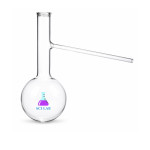
Baffled Culture Flask

Product Code : LSK-LF-10422
The Baffled Culture Flask is a baffled Erlenmeyer flask in borosilicate glass 3.3, made in 250, 500 and 1000 ml sizes, for preparing cultures on an orbital shaker. Four equidistant bottom baffles break up the swirling medium, giving consistent agitation and better mixing of air into the liquid. The glass is suitable for repeated autoclave cycles at 121 °C, so the flask can be reused run after run.
Specifications of the Baffled Culture Flask
| Specification | Value |
|---|---|
| Type | Baffled Erlenmeyer (conical) culture flask |
| Capacities | 250, 500 and 1000 ml nominal |
| Material | Borosilicate glass 3.3, heat resistant |
| Baffles | Four, equidistant, in the bottom |
| Neck | Wide, plain, for a breathable closure held by an overcap |
| Working volume | About 20-30% of the nominal volume for first shaker trials (50-75 ml in the 250 ml flask) |
| Sterilisation | Suitable for repeated autoclave cycles at 121 °C |
| Use | Culture preparation with compatible orbital shakers |
| Manufacturer | Science Lab Supplies, Saha, Ambala, India |
Shake-Flask Culture in the Baffled Flask
In a plain conical flask the medium swirls as a smooth ring. The baffles interrupt that ring, so the liquid tumbles and fresh air keeps mixing in. Aerobic bacteria and yeasts then grow faster and more evenly.
- Preparing the medium: pour in the broth, close the wide neck with a breathable closure, such as a cotton plug under an overcap, and sterilise the flask in an Autoclave Analogue Top Loading at 121 °C.
- Growing a starter culture: inoculate near a flame, clamp the flask on an Orbital Shaker and run at a steady speed for the time the method gives.
- Comparing aeration: grow the same strain in a baffled and a plain flask and compare cloudiness after a set time.
Common errors: too much medium, a closure that does not let air through, and a speed so high that broth wets the plug.
Frequently Asked Questions
What do the baffles do in a culture flask?
They break the smooth, laminar swirl of the medium into turbulent flow. Turbulence renews the liquid surface and pulls air into the broth, so more oxygen reaches the cells than in a flask with smooth walls.
Which shakers is the flask meant for?
It is made for orbital shakers. Hold it in a flask clamp or on a platform with a grip mat sized for the flask, and keep the shaker load within its rated limit.
Which closure should be used on the flask?
The wide plain neck takes a breathable sterile closure, such as a cotton plug, held in place by an overcap. Air passes in while microbes stay out. A tight rubber stopper stops the gas exchange that the baffles are there to improve.
Why do cultures grow poorly when the flask holds too much medium?
A deep layer of broth has little surface for its volume, and the baffles cannot mix it as well. Oxygen runs short and growth slows. For first shaker trials, fill to about 20 to 30% of the nominal volume: 50 to 75 ml in the 250 ml flask.
Why does the medium volume drop during a long shaking run?
Warmth and constant motion evaporate water through a breathable closure. Over a long run this concentrates the medium and can change results. Check the level, or keep the shaker in a humid space.
How should baffled flasks be cleaned?
Residue collects behind the baffles, so soak the flask soon after use, scrub the baffle edges with a bottle brush and rinse well. A regular cleaning routine stops old growth spoiling the next culture.
Related Culture Glassware and Equipment
- Flask Erlenmeyer with Screw Cap: borosilicate conical flask with an autoclavable polyethylene cap and PTFE liner.
- Conical (Erlenmeyer) Flask, 250 ml: graduated glass flask with a narrow mouth.
- Glass Petri Dish with Cover, 100 mm: clear glass dish, 20 mm high, with a cover.
- Incubator 32 L, up to 80 C: natural convection, from 5 °C above ambient up to 80 °C.
- Autoclave Bags: leak-resistant and puncture-resistant bags.
Flasks for media, reactions and analysis are collected in Laboratory Flasks, part of the School Lab Equipments range.
Baffled flasks can be sent from India to Sri Lanka, Vietnam, Malaysia, Peru, Egypt and Iraq under the Importer-Exporter Code of Science Lab Supplies. To get a quotation, send the number of flasks through the contact page or drop the item into the enquiry cart.
Last updated: 20 November 2026




.jpg)

